Toyota has officially revealed the all-new 2027 Highlander EV, marking a significant milestone for the Japanese carmaker as it joins the three-row electric SUV sector. Highlander becomes a purely electric car, leaving its petrol and hybrid roots for the first time.
The new Highlander EV is targeted directly at families who are looking for space, range, and convenience in an all-electric package. With a stated driving range of up to 515 km on a single charge, the brand presents the SUV as a worthy contender in the expanding electric SUV market.
An all-electric vehicle Segment
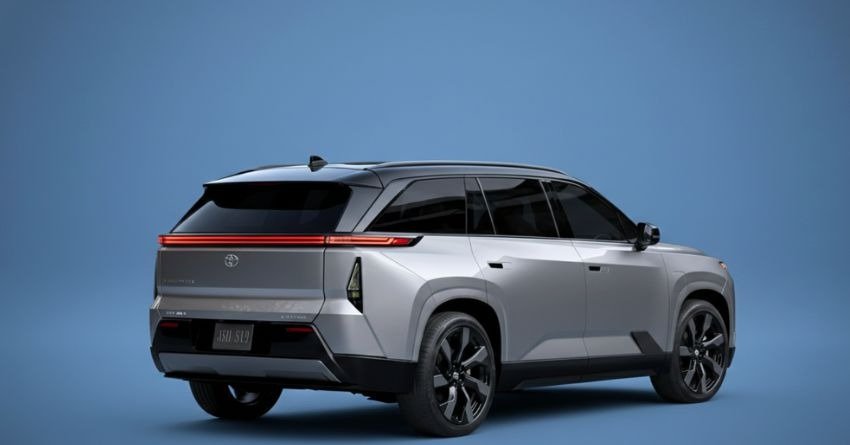
Unlike earlier versions, the 2027 Highlander is an all-electric vehicle. The exterior has a sleeker and more aerodynamic look, with a closed-off grille, brighter LED lighting, and flush door handles. The design language is more modern and sleek, distinguishing it from the previous combustion-powered model. It gets a 19-inch alloy wheels as standard, which improves the overall stability.
Inside, the Highlander EV keeps its three-row setup, seating up to seven people. Inside, you get a huge 14-inch infotainment touchscreen, a fixed glass panoramic roof and a 12.3-inch digital instrument cluster. Toyota has prioritised practicality, offering several USB-C charging connections across all rows, wireless smartphone integration, and enhanced connectivity.
The SUV also comes with heated front seats as standard, and the cabin features soft-touch materials on the dashboard and doors, along with customisable ambient lighting. Higher variants include a ventilated front seat and heated second-row seats. With the third row folded flat, cargo capacity exceeds 1,274 litres. Dimension-wise, it measures 1,988 mm in height, 1,709 mm in height, and has a wheelbase of 3050 mm.
Toyota Highlander EV Key Performance
The SUV is based on a revised TNGA-K platform that has been adapted to fit larger batteries and maximise interior space. And the brand will sell the Highlander EV in two battery pack options, 77 kWh and 95.8 kWh, depending on the variants, and the long-range model comes with an AWD version. The larger battery pack allows for a stated maximum range of roughly 515 km, making it ideal for long family road excursions.
Customers will be able to select between front-wheel-drive and dual-motor all-wheel-drive variants. Power output is predicted to range from slightly more than 220 hp in the base variant to about 340 hp in higher AWD trim levels. The dual-motor configuration not only boosts performance but also increases traction in a variety of driving conditions.
Under ideal conditions, the SUV enables DC fast charging, which allows the battery to recharge from 10 to 80 per cent in around 30 minutes. Toyota has also confirmed compatibility with the North American Charging Standard (NACS), which will allow for faster charging.
Toyota Highlander EV Technology and Safety
Toyota has loaded the Highlander EV with its most recent Safety Sense suite, which includes advanced driver assistance systems such as adaptive cruise control, lane-keeping assist, blind-spot monitoring, and automatic emergency braking. The electric SUV also has vehicle-to-load (V2L) capacity, which allows it to charge external equipment — a handy feature for road trips or emergencies.
The 2027 Highlander EV will be manufactured in the United States, with sales set to begin in late 2026. Toyota has not yet released pricing information. While the debut has been announced for the United States, no word yet on availability in India or other territories. However, given the growing demand for premium electric SUVs, Toyota may consider global growth in the future.
Toyota Highlander EV A Strategic Shift for Toyota
Toyota’s Highlander EV debut represents a stronger push into the fully electric market. While the company has previously focused on hybrid vehicles, the new three-row EV shows a stronger commitment to a battery-electric mode of transport. The 2027 Highlander EV, with its spacious seating, competitive range, and Toyota’s reputation for reliability, is positioned to compete directly with competing three-row electric SUVs in global markets.