2026 Tata Punch EV Facelift Expert Review
- Electric
- Car
- 5 Seater
What's good
-
A complete, zero-emissions package at a highly competitive and affordable price point
-
Real-world range of around 300 km is more than adequate for most commuters
-
Punches above its weight with premium kit like ventilated front seats, etc.
-
Excellent road manners, and reassuring high-speed stability.
-
Uncompromised, robust safety kit.
What's not so good
-
No Spare Tire
-
Hit-or-Miss Service
-
Prone to the usual Tata quirks, including minor electronic glitches
-
Strictly a Four-Seater
The 2026 Tata Punch EV has officially launched in India, featuring several significant upgrades. It is equipped with a 40 kWh battery pack that offers a claimed ARAI range of 468 km and approximately 355 km under real-world driving conditions. One of the standout features is the lifetime battery warranty with no limit on kilometres, instilling strong confidence for long-term ownership. Additionally, the Punch EV introduces a segment-first eTXV system, which optimises cabin and battery cooling to enhance passenger comfort and improve efficiency by about 1 per cent. With these updates, the Punch EV remains a practical and well-rounded electric SUV suitable for everyday city use.
What's good
-
A complete, zero-emissions package at a highly competitive and affordable price point
-
Real-world range of around 300 km is more than adequate for most commuters
-
Punches above its weight with premium kit like ventilated front seats, etc.
-
Excellent road manners, and reassuring high-speed stability.
-
Uncompromised, robust safety kit.
What's not so good
-
No Spare Tire
-
Hit-or-Miss Service
-
Prone to the usual Tata quirks, including minor electronic glitches
-
Strictly a Four-Seater
The 2026 Tata Punch EV has officially launched in India, featuring several significant upgrades. It is equipped with a 40 kWh battery pack that offers a claimed ARAI range of 468 km and approximately 355 km under real-world driving conditions. One of the standout features is the lifetime battery warranty with no limit on kilometres, instilling strong confidence for long-term ownership. Additionally, the Punch EV introduces a segment-first eTXV system, which optimises cabin and battery cooling to enhance passenger comfort and improve efficiency by about 1 per cent. With these updates, the Punch EV remains a practical and well-rounded electric SUV suitable for everyday city use.
2026 Tata Punch EV Facelift Expert Review
SEV Score

Prashanth Jagadeesh
Tested and reviewed by SEV Experts on 8 parameters
SEV Score

Prashanth Jagadeesh
Tested and reviewed by SEV Experts on 8 parameters
Expert Verdict
The Punch EV is highly affordable, comes loaded with niceties, and delivers a real-world range of over 300 kilometres. Coupled with a city-friendly footprint, and robust safety, the Punch EV is the ideal choice for daily commuters looking to slash running costs.
2026 Tata Punch EV Facelift Design
Exterior
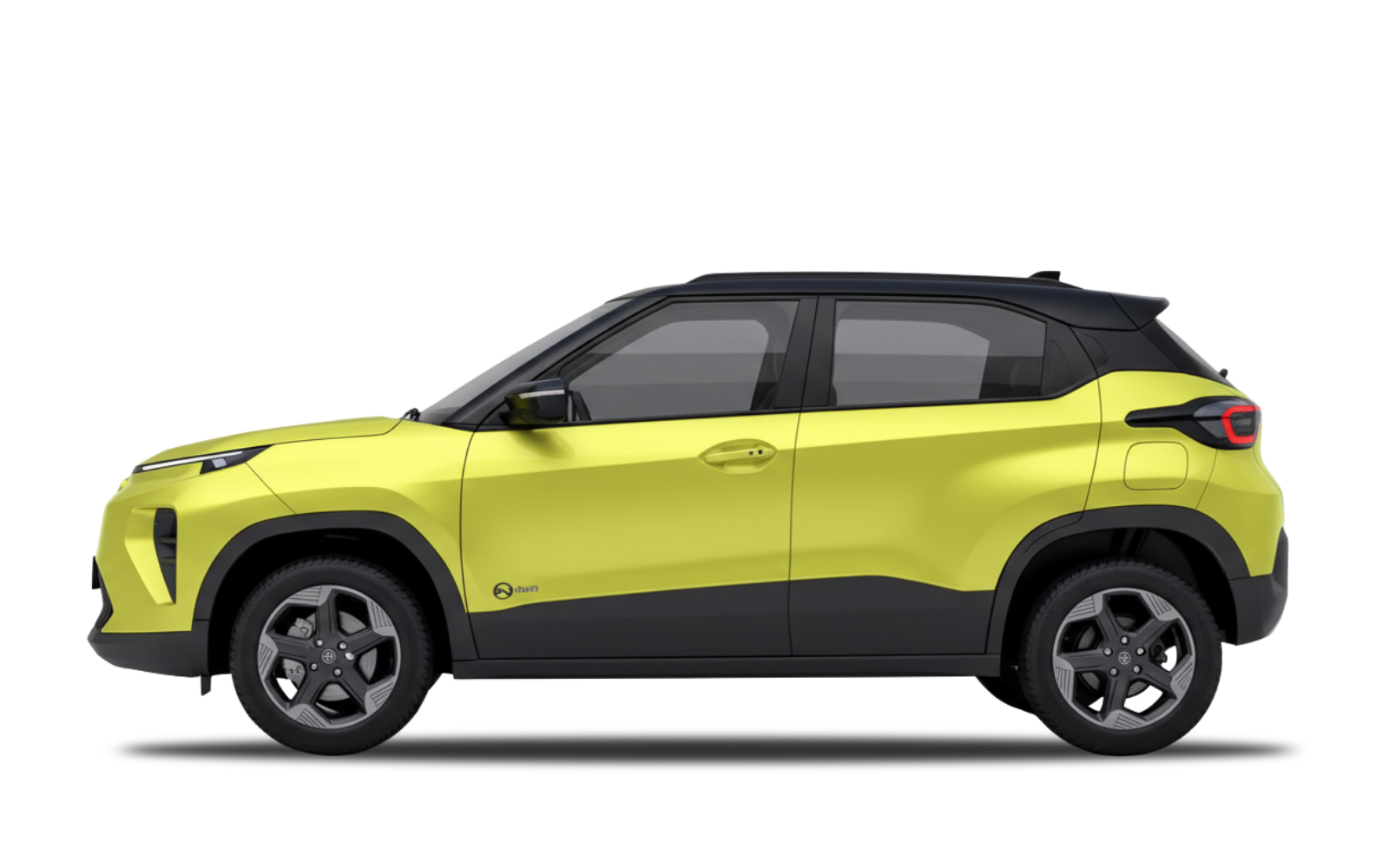
The facelifted Punch EV is honestly hard to tell from the outgoing model in terms of the exterior. Up front, the most noticeable difference is the lack of the LED strip that used to connect the daytime running lamps (DRLs). These DRLs still double as turn indicators (though they are no longer sequential like the previous model). Also, the small air intake now sits lower down in the bumper, surrounded by new vertical slats and finished in grey cladding instead of the older black.
It’s easier to tell the new car apart from the back, which borrows the ICE Punch’s connected LED tail-lamp setup. All in all, the Tata Punch EV remains a good-looking micro SUV, and it successfully maintains its visual uniqueness compared to the standard ICE-powered Punch.
Interior
The interior of the Punch EV also doesn’t see any major layout updates, but it continues to impress with its sense of space for such a small car. Part of the credit for this airy feel goes to the new dual-tone cabin with a white and grey combination (which feels much lighter than the previous black-and-beige theme).
However, the usual functionality and ergonomic challenges continue. The steering-mounted controls on the two-spoke wheel are prone to getting accidentally pressed while you’re reaching for the horn. Furthermore, the climate control panel, which comes from pricier Tata cars like the Nexon and Harrier EV, looks sleek, but its mix of toggles and capacitive touch surfaces remains hard to use intuitively on the move.
Build Quality
Built on the dedicated acti.ev platform, the Punch EV continues Tata’s tradition of offering reassuringly solid construction. Inside, elements like the newly added metal window switches, improved control stalks, and the textured plastic across the dash feel built to last.
2026 Tata Punch EV Facelift Features
For a micro SUV, the Punch EV punches well above its weight class when it comes to the equipment list. Step inside the higher variants, and you are greeted by twin 10.25-inch screens. The Harman-sourced infotainment system offers a snappy UI alongside wireless smartphone integration. Right in front of the driver, the equally crisp 10.25-inch digital instrument cluster can mirror your navigation maps directly in your line of sight.
Tata has also packed in the “feel-good” features that give modern buyers that much-needed perception of premiumness. You get an electrically operated sunroof, an integrated air purifier, and an auto-dimming interior rearview mirror (IRVM). Most importantly, you get ventilated front seats that work well to keep your back sweat-free.
2026 Tata Punch EV Facelift Performance & Range
The Tata Punch EV brings notable changes to its overall powertrain. The battery packs have been made larger, growing from the previous 25 kWh and 35 kWh setups to 30 kWh and 40 kWh, respectively. This increase in capacity was achieved without altering the vehicle’s physical footprint, thanks to a shift from cylindrical cells to higher-density prismatic cells that can be packed much closer together.
Power outputs have also seen a bump, with the smaller battery now producing 87 hp and the larger battery making 127 hp, while the peak torque drops from 190 Nm to 154 Nm. The range has naturally benefited from these larger batteries and the revised, more efficient motor setup.
Tata Motors now claims an ARAI-certified 375 km for the 30 kWh unit and an impressive 468 km for the 40 kWh unit. In the real world, the 30 kWh version can reliably cover about 250 km on a single charge, while the larger 40 kWh pack will do up to 320 km.
In terms of driving dynamics, the Punch EV is tuned heavily for ease of use, offering an effortlessly smooth performance. The acceleration doesn’t aggressively pin you back into the seat, but it is certainly strong enough to show a clean pair of heels to ICE cars during a quick sprint off the traffic lights. The SUV features three clearly defined drive modes including Eco, City, and Sport, all of which are beautifully calibrated.
2026 Tata Punch EV Facelift Ride & Handling
Despite having the footprint of a compact city runabout, the Punch EV rides with a level of maturity usually reserved for cars a segment above. It confidently swallows up most of the everyday road imperfections you will encounter on a standard commute. Tata has managed the added weight of the battery pack incredibly effectively. Because the acti.ev platform offers increased torsional rigidity, engineers were able to use softer dampers.
Out on the highway, the added weight actually works in the EV’s favor, helping it hold its line with excellent stability at triple-digit speeds. That said, it is still a tall micro-SUV, and not a a sedan, therefore, quick, high-speed lane changes will make you experience a noticeable amount of body roll, though nothing that will scare you.
As you would expect from an EV, refinement is a strong point. The cabin remains a fairly quiet place to be, with only a bit of tire and road noise filtering in once you push past 80 km/h.
In terms of braking, Tata has replaced the rear disc brakes with drum brakes. However, the stopping power remains progressive, largely because EVs rely so heavily on the motor to slow down. To that end, the regenerative braking can be adjusted across four levels using the convenient paddle shifters behind the steering wheel, and the calibration feels entirely predictable and natural.
2026 Tata Punch EV Facelift Safety
While this newly updated iteration of the Punch EV hasn’t been tested by the Bharat NCAP yet, the outgoing model set a big benchmark in the segment. It scored a 5-star rating, bagging an impressive 31.46 out of 32 points for Adult Occupant Protection (AOP) and 45 out of 49 points for Child Occupant Protection (COP). Since the new Punch EV is largely the same apart from changes in the battery configuration, coupled with Tata’s commitment to safety, we expect the same safety credentials here as well.
In terms of safety features, right from the base Smart trim, the Punch EV comes loaded with six airbags, ABS with EBD, an Electronic Stability Program (ESP), hill-hold assist, and ISOFIX child seat mounts. Higher trims add niceties like a reverse parking camera and an electronic parking brake with an auto-hold function. A very thoughtful new addition to the active safety suite is the high-beam alert, which gently chimes if you leave the high beams engaged at low city speeds for an extended period.
However, while active and passive crash safety is thoroughly sorted, there is one major frustration from a practical ownership perspective: the Punch EV does not come with a physical spare wheel. Tata only provides a puncture repair kit bundled with an electric inflator. This setup leaves you completely stranded in the event of a major tyre blowout, especially if you are driving through areas with limited roadside support.
2026 Tata Punch EV Facelift Space & Comfort
Frunk Space, Boot Space, Cabin Space
Wide 90-degree opening doors allow an easy ingress for even elderly people. Once inside, the cabin space is comfortably adequate for four adults. However, because the car isn’t particularly wide, trying to squeeze a third passenger onto the rear bench will definitely be a tight fit.
Plus, we do miss AC vents at the back. What’s also a highly irritating quirk is the lack of load sensors for the rear seatbelts; the warning chime will ring incessantly for a couple of minutes even when the rear seat is completely empty.
Where the Punch EV impresses back is in cargo capacity. While cabin width isn’t lavish, the car boasts a genuinely generous 366-litre boot that easily swallows weekend luggage. Under the hood, Tata has also carved out a neat little 14-litre frunk, which is perfectly sized to hold your portable charging cables, avoiding any clutter in your main boot.
Headroom, Sitting Posture, Under-thigh support
Comfort up front is excellent. The seats offer solid all-around support, and you sit high up with a commanding view out over the bonnet.
Moving to the rear, the seat cushioning is well-judged. Crucially, Tata’s clever battery packaging underneath the floor means there is still decent under-thigh support, and passengers don’t suffer from that awkward, knees-up seating posture that we have seen on so many other electric vehicles on the market today.
2026 Tata Punch EV Facelift Charging & Warranty
Charging & Infrastructure
The Punch EV now accepts up to 65kW DC fast charging, which is a considerable jump from the previous 50kW. This allows for a claimed 10 to 80 percent top-up in just 30 minutes. Tata also claims that you can add roughly 135km of real-world range in a mere 15 minutes of charging.
When it comes to home charging, a 3.3kW portable charger is included as standard. However, if you want to significantly reduce your overnight refueling time, a 7.2kW AC wall-box charger can be installed at an additional cost. Moreover, the Tata Power EZ Charge network continues to be India’s largest and most widespread charging infrastructure..
Warranty
On the warranty front, the most critical components, such as the battery pack and the electric motor, are covered by a robust 8-year or 1,60,000 km warranty (whichever comes first). The vehicle itself comes with a standard warranty of 3 years or 1,25,000 km.
2026 Tata Punch EV Facelift Service & Network
When it comes to long-term ownership, in a group of five Tata Punch EV owners, you will easily find four who have experienced absolutely zero issues and will happily sing the car’s praises. However, one of them might be pulling their hair out over a series of frustrating, recurring problems. It is this “hit-or-miss” nature of their quality control that remains the biggest caveat of opting for the brand.
For the Punch EV specifically, users have reported a set of recurring niggles, usually revolve around software and sensor glitches, including “Park Brake Failure” messages, or false iTPMS alerts, popping up on the instrument cluster even when the car is functioning perfectly.
Tata Motors boasts one of the most extensive and widespread service networks in the country, however, the service floor experience is also highly inconsistent. Some service centers are incredibly proactive, highly trained in EV architecture, and communicative. Others, however, are severely overwhelmed by the sheer volume of cars, leading to longer wait times. Hence, this aspect needs to be considered and it’s ideal to check reviews of your nearest Tata ASS from EV owners.
What's good
-
A complete, zero-emissions package at a highly competitive and affordable price point
-
Real-world range of around 300 km is more than adequate for most commuters
-
Punches above its weight with premium kit like ventilated front seats, etc.
-
Excellent road manners, and reassuring high-speed stability.
-
Uncompromised, robust safety kit.
What's not so good
-
No Spare Tire
-
Hit-or-Miss Service
-
Prone to the usual Tata quirks, including minor electronic glitches
-
Strictly a Four-Seater
2026 Tata Punch EV Facelift Price
What's good
-
A complete, zero-emissions package at a highly competitive and affordable price point
-
Real-world range of around 300 km is more than adequate for most commuters
-
Punches above its weight with premium kit like ventilated front seats, etc.
-
Excellent road manners, and reassuring high-speed stability.
-
Uncompromised, robust safety kit.
What's not so good
-
No Spare Tire
-
Hit-or-Miss Service
-
Prone to the usual Tata quirks, including minor electronic glitches
-
Strictly a Four-Seater