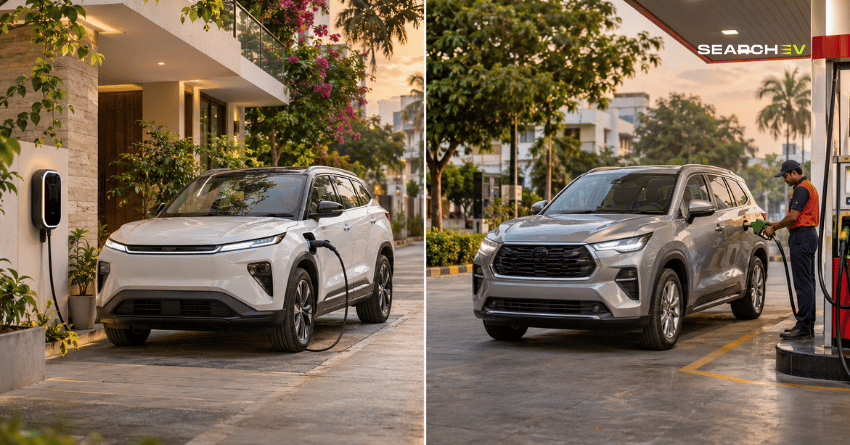
Quick answer: Choose an EV if you can charge at home or at work and drive regularly, because it can cost roughly ₹1 to ₹1.5 per kilometre to run against ₹4 to ₹5 for a strong hybrid. Choose a strong hybrid if you can’t charge easily or often drive long, remote routes. Neither is the better car for everyone. It depends on where you park and how far you go.
This is one of the most common questions buyers ask, and the honest answer starts with a different question: can you plug in where you park? Everything else follows from that.
What the two cars actually are
An EV runs only on a battery and needs charging. A strong hybrid, such as the Toyota Hyryder, Maruti Grand Vitara or Honda City e:HEV, has a petrol engine and a small battery that charges itself while you drive, so you never plug it in. It simply uses much less petrol than a normal car.
Mild hybrids and plug-in hybrids are different again. Mild hybrids give only a small efficiency boost, and plug-in hybrids are rare and pricey in India right now, so this guide compares EVs with strong hybrids.
Running cost: the EV’s biggest advantage
Home charging costs roughly ₹1 to ₹1.5 per kilometre, going by recent 2026 guides. A strong hybrid works out at about ₹4 to ₹5 per kilometre, based on claimed city efficiency of 20 to 27 km per litre and petrol at around ₹95 to ₹100. Both are estimates, and real-world figures vary.
Over 1,000 km a month, that is roughly ₹1,000 to ₹1,500 for the EV against ₹4,000 to ₹5,000 for the hybrid. Public fast charging closes some of the gap, since it can cost ₹2 to ₹3.30 per kilometre, so the EV advantage is largest when you charge at home.
Purchase price and tax
Electric cars attract just 5% GST. Since the September 2025 GST changes, larger hybrids sit in the 40% slab, the same as big conventional cars, while small hybrids pay 18%. There have been calls to cut the tax on hybrids, and reports say the issue is under review, but I’d treat any change as unconfirmed until it is notified.
Road tax matters too. Many states waive it for EVs. Hybrids usually pay in full, though some states offer part relief. A draft Delhi EV policy would give strong hybrids priced under ₹30 lakh a 50% road tax exemption, against 100% for EVs. It was still a draft when last reported, so check your state.
The sticker price still often favours the hybrid, so you are trading a higher purchase price for lower running costs when you pick an EV. If budget is tight, our guides to the most affordable EV cars in India and the best electric cars under ₹20 lakh show how far the gap has narrowed.
Servicing and ownership
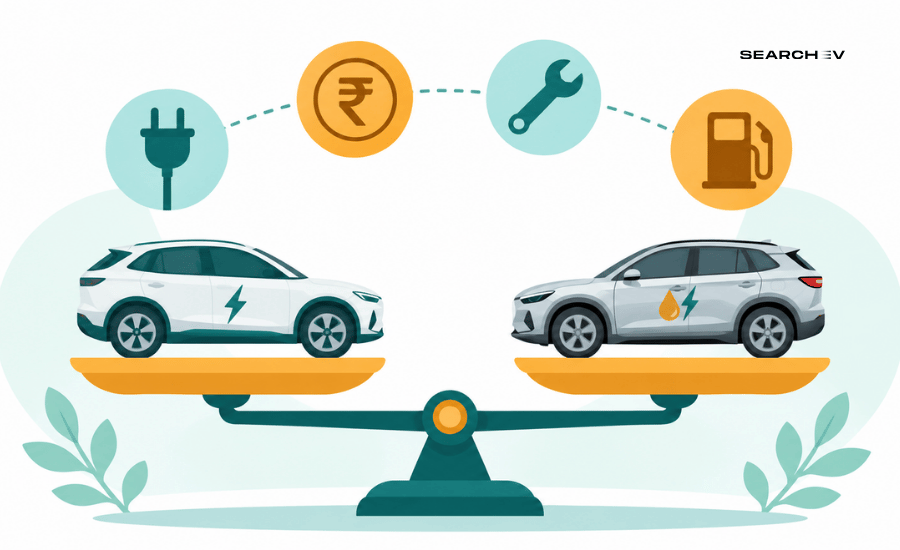
EVs have fewer moving parts, so routine servicing is usually the cheapest of the lot. A hybrid needs everything a petrol car does, plus checks on its hybrid system. One 2024 five-year comparison put EV maintenance far below the hybrids’ in rupee terms, though prices have moved since.
Battery worries cut both ways. EV batteries typically carry 8-year warranties of around 1.6 lakh km, with longer “lifetime” cover on some models for first owners. Hybrid batteries are much smaller, and replacing one is generally a smaller bill, though this varies by model.
Side by side
| Electric car | Strong hybrid | |
| Running cost per km (approx.) | ₹1–1.5 at home | ₹4–5 |
| Cost for 1,000 km (approx.) | ₹1,000–1,500 | ₹4,000–5,000 |
| GST | 5% | 18% (small) or 40% (large) |
| Road tax | Waived in many states | Usually payable |
| Servicing | Lowest | Similar to petrol, plus hybrid system |
| Needs charging | Yes, ideally at home | No |
| Long, remote trips | Needs planning | Easy |
These figures are indicative. They assume home charging for the EV and petrol around ₹95 to ₹100 a litre.
Which should you pick?
Pick an EV if:
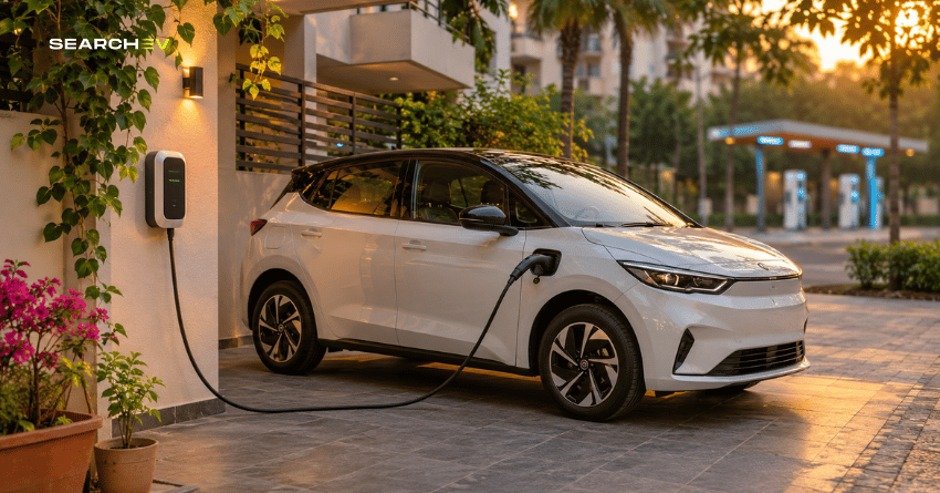
- You can charge at home or at work
- Your daily driving is predictable and mostly in town
- You plan to keep the car for five years or more
- You drive a lot, since the running cost saving grows with every kilometre
Pick a strong hybrid if:
- You live in a flat with no reliable charging
- You often take long trips through areas with few chargers
- You want to spend less upfront and don’t drive many kilometres
- You change cars every few years and worry about resale
Mileage matters most. One 2024 ownership comparison found a strong hybrid stayed cheaper overall at 12,000 km a year over many years, while an EV pulled ahead once the driving rose to 24,000 km a year. So the more you drive, the stronger the case for electric.
Frequently asked questions
- Is a hybrid cheaper to run than a petrol car?
Yes. A strong hybrid typically uses much less fuel than a petrol car of similar size, especially in city traffic.
- Is an EV cheaper than a hybrid in the long run?
Usually, if you charge at home and drive regularly. The lower running cost eventually offsets a higher purchase price.
- Do hybrids need charging?
No. Strong hybrids charge their own battery as you drive, so you only fill the petrol tank.
- Which is better for long drives?
A hybrid is simpler on long trips because petrol pumps are everywhere. EVs are fine on major highways but need route planning.
The bottom line: if you can charge at home and drive often, buy the EV. If you can’t charge easily or travel far off the beaten track, the strong hybrid is a sensible choice.