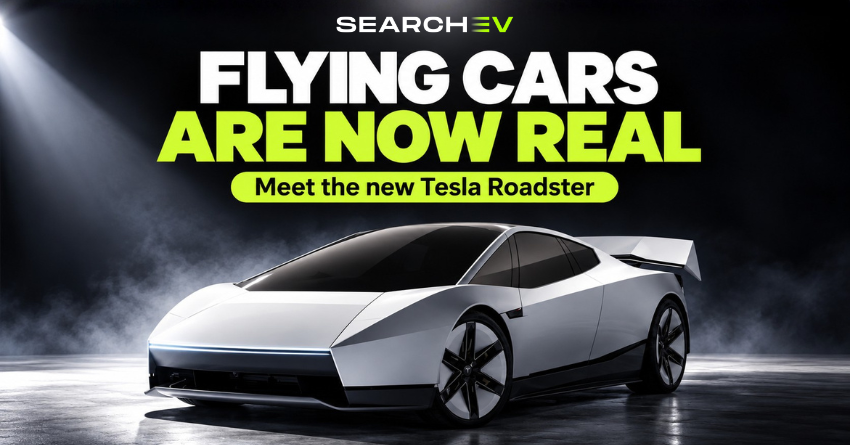
Almost a decade after its initial prototype debut, the second generation Tesla Roadster is finally a reality. In a massive spectacle hosted at a rocket testing facility on October 15, 2026, CEO Elon Musk showcased a vehicle that completely blurs the line between a traditional supercar and a rocket. The live demonstration left the automotive world stunned as the electric coupe literally took flight. Far from a conventional performance vehicle, the new Roadster integrates ground effect suction systems and cold gas thrusters to deliver acceleration figures that actively challenge the laws of physics.
It Can Fly?
Tesla put its long-delayed Roadster in front of a live audience on Thursday, October 15, at a SpaceX rocket test site in McGregor, Texas, near Waco. A white prototype raced up a curved ramp, held itself there upside down, jumped off, and turned in the air before landing.
However, the vehicle that performed the stunt showed what looked like a bare metal frame with no visible suspension, which suggests a prototype well short of a production car.
Tesla said no one sat in the demonstration cars, since some manoeuvres could injure an occupant. Musk himself told the crowd that success was not guaranteed and that everyone was at a safe distance if it failed.
Tesla also put one live acceleration run at 0.81 seconds from 0 to 60 mph, though no outside party has verified the figure. Elon Musk said production would begin in 2028 and stressed that he meant it. A price was not given for any version.
The Roadster has been on Tesla’s books for nearly nine years. A prototype appeared in November 2017 at the launch of the Semi truck, deposits followed, and deliveries were promised for 2020. None happened. What stood in Texas this week is a different car from the one early buyers paid for: two seats instead of four, a new angular body, and a layout built around compressed-gas thrusters developed with SpaceX.
The event itself was first set for October 1 in Waco. On September 28, Tesla moved it by two weeks, citing severe weather in the forecast and saying the show could only be held outdoors. Earlier this year Musk had pointed to April, then late April, then August.
One remark was about driving itself. Musk said that, over the long run, the Roadster would be the only Tesla people drive manually as the rest of the range moves toward autonomy.
Aerodynamics and SpaceX Thrusters
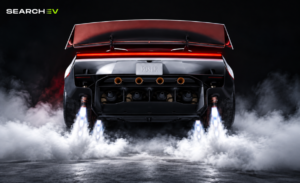
The engineering beneath the skin of the new Roadster represents a radical departure from traditional automotive design constraints.
Like we mentioned, the most jaw-dropping element of the reveal was the live demonstration of the SpaceX thruster package. The vehicle incorporates a massive 600-litre air tank linked to ten cold gas nozzles strategically positioned around the body.
Four at the corners push the car upward, one on each front fender pushes it sideways, and four at the rear push it forward. Tesla says the rear thrusters produce more than 80 kilonewtons, and that thruster force is four to five times what the tyres can transmit, which is how the car gets past the usual traction limit.
A multimode fan does the opposite job. It pulls air from beneath the car and presses it onto the road. Tesla says the suction can hold the car upside down while stationary. In Track Mode the car lowers itself and deploys active wings driven by actuators first developed for the Optimus robot, and Tesla describes the downforce as approaching Formula 1 levels, with cornering above 2 g.
Design and cabin
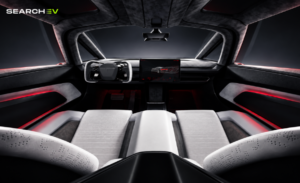
Tesla says its design language has moved from the S3XY era, a fan shorthand for the Model S, 3, X and Y, through the Cybertruck, Cybercab and Optimus, and it names the SR-71 and F-35 jets as inspiration.
To counteract the massive forces generated during launch, the Roadster utilises an exotic blend of magnesium, titanium, and carbon fibre in its core construction. The exterior showcases hidden headlights, a full-length rear taillight, an Ano White paint which is said to borrow from coatings that protect rockets, and tinted glass meant to recall the gold visor of a spacesuit.
At the rear, four thruster nozzles sit inside a large diffuser, with a deployable wing above. The front suspension appears to have moved inboard, which may be a packaging choice to leave room for the airlines.
Inside, a steering yoke connects to a steer-by-wire system, as on the Cybertruck. The Ultrawhite interior is accented with gray microsuede, while the digital layout consists of a primary center touchscreen flanked by two smaller forward displays. Tesla fixed the seat position and chose manual controls to save weight, and says magnesium, titanium and carbon fibre run throughout the cabin.
Performance and Trims
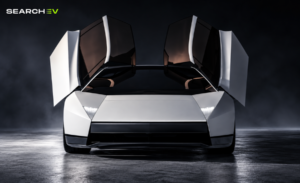
Tesla will offer the Roadster in three separate configurations. Buyers can choose the standard two-seat Performance trim or step up to the two-seat Thrust version. The absolute pinnacle of the lineup is the single seat Rocket variant, which is available strictly by invitation. However, Tesla explicitly noted that the Rocket configuration is not yet approved for public road use.
| Version | Seats | Availability | Thrusters | 0 to 60 mph (Tesla claim) | Road use |
| Performance | 2 | By reservation | None, but has the suction fan and active aero | Under 1.6 s | Road ready, per Tesla |
| Thrust | 2 | Limited release | Four, at the rear | Under 0.9 s | Called race ready by Tesla |
| Rocket | 1 | Invite only | Ten, around the car | Under 0.59 s | Not approved for public roads, per Tesla |
Tesla quotes a range above 300 miles, about 480 km, and a top speed above 230 mph, roughly 370 km/h, for the Rocket. It did not disclose battery size, motor count or power output.
For scale, Rimac says its Nevera R reached 60 mph in 1.66 seconds in testing and topped out at 268.2 mph. Tesla’s Performance claim sits close to that mark. The Thrust and Rocket claims sit far below it. Every one of them remains a Tesla figure until independent testers repeat it.
The thrusters are cold-gas units. They release compressed gas through nozzles without burning anything, in the way SpaceX uses small nozzles to steer its Falcon 9 boosters.
Price, reservations and timing
Tesla has not given a price for any version. Reservations have reopened at $50,000, the same sum as before. Buyers pay $5,000 by card, which Tesla calls fully refundable, and wire $45,000 within 10 days. Tesla has not said what happens to people who reserved the 2017 car.
Production is set for 2028 at Gigafactory Texas near Austin, where Tesla also builds the Model Y, Cybercab and Cybertruck. Moravy and chief designer Franz von Holzhausen said in May that the car would be built in Texas.
The commercial weight of the car looks small, as it is a high-end, low-volume model unlikely to have a material financial effect on Tesla.
What SearchEV Thinks
For readers who know Tesla only through the Model Y, the name has a history. The first Roadster was Tesla’s first production car. It went on sale in 2008, was based on the Lotus Elise, and did 0 to 60 mph in under 4 seconds. Reports suggest that fewer than 2,500 were sold over roughly four years, at nearly $100,000. The 2017 prototype arrived as a surprise at the end of the Semi truck launch, and early buyers paid deposits for a car that has since been redesigned.
The engineering on show on this latest event looks real, and some of it is new in combination: in-atmosphere thrusters, a suction fan and active wings on one car. But the stunt cars are not what most buyers could use. The Performance version is, and Tesla showed the least about it. We have an acceleration claim under 1.6 seconds and a range figure above 300 miles. Range is about half of what Tesla promised in 2017. The production date moved from 2020 to 2028. People who paid for the earlier car have not been told what happens next.
What remains for sure is that while major questions remain regarding the exact production timeline and the legality of thruster-equipped vehicles on public streets, the technological statement is undeniable. By integrating literal rocket technology, Tesla has created a halo car that makes contemporary hypercars look remarkably tame.
Also Read