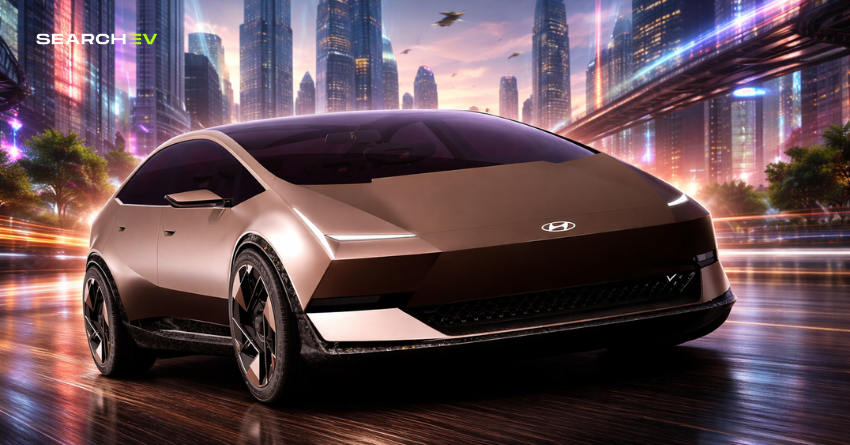
Hyundai is preparing for a full visual reset of its electric vehicle lineup, and it is starting by looking up at the stars. To mark the official launch of its all-electric Ioniq subbrand in the highly competitive Chinese market, the South Korean automaker has taken the wraps off two striking new design concepts: the Earth SUV and the Venus sedan. This official public debut comes just ahead of the 2026 Beijing Auto Show scheduled for April 24.
The Shift: No More Pixels or Numbers
Part of Hyundai’s localised strategy for the Chinese market, the retro-futuristic “pixel” lighting and numerical naming structure of the Ioniq 5 and Ioniq 6, have been traded for nameplates that are inspired after planets in our solar system. According to the brand, this symbolises how each vehicle will “orbit around the customer” in their EV universe.
Visually, both concepts abandon the pixel motifs in favor of sharper, edgier forms defined by a “single-curve” silhouette, where the vehicle’s entire profile flows smoothly without traditional sharp corners or the standard three-box design.
The Venus Concept: The Sleek Celestial Sedan
The Venus Concept takes the form of a sleek, high-riding sedan that heavily emphasises a premium, aerodynamic aesthetic.
- The Exterior: Finished in a striking ‘Radiant Gold’ paint, the Venus features a massive panoramic glass roof, slim LED DRLs forming two halves of the letter ‘H’, and a unique transparent lip spoiler at the rear. A quirky detail is included in the brake pads, which appear to be inscribed with designs inspired by the 1977 Voyager Golden Records, phonographic records sent into space by NASA.
- The Cabin: The interior of the Venus Concept takes driver indulgence at the forefront with a wraparound cockpit. The setup is dominated by a panoramic infotainment screen that also doubles as a passenger display. An octagonal steering wheel carries the futuristic theme while gold ambient lighting and grey suede upholstery adds more premiumness..
The Earth Concept: The Rugged Family Cruiser
The Earth concept is positioned as a more rugged, dependable family SUV.
- The Exterior: In contrast to the high-riding sedan silhouette, the Earth concept has a more intimidating, boxy stance. Adding the sense of ruggedness, are features such as the chunky lower body cladding, exposed bolts on the bumper, alongside a skid plate, and integrated tow hooks. It also features unique glass elements built into the A-pillars to improve visibility.
- The Cabin: The interior takes a minimalist, nature-inspired approach, featuring segmented glass roof sections to make the cabin feel airy. The standout feature is what Hyundai calls “air-hug” seats, which basically means soft modules equipped with air-filled cushioning designed to contour perfectly around the passenger’s body. A compact tablet protruding from a clutter-free dashboard completes the layout, while ambient lighting mimics the shadows cast by trees.
The China Strategy for Hyundai
While these highly localised concepts highlight Hyundai’s readiness to tackle China’s booming new energy vehicle (NEV) market, the underlying technology is equally tailored for local demands. Hyundai has indicated that the production vehicles spawned from these concepts will be equipped with locally developed ADAS technology.
Furthermore, the brand is openly exploring “market-specific” solutions, meaning these futuristic platforms might not just be pure EVs, but could also house range-extender hybrid powertrains to alleviate local range anxieties.
As the April 24 Beijing Auto Show approaches, the global automotive industry will be watching closely to see how much of this radical planetary design language trickles down into Hyundai’s worldwide Ioniq lineup.