Quick Reads
- India could have ethanol blends up to E100 for near future
- Critics are worried about excessive water consumption and food security concerns
- New Flex-fuel vehicles can run on high ethanol blends such as E85
- Electric mobility is a much more cleaner alternative to this
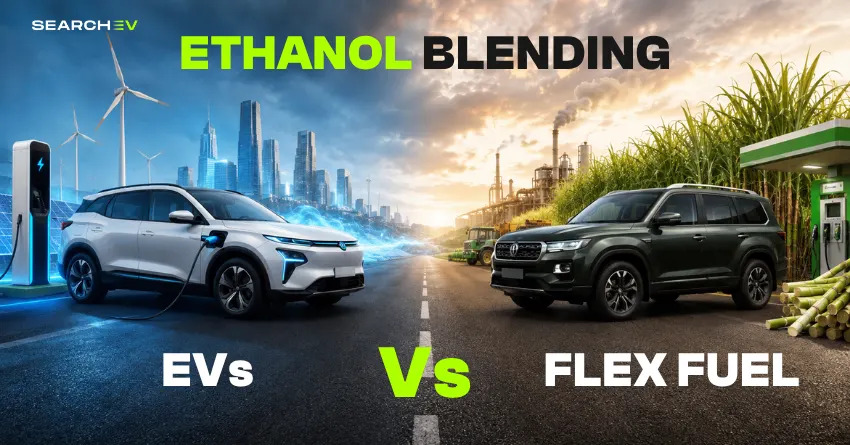
The Indian government’s repeated encouragement for cleaner transportation has sparked a new debate between flex-fuel and electric vehicle supporters. This debate has intensified significantly after the government sought public feedback on policies, which involve higher ethanol blends, including fuels with 80-100% ethanol.
Why is the government pushing Ethanol?
Ethanol is manufactured from agricultural feedstocks such as sugarcane, maize and rice. The government’s ethanol blending programme was originally designed to reduce dependence on imported crude oil, support farmers and make use of surplus agricultural stock. India already achieved its E20 target ahead of schedule and is now exploring higher blending levels for the future, which include E85, and E100 mixtures.
The Water And Food Security Concerns
We think that the recent, rapid boom in ethanol production could have some unintended consequences. For crops such as sugarcane, rice, and maize, which are required for ethanol production, the water consumption rate is very high. For context, to produce 1 litre of ethanol from sugarcane, you need around 3,000 litres of water. For the same amount of ethanol from rice, the number goes up to 10,000 litres.
Also, as per recent reports, the government allocated 52 lakh tonnes of rice for ethanol production in 2024–25, with a targeted 90 lakh tonnes for this year. And, where will this rice come from? The share of broken rice that was meant to be distributed to poor households through various schemes. Food Ministry policy reduced the broken rice distributed via the Public Distribution System (PDS) from 25% to 10% to free up this grain volume for fuel manufacturing and then branded it as a renewable energy source.
Apart from this, if farmers start producing crops mainly for commercial purposes, the food industry will definitely face a grain shortage. The irrigation system in arid areas, where water is a scarce resource, will take a hit, and face pressure if these commercial crops are cultivated extensively. And, this will definitely pose a sustainability concern over a longer period of time.
Vehicle Compatibility Remains A Talking Point
Another area of debate is vehicle compatibility. While the government and industry experts state that E20 fuel is safe for most vehicles, concerns still continue rising among older vehicle owners, as the vehicles were originally developed for lower ethanol blends. Also, industry experts have acknowledged that E20 can slightly reduce the fuel efficiency of your vehicle because ethanol contains less energy than petrol. This new ethanol-blended fuel will also damage parts of your vehicle and corrode them over time, as ethanol attracts water. And, you don’t have an option to buy pure fuel today.
| Reason | Consequence On Vehicle |
| Energy Density | Ethanol contains 45-55% less energy per litre than pure petrol |
| Mileage Drop | Nearly 50% of pre-2023 vehicle owners have reported a noticeable drop in fuel efficiency |
| Reduced Reliability | Ethanol naturally attracts moisture, threatening to corrode fuel lines, rubber gaskets, and older carburettors. |
Where EVs Fit Into The Picture
Not only do EVs reduce crude oil dependency on imports, but they also reduce the load on agricultural resources. Since EVs do not use food crops as raw materials for fuel blending, they already address many of the concerns regarding water use and food supply diversion for commercial purposes.
Our Opinion
We think that the ethanol-versus-EV debate won’t end anytime soon. Ethanol blending does help reduce oil imports and creates new opportunities for farmers, but EVs, on the other hand, promise lower emissions without placing additional burden on our agricultural resources. As of now, we think that the most sensible thing for India may not be choosing only one technology but allowing all of them to coexist, be it EVs, hybrids, CNGs, flex-fuel vehicles and conventionally fuelled ones.