Quick reads
- The TVS iQube ST 5.3 kWh now costs Rs 1,72,384, up by Rs 10,400
- The base iQube 2.2 kWh is just Rs 500 dearer
- TVS Orbiter V2 takes the steepest hit with a Rs 13,580 increase
- Orbiter V1’s price rises by Rs 7,000
- Rising input costs and external supply chain constraints cited as hike reasons
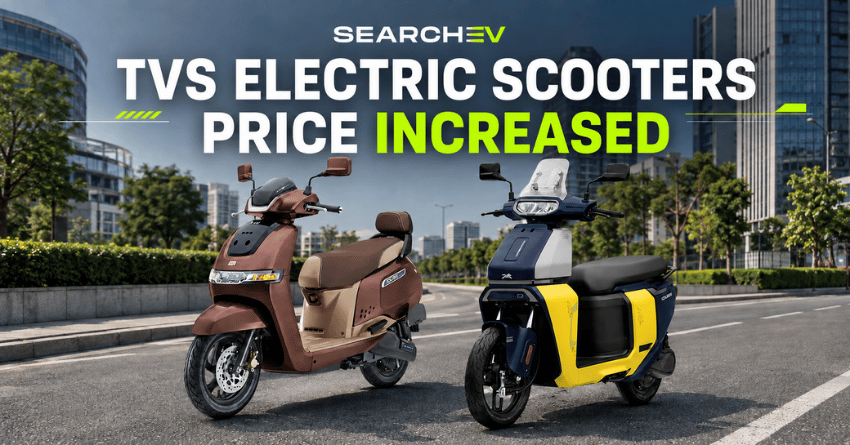
Buying a battery-powered scooter from TVS just became a bit more expensive. The homegrown manufacturer announced a fresh round of price revision for its electric vehicle portfolio, effective from August 2026. While the company adjusted pricing across its entire petrol and electric range, the zero-emission models took a noticeable hit. Buyers planning to purchase popular models like the TVS iQube or the newer TVS Orbiter will now have to stretch their budgets. We take a closer look at the exact numbers and examine how this move might affect the broader market.
TVS Electric Scooters Price Comparison
TVS offers several variants of the iQube and the Orbiter for multiple range and utility requirements. Here is a detailed breakdown of the old and new ex-showroom prices for the TVS electric scooters with the price difference.
| Model | Variant | Old Price | New Price | Price Difference |
| TVS iQube | 2.2 kWh | Rs 1,15,322 | Rs 1,15,822 | + Rs 500 |
| 3.1 kWh | Rs 1,25,315 | Rs 1,26,965 | + Rs 1,650 | |
| 3.5 kWh | Rs 1,35,043 | Rs 1,38,943 | + Rs 3,900 | |
| TVS iQube S | 4.7 kWh | Rs 1,59,142 | Rs 1,62,142 | + Rs 3,000 |
| TVS iQube ST | 5.3 kWh | Rs 1,61,984 | Rs 1,72,384 | + Rs 10,400 |
| TVS Orbiter | V1 | Rs 88,250 | Rs 95,250 | + Rs 7,000 |
| V2 | Rs 1,04,900 | Rs 1,18,480 | + Rs 13,580 |
(Note: The mentioned prices are ex-showroom figures. On-road costs will vary depending on state taxes and insurance policies.)
The increase isn’t proportional to the price of the scooter; it’s proportional to battery size, more or less. The 2.2 kWh iQube, the smallest pack in the range, moves by a token of Rs 500. The ST, with more than double that battery capacity, absorbs a hike twenty times. The orbiter follows the same logic.
Why Did TVS Raise Electric Scooter Prices?
TVS stated rising input costs and constraints across external supplies as the reasons for this hike. Building electric vehicles requires sourcing complex battery cells and electronic components from global suppliers. When the cost of securing these raw materials goes up, manufacturers eventually pass that burden down to the customer.
Companies rarely name the exact component behind a price hike. But the shape of this particular hike, heavier on bigger battery variants, lines up with a supply chain story that’s been building through 2025 and into this year: the shortage of rare earth magnets used in EV motors.
An Expert Take on the Market Impact
This specific price hike arrives at an interesting time for the Indian electric two-wheeler industry. The market is highly sensitive to upfront costs. A sudden jump of Rs 13,580 on the Orbiter V2 could force some buyers to reconsider their choices and enter competition like Bajaj Auto and Ather Energy.
However, TVS holds a very strong brand reputation built over decades. Their scooters offer a familiar, family-orientated design that many buyers prefer over radical, futuristic shapes. The base 2.2 kWh iQube remains very accessible since its price only went up by a tiny margin of Rs 500.