Key Takeaways
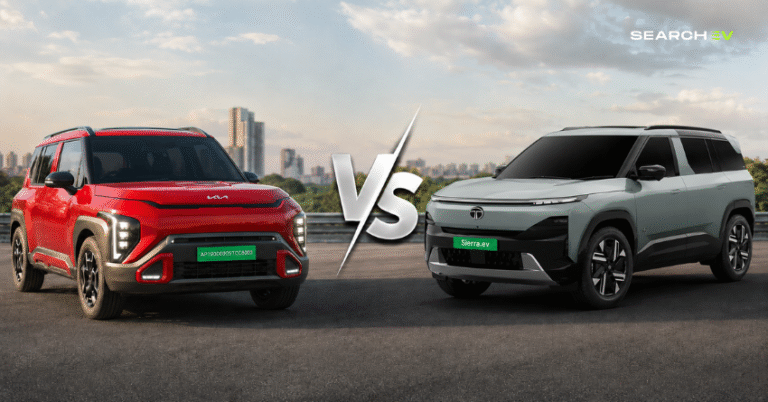
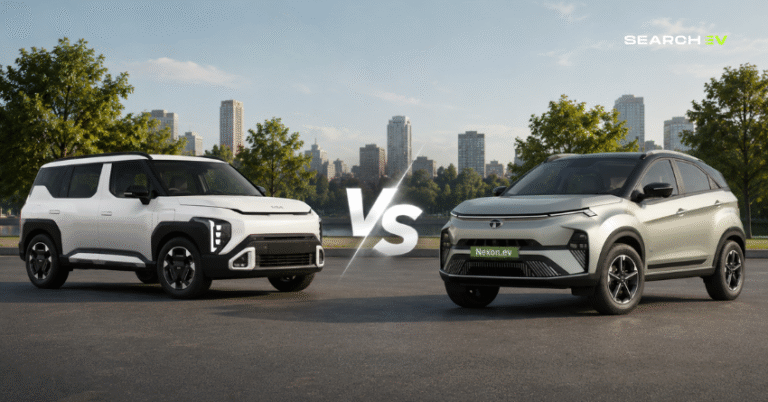
- The Kia Syros EV is a subcompact choice with relatively more accessible pricing.
- The Sierra EV offers larger 63 kWh and 75 kWh battery options, compared to the 42 kWh and 51.4 kWh packs found in the Syros EV.
- Tata provides an all-wheel-drive (QWD) option on its top variant, whereas the Syros EV sticks entirely to a front-wheel-drive layout.
- The Sierra EV is undeniably larger and more spacious, though Syros EV is still surprisingly roomy for its size alongside packing segment-first features like rear-seat ventilation.
Kia Syros EV vs Tata Sierra EV: Price and Value Comparison
Though the official pricing is not out, the Kia Syros EV is undeniably the cheaper electric car here, thanks to its smaller footprint and battery capacity. Kia has targeted a more price-sensitive segment with the Syros EV, which is expected to start around Rs 14 lakh.
Ex-Showroom Variant Price Breakdown
| Kia Syros EV Variant | Expected Price | Tata Sierra EV Variant | Official Price |
| HTK (42 kWh) | Rs 13.99 Lakh | Pure (63 kWh) | Rs 18.79 Lakh |
| HTK+ (42 kWh) | Rs 14.69 Lakh | Pure S (63 kWh) | Rs 19.99 Lakh |
| HTX (42 kWh) | Rs 15.49 Lakh | Adventure (63 kWh) | Rs 20.99 Lakh |
| HTK+ ER (51.4 kWh) | Rs 16.49 Lakh | Adventure (75 kWh) | Rs 22.19 Lakh |
| HTX ER (51.4 kWh) | Rs 17.49 Lakh | Empowered (63 kWh) | Rs 22.79 Lakh |
| HTX+ ER (51.4 kWh) | Rs 18.49 Lakh | Empowered (75 kWh) | Rs 23.79 Lakh |
| X-Line ER (51.4 kWh) | Rs 18.99 Lakh | Empowered A (75 kWh) | Rs 24.79 Lakh |
| — | — | Empowered A with QWD (75 kWh) | Rs 25.99 Lakh |
(Note: The Kia Syros EV pricing is estimated based on industry expectations, as official prices have not yet been released.)
The entry-level Syros EV allows buyers to save considerably over the base Sierra EV, making it an attractive choice for city driving. However, at the absolute top end, the fully loaded Sierra EV Empowered A with QWD offers an advanced dual-motor system for its higher price tag.
Road Presence, Dimensions, and Practicality Comparison
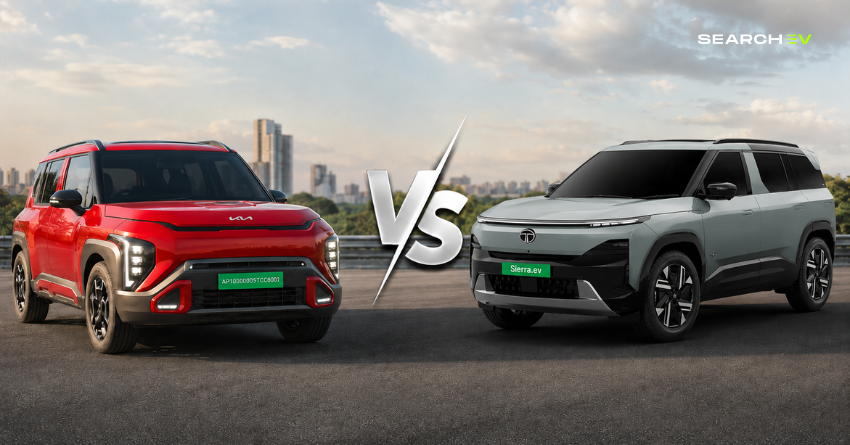
Both electric SUVs carry a boxy design language. The Syros EV has a more tall-boy design in an attempt to free up more additional cabin space despite the compact sub-4-metre footprint. The Tata Sierra EV, on the other hand, has a much larger physical presence on the road, revisiting its heritage silhouette with a clean look, a flat clamshell tailgate, flush door handles, and large panoramic rear side windows.
Physical Footprint and Space
| Dimension / Capacity | Kia Syros EV | Tata Sierra EV |
| Overall Length | 3,995 mm | 4,340 mm |
| Overall Width | 1,805 mm | 1,841 mm |
| Overall Height | 1,680 mm | 1,750 mm |
| Alloy Wheel Size | 16-inch / 17-inch | 19-inch |
| Luggage Boot Space | 465 litres | 622 litres |
While the Sierra EV provides a much larger 622-litre boot and broader road presence, the Syros EV is easier to park and navigate through dense urban traffic. At the same time, the Syros EV uses its tall roofline to keep cabin headroom competitive for rear passengers.
Kia Syros EV vs Tata Sierra EV: Which EV Offers More Features?
Both vehicles integrate screen-heavy cabin layouts and eliminate many old-school physical buttons, yet they distribute their premium features differently.
Tata and Kia have equipped these SUVs with a modern tech package, standardising large infotainment touchscreens and digital instrument clusters on their primary trims.
Comfort and Technology Summary
| Feature Category | Kia Syros EV | Tata Sierra EV |
| Infotainment Screen | 12.3-inch Touchscreen | 12.3-inch Touchscreen |
| Instrument Cluster | 12.3-inch Display | 10.25-inch Cluster |
| Panoramic Sunroof | Yes | Yes |
| Ventilated Seats | Front & Rear (Seat Base) | Front Only |
| Audio System | 8-speaker Harman Kardon | 12-speaker JBL |
| Driving Safety | ADAS Level 2 | ADAS Level 2+ |
Unique Highlights of the Kia Syros EV:
- A 30-inch Trinity Panoramic Display that brings the driver display, central infotainment, and secondary controls together.
- Features sliding and reclining rear seats alongside a dedicated rear seat base ventilation system.
Unique Highlights of the Tata Sierra EV:
- Dedicated Passenger Touchscreen
- 540-degree camera system with clear view assist
- Summon mode
Performance, Range, and Charging Speed Comparison
The mechanical setups separate these two cars into different driving brackets, with the Sierra EV focusing on power and battery volume, while the Syros EV targets urban efficiency.
Power, Efficiency, and Charging Specifications
| Metric | Kia Syros EV | Tata Sierra EV |
| Battery Sizes | 42 kWh & 51.4 kWh | 63 kWh & 75 kWh |
| Official Claimed Range | 443 km (42 kWh) / 526 km (51.4 kWh) | 565 km (63 kWh) / 665 km (75 kWh) |
| Acceleration (0-100 km/h) | 8.1 seconds (51.4 kWh) | 5.8 seconds (QWD Variant) |
| Peak Power Output | 133 bhp (42 kWh) / 168 bhp (51.4 kWh) | 238 bhp (RWD) / 390 bhp (QWD) |
| Peak Torque Output | 255 Nm | 315 Nm (RWD) / 504 Nm (QWD) |
| DC Fast Charging Speed | 10% to 80% in 39 minutes (100 kW) | 20% to 80% in 26 minutes (120 kW) |
The Syros EV delivers performance through its 51.4 kWh variant, generating 168 bhp and 255 Nm of torque to achieve an 8.1-second sprint to 100 km/h. It also handles fast charging well, requiring 39 minutes on a 100 kW DC connection.
The Sierra EV uses its larger batteries to secure longer range limits, with the 75 kWh pack targeting reliable highway coverage. It also remains the only option here to feature a dual-motor all-wheel-drive system, which delivers 504 Nm of torque and a 5.8-second acceleration time. Both models feature bidirectional charging tools to power external electrical hardware.
Kia Syros EV vs Tata Sierra EV: Which Electric SUV is the Better Buy?
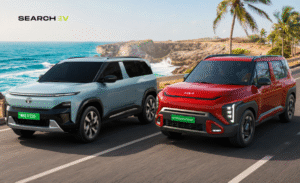
Kia Syros EV Pros and Cons
- Pros: Cheaper to buy upfront; sub-4-metre footprint makes it more suitable for city settings; rapid 39-minute fast charging; segment-first rear seat ventilation.
- Cons: Top-end pricing ventures into segments with much larger footprint, polarising design
Tata Sierra EV Pros and Cons
- Pros: Substantial real-world driving range on full charge; choice of a dual-motor AWD system for poor weather; large 622-litre storage capacity.
- Cons: Demands a higher financial investment across all comparable trims; a larger exterior size can be more cumbersome in tight neighbourhood lanes.
Expert Take on the Best Electric SUV for You
The Tata Sierra EV is an ideal car for those who need high range for highway duties and plenty of space for family trips. This model provides good headroom for passengers, great battery capacities, and the stability of an all-wheel drive version.
But if you are going to use the car mainly for commuting within the city, then the Kia Syros EV would be a very convenient choice for you. It allows you to keep the cost of purchase low and at the same time gives you such options as rear-seat sliding and reclining, ventilation of the rear cabin, and a 526 km claimed range.