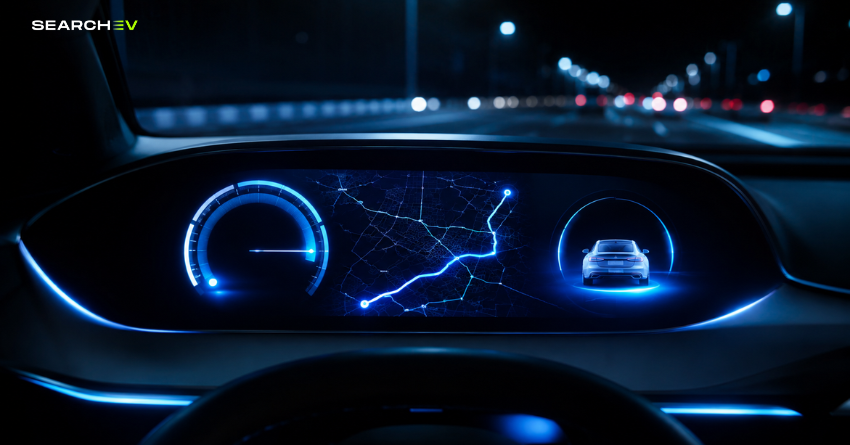
If you’ve owned an EV for a while, you’ve probably noticed something. The range estimate on day one felt a bit unreliable — sometimes optimistic, sometimes weirdly conservative. But a few months in, it started feeling more… accurate. More like it actually knew what you were about to do.
That’s not your imagination. That’s AI and it’s been quietly studying you since the first time you turned the key.
Why Early Range Estimates Are Always a Little Off
Every EV leaves the factory with a range prediction model built on controlled test data. Engineers drive the vehicle on standardised routes, in controlled temperatures, at specific speeds. The number that comes out of that process is the certified range — and it’s accurate for those exact conditions.
Your conditions are never those exact conditions.
You drive on Indian roads. You brake hard in traffic and then sit at a standstill for four minutes. You run the AC at full blast. You take the highway on weekends and city roads every weekday. You drive uphill on one side of your commute and coast down on the other. Your car has no idea about any of this when it’s brand new — so it uses the general model as a starting point and does its best.
The early inaccuracy isn’t a flaw. It’s just the model working with incomplete information about you specifically.
What the AI Is Actually Learning
Here’s where it gets genuinely interesting from a technology standpoint.
Modern EVs are constantly collecting data across every drive. Battery temperature at the start of the journey. How aggressively you accelerate at junctions. Average speed on your common routes. How much energy is recovered through regenerative braking on roads you take regularly. How long you typically sit idle with the AC running. How your charging habits affect the battery’s starting state each morning.
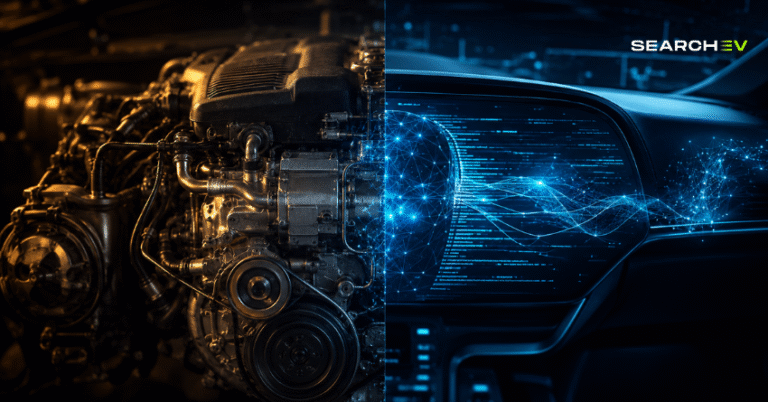
All of this feeds into a machine learning model that runs onboard. The model isn’t following a fixed formula — it’s building a statistical picture of how this specific car, driven by this specific person, on these specific roads, actually consumes energy. Over hundreds of trips, the picture gets sharper. Predictions that were once based on population averages start being based on your actual patterns.
A well-trained AI range model learns to adapt to personal driving styles and even hidden factors like a vehicle’s real-world aerodynamic drag — things that a fixed formula simply cannot account for. That’s the fundamental shift from traditional range calculation to AI-driven prediction.
The Variables That Matter Most
Not all data points are equal. The AI weighs some inputs far more heavily than others.
- Driving behaviour is the biggest single variable. How you accelerate, how early you anticipate braking, and how consistently you drive at stable speeds account for more range variation than almost any other factor. The AI learns your style — and a model trained on an aggressive driver adjusts downward; one trained on a smooth, anticipatory driver adjusts upward.
- Route familiarity compounds over time. Once the system has seen your commute route dozens of times, it knows the elevation changes, the typical traffic slowdowns, the junction where you always have to brake hard. A route-aware prediction for a known road is meaningfully more accurate than a cold estimate for somewhere new.
- Weather and temperature are pulled in from external data on connected vehicles. The AI knows that your battery performs differently on a 42°C afternoon versus an 18°C morning in December — and factors that into the prediction before you’ve even moved.
- Battery age and health are monitored continuously. AI-powered battery management systems track degradation patterns over time, improving the accuracy of both state-of-charge estimates and range predictions as the battery ages. An older battery’s behaviour is modelled differently from a new one — and the range prediction reflects that automatically rather than using factory specs that no longer apply.
Where OTA Updates Come In
Here’s the part most EV owners don’t connect: the AI model in your car isn’t static. It gets better not just from your own data, but from fleet-wide learning pushed back through OTA software updates.
Manufacturers collect anonymised driving and energy data from thousands of vehicles on their fleet. Engineers use this to refine the base prediction model — improving accuracy for specific road types, regional weather patterns, and common driving behaviours they observe across the fleet. That refined model is then pushed to all vehicles via an OTA update.
This means your car in Bengaluru benefits from learning patterns observed in Mumbai, Delhi, and Chennai — building a more regionally intelligent prediction model than any single vehicle could develop on its own.
Why This Matters Beyond Just a Number on the Screen
Accurate range prediction is about more than knowing whether you’ll make it home. It affects charging decisions, route planning, and how confident you feel about the vehicle day to day.
Range anxiety is largely a trust problem. Owners don’t distrust the battery — they distrust the estimate. When the number matches reality consistently, that anxiety dissolves. The best range systems in 2026 are accurate to within 5 to 8% on familiar routes — a significant jump from early systems that swung 15 to 20% in either direction. That improvement is almost entirely AI, not bigger batteries.
The Bottom Line
Your EV is not a static machine. It’s a learning system — one that gets measurably better at understanding your specific driving reality over months of use.
The range estimate you see today is already smarter than the one you saw when you first drove off. Six months from now, it’ll be even smarter. That’s machine learning doing exactly what it was designed for — getting more useful the more it knows about you.
Stay on top of every EV technology insight and ownership guide — SearchEV covers the technology that’s actually moving the needle.