Tata Tigor EV Expert Review
- Electric
- Car
- 5 Seater
What's good
-
One of the most affordable electric sedans in India.
-
Very low running cost compared to petrol cars.
-
Good safety rating for peace of mind.
-
Quick and smooth performance for city driving.
What's not so good
-
Real-world range is lower than claimed.
-
Higher upfront cost compared to the petrol version.
-
Boot space is reduced due to battery placement.
-
The infotainment system feels outdated.
The Tata Tigor EV is a compact electric sedan built on Tata’s Ziptron technology, priced from Rs 12.49 lakh to Rs 13.75 lakh (ex-showroom). It uses a 26 kWh battery pack delivering 55 kW power, 170 Nm torque, and a claimed ARAI range of 315 km, backed by a 4-star Global NCAP safety rating.
What's good
-
One of the most affordable electric sedans in India.
-
Very low running cost compared to petrol cars.
-
Good safety rating for peace of mind.
-
Quick and smooth performance for city driving.
What's not so good
-
Real-world range is lower than claimed.
-
Higher upfront cost compared to the petrol version.
-
Boot space is reduced due to battery placement.
-
The infotainment system feels outdated.
The Tata Tigor EV is a compact electric sedan built on Tata’s Ziptron technology, priced from Rs 12.49 lakh to Rs 13.75 lakh (ex-showroom). It uses a 26 kWh battery pack delivering 55 kW power, 170 Nm torque, and a claimed ARAI range of 315 km, backed by a 4-star Global NCAP safety rating.
Tata Tigor EV Expert Review
SEV Score

Samarth Kudale
Tested and reviewed by SEV Experts on 8 parameters
SEV Score

Samarth Kudale
Tested and reviewed by SEV Experts on 8 parameters
Expert Verdict
The Tata Tigor EV has already set the stage as the only mass-market sub-4-metre compact electric sedan currently available in India. The Tigor EV is designed around the high-voltage Ziptron architecture, balancing performance for urban commuting and structural strength for safety. The Tata Tigor EV is designed with feature integrations prioritised to enhance its practical appeal.
Tata Tigor EV Design
Exterior:
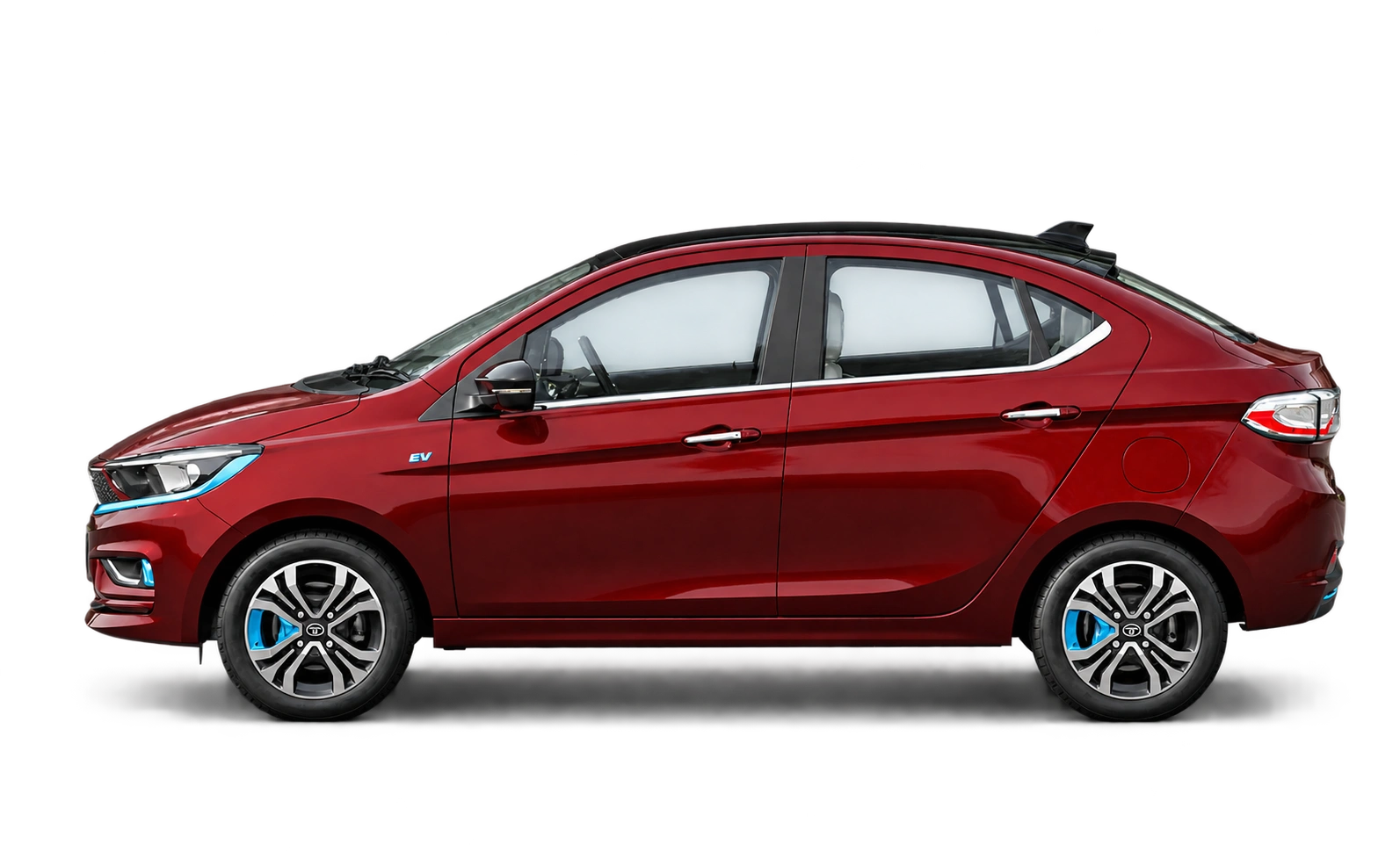
The exterior design of the Tigor EV is structured around aerodynamically contoured architecture, featuring modern elements like lighting to enhance the contemporary styling appeal it establishes. With signature electric styling accents, the Tigor EV aces in appeal as a new-age urban vehicle. The front section also features a closed-off grille section to announce its electric appeal. The tri-arrow integrations on the fascia are another teller that distinguishes it from its petrol counterpart.
The fascia also integrates projector headlights with electric blue highlights; a signature styling cue that immediately establishes that it is an electric vehicle, unlike the ICE counterpart. To further elevate the styling appeal, the DRLs, or daytime running lights, are placed in the lower bumper section near the fog-lamp housing. Speaking of the lighting setup, they offer good throw at night.
However, the ‘Humanity Line’ or bright teal blue accents may not be everyone’s taste, as it is felt to be overly aggressive or noisy in its approach, not blending well with the colour scheme. While it does have haters, some customers have also reported it to be the distinguishing factor that makes it stylish in appeal. Nevertheless, these teal-blue trims offer a premium design appeal to us.
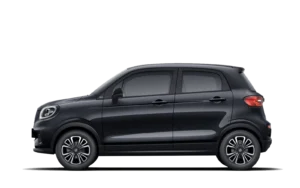
Coming to the side section, the Tata Tigor EV has a notched-down, forward-sloping roofline, giving it a slightly aggressive and muscular styling; it is complemented by a sharp crease running across the entire length of the vehicle. The blacked-out pillars and glossy black side mirror coverings (electric ORVMs) with integrated turn indicator lighting are also a neat touch that elevates its new-age appeal.
Additionally, the section also features Hyperstyle wheels; these are aerodynamically designed to maximise efficiency with minimal turbulence. However, the Hyperstyle wheels are 14-inch steel rims, basically featuring wheel covers that look a bit extreme, with the teal-blue accents – an overkill, according to us. That said, they have a lightweight design to maximise efficiency.
At the rear, the profile feels proportionate, with split LED taillights complemented by chrome strips. The well-contoured bumper section looks muscular, and the lower section of the bumper gets the teal-blue strip to support its overall design. The shark fin antenna, prominently displayed, along with a blacked-out roof featuring an integrated roof spoiler, gives the Tigor EV an aggressive stance. Overall, from an exterior point of view, the Tata Tigor EV sets a strong design language.
Interior:
Inside, the Tata Tigor EV offers an off-white and black (dual-tone) theme to enhance its premium feel. The setup is meant to enhance the ambient cabin lighting for an airy and refreshing feel. The dashboard layout features a layered colour scheme (off-white on the top portion and black on the lower half); this helps the cabin feel plush and premium in appeal. Of course, there are teal-blue accents to complement the exterior styling cues established by Tata Motors.
To further extend its premiumness, the centre console replaces the gear lever with a rotary knob for drive mode selections – this is a neat touch that does not feel tacky. The steering wheel also feels chunky, with mounted controls making the infotainment easier to operate. Speaking of which, while the audio quality is good, the user interface is poor, with subpar haptics. This is one section that we feel can be improved to enhance the premium cabin layout of the Tata Tigor EV. That said, the 4 speakers and 4 tweeters tuned by Harman System offer good sound quality.
Another aspect that can be improved is eliminating the use of hard composite plastics; instead, soft-touch materials can be offered, considering this day and age, wherein appeal is a priority. Nevertheless, with leatherette upholstery and decent seat bolstering, the cabin is well-tied to feel premium. In fact, top-tier trims feature off-white leatherette upholstery stitched with electric blue threads; these improve the design feel and overall cabin appeal to a large extent.
Build Quality:
The Tata Tigor EV has two sides of appeal when it comes to build quality; while it maintains strong structural integrity, the overall fit and finish of the panelling is not so great. The Tigor EV shines well in crashworthiness; however, it lacks good panel fitment. The body structure is rated as stable. The paint coating is thicker and durable, making it a decent solution for the price bracket it is offered at in India. That said, fitment of panels could have been made slightly better.
Tata Tigor EV Features
The Tata Tigor EV comes equipped with features that are necessary to elevate the user experience. The cabin gets a leatherette-wrapped steering wheel and leatherette seating upholstery for better comfort and experience. While on the subject, the cabin gets a fully automatic climate control system, ideal for staying comfortable on longer trips. The glove box also gets a cooling function. The steering gets tilt and telescopic adjustments for a better driving posture.
For entertainment, the Tigor EV’s cabin is equipped with a 17.78 cm ConnectNext floating touchscreen infotainment system by Harman. This system supports FM, USB, iPod connectivity
Bluetooth connectivity, phone diary access, audio streaming, and incoming SMS alerts, complemented by Apple CarPlay and Android Auto. The only downside to this system is the outdated interface, which needs improvement through updates or refreshed system integration.
For driver-centric appeal and access to useful information, the dashboard houses an informative digital instrument cluster with EV blue accents to provide an upmarket feel. For convenience, the driver’s side also gets a one-touch-down window function. However, a one-touch-up window function is not available; offering this can enhance the user experience for the driver and is a necessary feature by today’s modern standards expected from an urban compact sedan.
Tata Tigor EV Performance & Range
The Tata Tigor EV is equipped with an advanced permanent magnet synchronous motor, paired with a 26 kWh high energy density lithium-ion battery pack. This powertrain configuration enables the Tigor EV to produce 55 kW of peak power and 170 Nm of maximum torque. These performance figures translate to instantaneous torque from standstill to reach double-digit speeds quickly (0-60 kmph in 5.7 seconds). This performance is equivalent to petrol compact sedans.
Additionally, with such performance capacities, overtaking slower traffic is easier with accelerative responsiveness from the powertrain. However, acceleration slows down as it approaches 100 kmph. This can be a bummer if you are driving on highway stretches like City ring roads, where high-speed performance is necessary. That said, this progressive performance is to maximise range output. The Tigor EV from Tata Motors delivers an ARAI-certified range of 315 km / full charge. This is also ensured with a multi-level regenerative braking system: off, level 1, 2, and 3.
While on the subject, the regenerative braking system allows drivers to adjust the kinetic energy recovery. When engaged in level 3, the system also offers strong engine braking-like deceleration ideal for one-pedal city stop-and-go traffic conditions. But there are a few areas where the powertrain can be improved; range depletion under heavy acceleration is significant: The 26 kWh battery depletes faster when keeping a speed of 80 kmph and above, which can be improved.
The limp-mode-like functionality: when the car’s thermal management system detects heating under high-speed operations, the vehicle feels lethargic, limiting speeds until it cools down; while it is indeed a good feature, for some users, it is found to kick in regularly in such conditions – this occurs when operating the vehicle at peak speeds for a longer time on open highway stretches.
Tata Tigor EV Ride & Handling
The Tata Tigor EV offers planted high-speed performance, with effective ride and handling output, supported by even weight distribution enabled by the battery pack fitment. In fact, the low-mounted battery offers a lower centre of gravity, ideal for keeping the Tigor EV planted at speeds of 80-100 kmph. The vehicle showcases less highway floating at such speeds, ideal for occupant comfort.
Under moderate driving conditions, at lower speeds, body roll is minimal, keeping occupants comfortable. Also, when cornering, the body roll is well controlled, especially under braking in such corners. The vehicle can be turned into a corner with adequate stability with occupants on board. The chassis remains planted, resisting leaning for better driveability under cornering and braking.
The electric power steering (EPS) system also offers good feedback; it is light at slow speeds, easy to navigate through traffic, while offering adequate heft at high-speed operations. However, heavy acceleration can break traction, causing wheel spin, which can be exciting but bad for the tyres. Overall, in terms of ride and handling, the Tata Tigor EV offers decent performance.
Tata Tigor EV Safety
The strong point of the Tata Tigor EV is its high-strength architecture meant to maximise occupant protection in the event of a crash. In fact, the Tata Tigor EV has scored 4-stars in Global NCAP crash tests. In the same testing, the Tigor EV scored 12 points out of 17 for adult occupant safety and 37.24 out of 49 points for child occupant safety. Global NCAP stated that the chassis is unstable under full load, but offered good head and chest protection for front occupants, supported by heavy steel panelling. Apart from these, the vehicle’s high-voltage architecture is safe as well.
For high safety standards, the Tata Tigor EV also features dual airbags and an anti-lock braking system (ABS), electronic brake force distribution (EBD), and a corner stability control system. These help the vehicle maintain stability under heavy braking conditions and during cornering. However, the Tigor EV does not come with ADAS (advanced driver assistance systems), which can further enhance safety, offering lane departure warnings and emergency braking functions.
Tata Tigor EV Space & Comfort
Thanks to the long wheelbase, the Tata Tigor EV offers rear-row occupants superb comfort with generous leg and knee room. Taller passengers also won’t feel cramped when seated in this section. The rear bench seat comes with sufficient cushioning and bolstering for comfort too. The driver and co-driver seating arrangement is also good, with taller positioning for better visibility.
However, the Tata Tigor EV is strictly meant to seat 4 occupants; why do we state this? The rear bench – middle occupant will feel cramped due to the narrow width of the cabin, causing shoulder overlap. The floorboard bump can also mean there is no space to place the feet comfortably. Also, there are no rear AC vents to enhance the cooling profile for occupant comfort. And the rear bench seat does not come with a 60:40 split; it affects the convenience factor for taking large luggage.
Tata Tigor EV Charging & Warranty
The Tata Tigor EV takes a minimum of 59 minutes to recharge from 10 to 80 percent state of charge (SOC) using a DC fast charger. Meanwhile, 10-100 percent SOC can only be achieved by charging for around 9.4 hours (using an AC home wall charger or 15A plug point). This can be a cause of inconvenience for buyers looking to take the vehicle on long-distance journeys. But if overnight charging is the set plan, the Tigor EV is still a decent solution for such requirements.
As for warranty, Tata Motors is offering a solid battery and motor warranty of 8 years or 1,60,000 km (whichever is earlier). Meanwhile, the vehicle warranty is 3 years or 1,25,000 km (whichever is earlier). This makes the Tata Tigor EV a strategic investment for carrying out a longer duration of ownership in India. What about the service network and turnaround times:
Tata Tigor EV Service & Network
The Tigor EV owners will benefit from the extensive service network across 600-plus cities and towns in India. Unlike niche EV brands, owners of the Tata Tigor EV can find service stations in Tier-2 and Tier-3 cities. Tata is also focused on further extending the standalone Tata.ev service network across India for a unique service experience. With trained service technicians for diagnosis and better serviceability, the Tigor EV is said to deliver a unique ownership experience.
Who should buy this?
The Tata Tigor EV is meant for those business executives and owners who will utilise the vehicle primarily for city commutes, covering distances of 50 to 100 km per day. The Tigor EV is meant for customers who regularly transport large luggage; it has a large boot space while having a compact footprint to navigate city traffic conditions easily. For buyers prioritising safety, the Tigor EV is the best solution, as it provides structural integrity for occupant protection in the event of a crash. With extremely low maintenance requirements and low operating costs, it is perfect for shuttle services.
What's good
-
One of the most affordable electric sedans in India.
-
Very low running cost compared to petrol cars.
-
Good safety rating for peace of mind.
-
Quick and smooth performance for city driving.
What's not so good
-
Real-world range is lower than claimed.
-
Higher upfront cost compared to the petrol version.
-
Boot space is reduced due to battery placement.
-
The infotainment system feels outdated.
Tata Tigor EV Price
What's good
-
One of the most affordable electric sedans in India.
-
Very low running cost compared to petrol cars.
-
Good safety rating for peace of mind.
-
Quick and smooth performance for city driving.
What's not so good
-
Real-world range is lower than claimed.
-
Higher upfront cost compared to the petrol version.
-
Boot space is reduced due to battery placement.
-
The infotainment system feels outdated.
Connect Now