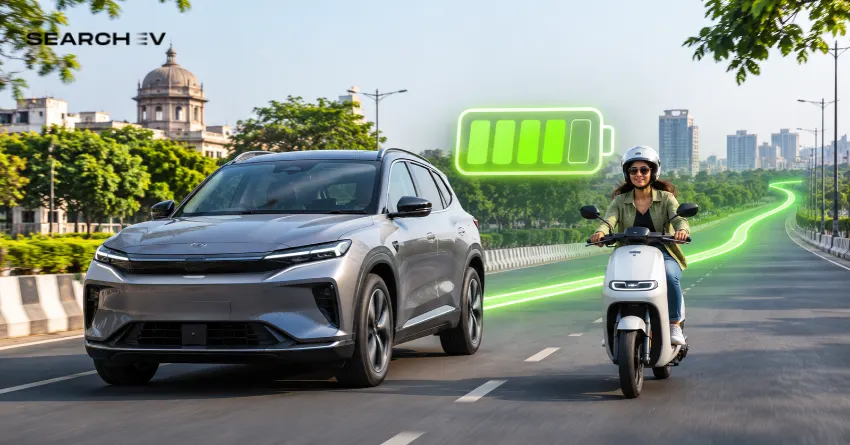
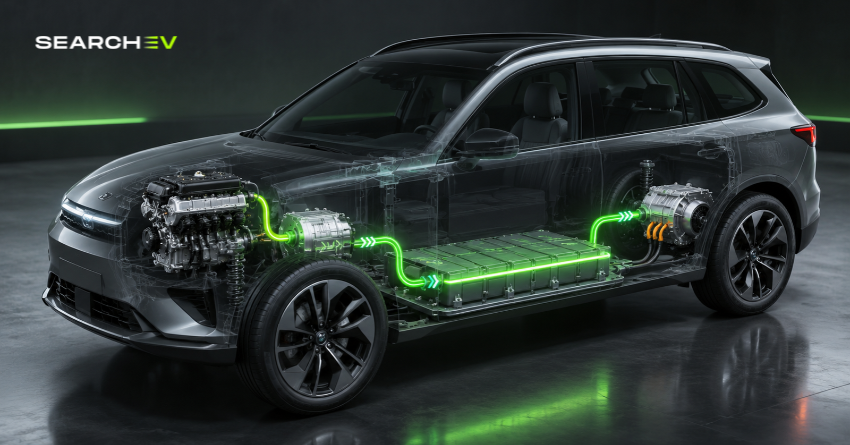
Electric cars have made significant progress in battery capacity, driving range and charging speeds. However, long-distance travel still raises practical questions for buyers, particularly when charging infrastructure is limited along certain routes. One technology attempting to address this concern is the range extender electric vehicle, commonly known as an EREV or REEV.
Unlike a conventional electric car, an EREV carries an additional onboard power generator. This allows it to continue generating electricity when its battery charge becomes low, without depending entirely on public charging stations.
The concept combines electric driving with an additional energy source. But how exactly does it work, how is it different from a plug-in hybrid, and could range extender electric cars become relevant in India?
What Is a Range Extender Electric Vehicle?
A range extender electric vehicle is primarily driven by an electric motor but also carries a secondary power source that generates electricity when required.
In many EREVs, this secondary source is a small petrol engine connected to an electric generator. The engine does not directly drive the wheels in a typical series-hybrid EREV. Instead, it generates electricity that can power the electric motor or maintain the battery’s charge.
This arrangement allows the vehicle to operate in two broad stages:
- Electric mode: The car runs using energy stored in its battery, much like a conventional battery electric vehicle.
- Range extender mode: When the battery reaches a predefined charge level, the onboard engine starts generating electricity to support the electric drive system.
The vehicle can still be charged externally, so owners can use grid electricity for regular journeys and rely on the onboard generator when additional energy is needed.
How Does an EV Range Extender Work?
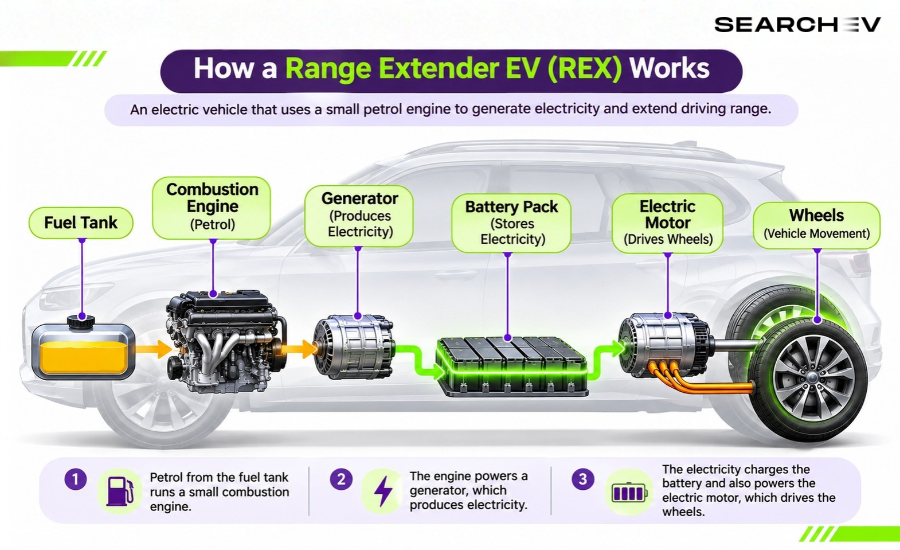
The working principle is relatively straightforward. An EREV has an electric motor, battery pack, fuel tank, engine and generator. These components work together to keep the vehicle moving.
Here is how the energy flow works:
- Battery charging: The battery is charged through a home charger or public charging station.
- Electric driving: The battery supplies electricity to the motor, which drives the wheels.
- Battery charge drops: When the battery reaches a programmed reserve level, the range extender system can start.
- Electricity generation: The engine runs a generator, producing electricity for the vehicle’s electrical drive system.
- Continued electric propulsion: The electric motor continues driving the wheels, while the generator supports the energy supply.
The important distinction is that the engine acts as an electricity generator rather than a conventional mechanical power source for the wheels.
EREV vs BEV vs PHEV: What Is the Difference?
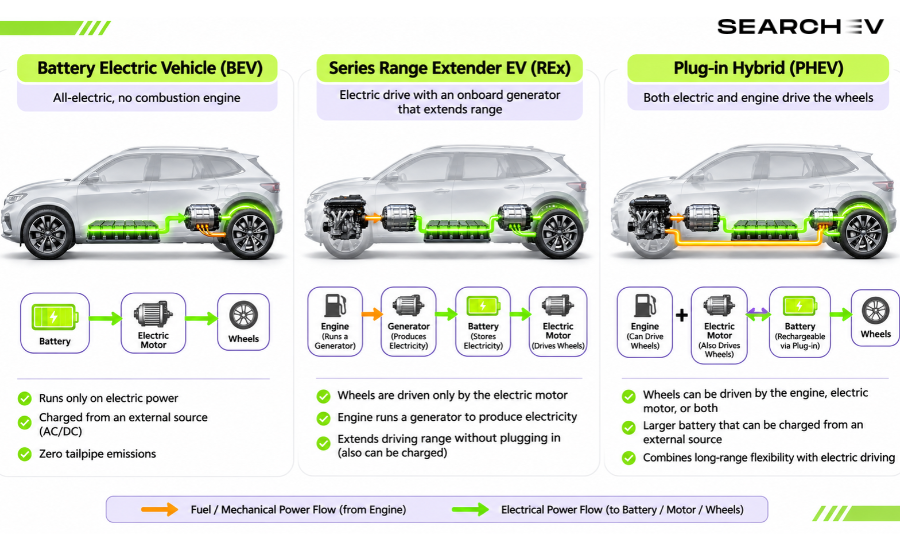
Although these technologies combine electric and combustion-based components in different ways, their powertrain layouts are not the same.
| Feature | BEV | EREV / REEV | PHEV |
| Main driving system | Electric motor | Electric motor | Electric motor and engine |
| Battery charging | External charging | External charging and onboard generation | External charging |
| Combustion engine | No | Usually present as a generator | Present |
| Engine drives wheels | No | No in a true series EREV | Can, depending on design |
| Fuel tank | No | Usually present | Present |
A battery electric vehicle depends entirely on its battery for propulsion. A range extender EV uses an onboard generator to provide additional electrical energy, while a plug-in hybrid can use both its electric motor and combustion engine to propel the vehicle.
The distinction matters because not every vehicle marketed as an extended-range or hybrid vehicle follows the same powertrain arrangement. Buyers should check how the engine is mechanically connected to the wheels.
What Are the Advantages of Range Extender Electric Cars?
Range extender technology attempts to combine the everyday driving experience of an electric car with the flexibility of an additional energy source.
1. Less Dependence on Public Charging
Drivers can use battery power for regular commutes and rely on the generator when the battery charge becomes low. This can be useful on routes where charging stations are not consistently available.
2. Electric Motor-Driven Performance
In a series EREV, the electric motor continues to drive the wheels. Drivers can therefore retain the immediate torque delivery and smooth acceleration associated with electric propulsion.
3. Potentially Smaller Battery Packs
Depending on the vehicle’s design and intended usage, manufacturers may be able to use a smaller battery than they would in a comparable long-range BEV. This could help manage battery cost and weight, although the generator and fuel system add their own weight and complexity.
4. Greater Flexibility for Long Journeys
The onboard generator can provide additional electrical energy during longer journeys. This reduces the need to plan every trip around the availability of charging infrastructure.
What Are the Limitations of EREVs?
Range extender technology is not a solution without trade-offs.
- Additional mechanical complexity: The vehicle needs an engine, generator, fuel system, battery and electric drivetrain.
- Fuel consumption: Once the generator operates, the vehicle uses fuel. It is not operating as a zero-tailpipe-emission vehicle during this period.
- Extra weight: Carrying both an electric powertrain and a generator system can increase vehicle weight.
- Maintenance requirements: The combustion engine introduces maintenance needs that a pure battery electric vehicle does not have.
- Energy conversion losses: Fuel is converted into mechanical energy and then electricity before being used by the motor. These conversion stages involve losses.
An EREV may be useful for buyers who regularly travel long distances but still want electric-motor-driven propulsion. For people who mainly drive within a city and have convenient charging access, a conventional BEV may remain the simpler option.
Are Range Extender Electric Cars Coming to India?
Range extender technology is gaining attention in markets where manufacturers are exploring alternatives to conventional battery-only electric vehicles.
In India, the technology has also entered the broader industry conversation. JSW MG Motor India’s ADAPT platform, unveiled in 2026, has been described as a multi-energy architecture designed to support different powertrain configurations, including range extender technology.
However, a platform’s technical capability should not be confused with a confirmed vehicle launch. Buyers should look for an official model announcement, specifications, launch timeline and pricing before treating an EREV as an upcoming purchase option.
India’s vehicle classification framework also recognises plug-in hybrid and range-extended electric vehicle configurations. The actual technical layout of a vehicle remains important when determining whether it is a true series EREV or another type of hybrid.
The technology could be relevant to Indian buyers who want electric driving for daily use but need additional flexibility for intercity travel. Its success will depend on vehicle pricing, fuel efficiency in generator mode, battery size, maintenance costs and the availability of suitable models.
Should You Wait for an EREV or Buy a Battery Electric Car?
The decision depends on how and where you drive.
A conventional BEV is worth considering if most of your journeys are predictable, you can charge at home or work, and the available driving range meets your daily requirements.
An EREV could make more sense for buyers who frequently travel between cities, encounter inconsistent charging access or prefer having an onboard backup energy source. However, the additional engine and generator system may increase purchase and maintenance costs.
Before deciding, compare the available electric cars by battery capacity, usable range, charging time and price. You can explore the latest options in our guide to long-range electric cars in India.
Frequently Asked Questions
1. What does EREV stand for?
EREV stands for Extended-Range Electric Vehicle. It is a vehicle that uses an electric motor for propulsion and an additional onboard energy source, commonly an engine-generator system, to extend its driving range.
2. Does a range extender EV use petrol?
Many range extender EVs use a petrol engine to operate an onboard generator. Other energy-conversion technologies are possible, but the petrol engine-generator arrangement is a common configuration.
3. Does the engine drive the wheels in an EREV?
In a true series EREV, the engine does not mechanically drive the wheels. It operates a generator that supplies electricity to the vehicle’s electric drive system.
4. Is an EREV the same as a plug-in hybrid?
No. A plug-in hybrid can use its combustion engine to drive the wheels, depending on its powertrain design. In a true series EREV, the electric motor drives the wheels and the engine acts as a generator.
5. Is a range extender EV completely emission-free?
No. It can drive using battery electricity without running its combustion engine, but when a fuel-powered generator operates, the vehicle produces tailpipe emissions.
6. Are EREVs available in India?
Range extender technology has entered discussions around Indian multi-energy vehicle platforms, but buyers should verify official production-model announcements and specifications before assuming a particular EREV is available for purchase.