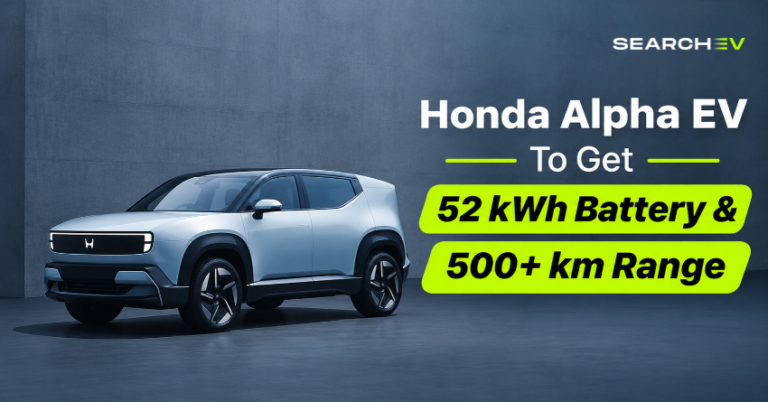
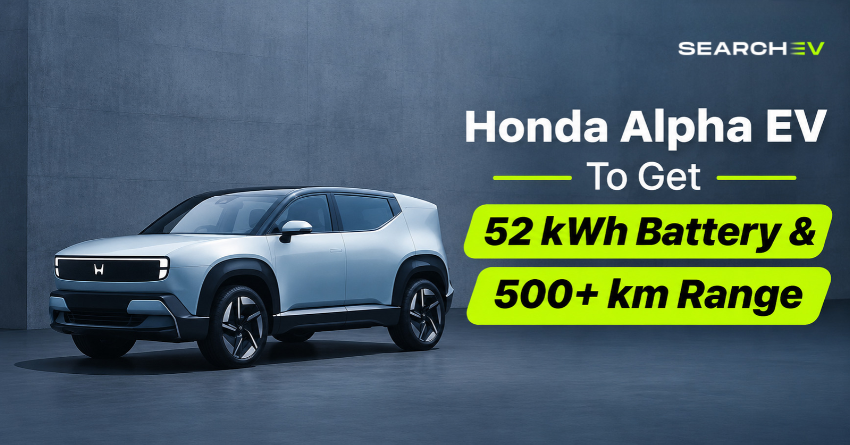
Only eight days remain before Honda pulls the cover off the Honda Alpha on December 2, 2026. Ahead of its global premiere, fresh details have surfaced about how Honda plans to package its very first electric SUV for Indian buyers. According to our internal sources, the upcoming Honda Alpha EV is expected to use a 52 kWh battery pack with a claimed driving range exceeding 500 kilometres, split across three variants, with the top trim expected around Rs 22 lakh to Rs 23 lakh ex-showroom.
52 kWh Battery Pack, 500 Km Plus Claimed Range
According to our internal sources, the Honda Alpha is expected to arrive in three core variants: Base, Mid, and Top (exact naming will differ). More importantly, all three trims could share the exact same 52 kWh battery pack. Buyers on a tighter budget would not have to settle for a short-range city battery just to avoid paying top trim money.
Delivering a claimed range in excess of 500 kilometres, the Honda Alpha EV will find itself sitting right in the competitive mid-size EV segment. For comparison, the Hyundai Creta Electric’s 51.4 kWh pack carries a claimed MIDC rating of 510 kilometres. Sticking to 52 kWh rather than using a heavier 75 kWh pack beneath the floor also fits Honda’s Thin, Light, and Wise engineering philosophy. Less battery mass helps ride comfort over broken city roads while keeping production costs under control.
Under the bonnet, power is expected to reach the front wheels through a single compact e-Axle electric motor. Honda’s new electric architecture is also targeting quick DC top-ups from 15 per cent to 80 per cent in roughly 15 to 20 minutes on compatible high-output chargers.
One Pedal Drive, Honda App Charging Connect, and Cabin Tech
If every variant shares the same 52 kWh battery, how does Honda justify stepping up to the flagship model? Software and everyday driving aids look set to do the heavy lifting. According to our internal sources, the top variant of the Alpha EV is expected to get One Pedal Drive, letting drivers accelerate, slow down, and come to a complete halt in urban traffic using only the throttle pedal.
Manali spy shots from June 2026 already hinted at this setup. Those high altitude test photos showed a three-spoke flat-bottomed steering wheel with paddle shifters mounted behind the rim. Lower trims should use those paddles for regular multi-stage regenerative braking, while the flagship variant unlocks full one-pedal operation.
Charging management is also moving into Honda’s digital ecosystem. According to our internal sources, the Alpha EV is expected to tie charging controls directly into Honda’s connected car smartphone app. Through that app connection setup, owners should be able to track live charge status, schedule home top-ups, and handle public charging sessions straight from their phone.
Earlier interior spy photos have also revealed notable cabin details, including:
- Separate Dual Displays: A large freestanding central touchscreen handles infotainment duties, paired with a separate rectangular digital driver cluster instead of a pillar-to-pillar glass slab.
- Physical Console Buttons: Test prototypes kept a dedicated bank of physical buttons below the screen for climate functions, saving drivers from hunting through touch menus.
- Expected Upper Trim Features: Top variants are expected to carry dual-zone automatic climate control, ventilated front seats, a panoramic glass roof, wireless phone charging, a 360-degree camera, and the Honda Sensing Level 2 ADAS suite with adaptive cruise control, lane keep assist, and autonomous emergency braking.
Made in Rajasthan for Global Export: Platform and Design Context
Named the Honda Alpha on November 3, 2026, after dropping the zero prefix from the 2025 Tokyo concept, the SUV will roll off the assembly line at Honda’s Tapukara plant in Rajasthan. India is not just getting the car first. Tapukara will serve as the global manufacturing hub, building units for Indian showrooms before exporting right-hand-drive models to Japan and other overseas markets.
Camouflaged test cars seen till now keep the upright, boxy silhouette shown in Tokyo. The Alpha is the first Honda in India to wear the redesigned, frameless H logo, mounted on a closed nose flanked by full-width LED lighting. Squared wheel arches, aero alloy wheels, a flat roof, and a near-vertical tailgate free up interior room. While overall length sits in the 4.3 to 4.4 metre midsize bracket, the dedicated EV platform allows an estimated wheelbase between 2,700 mm and 2,800 mm, beating the petrol Honda Elevate’s 2,650 millimeter wheelbase for better rear legroom.
Expected Rs 22 Lakh to Rs 23 Lakh Price and Segment Rivals
According to our internal sources, the Alpha EV is expected to be around Rs 22 lakh to Rs 23 lakh ex-showroom, which appears to be the target bracket for the top spec variant. If the flagship lands there, Honda has room to slot its Base and Mid trims under Rs 20 lakh, potentially opening the lineup around Rs 18 lakh to Rs 19 lakh when sales begin in early 2027.
Pricing the top Alpha near Rs 22 lakh to Rs 23 lakh puts it under the upper trims of the Creta Electric, Tata Sierra EV, and Mahindra BE 6 Sporteq.
Currently, Honda’s Indian lineup consists of just three locally built models, namely the Amaze, City, and Elevate, joined by the imported ZR V hybrid. There has been no EV offering till now.
The Alpha kicks off Honda’s broader push to introduce 10 new models, including seven SUVs, across India by 2030. While December 2 brings the full global unveiling of the production bodywork, interior, and official specifications, final variant pricing and customer deliveries are expected in the first quarter of 2027.