Imagine buying an electric car that promises a driving range of 500 km on a single charge. You plan a long weekend trip, check the battery percentage, and expect to cover most of the journey without stopping to recharge. But once you start driving, you realise the battery is draining faster than expected, and the distance shown on the dashboard keeps changing.
This is a common experience for many electric vehicle owners. The range mentioned in a car’s brochure and the distance it actually covers on Indian roads can be quite different.
So, does this mean electric vehicle manufacturers exaggerate their range figures? Not necessarily. The difference largely comes down to how electric vehicles are tested before their range is officially published and how people actually use them.
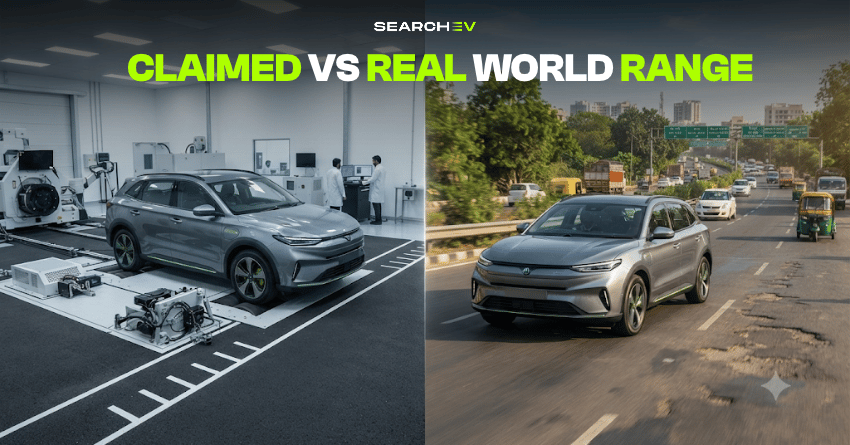
In India, electric cars generally carry ARAI-certified range figures based on the Modified Indian Driving Cycle (MIDC). These tests follow standardised conditions, whereas real-world driving involves traffic, different speeds, air-conditioning, passengers, weather and road conditions.
Understanding the difference between claimed and real-world EV range is important before purchasing an electric car or scooter. It helps you set realistic expectations, plan long-distance journeys and choose a vehicle that suits your daily driving requirements.
Let’s understand how these two range figures are calculated, why they differ and how much distance you can realistically expect from an electric vehicle.
What Is Claimed Range in an Electric Vehicle?
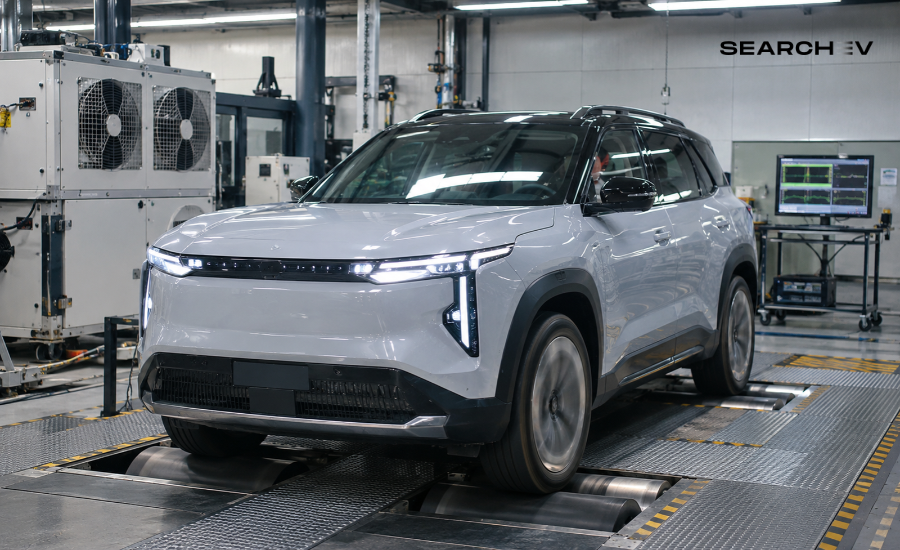
Claimed range is the driving distance an electric vehicle is rated to cover on a full battery charge under a prescribed testing procedure.
Manufacturers use this figure in advertisements, brochures, websites and vehicle specifications to communicate the vehicle’s driving range.
For example, if an electric car has a claimed range of 500 km, it means the vehicle has achieved that distance under the applicable certification test conditions.
In India, the range figures of electric cars are commonly associated with the Automotive Research Association of India (ARAI) and the Modified Indian Driving Cycle (MIDC).
The purpose of these tests is to evaluate vehicles under standardised conditions so buyers can compare different models using a common reference.
However, the claimed range is not a guarantee that the vehicle will cover the same distance during everyday driving.
A car claiming 500 km may deliver a lower figure when driven continuously at highway speeds, with the AC running and multiple passengers on board.
This is why claimed range should be treated as a certification benchmark rather than a guaranteed real-world driving distance.
What Is Real-World Range in an Electric Vehicle?
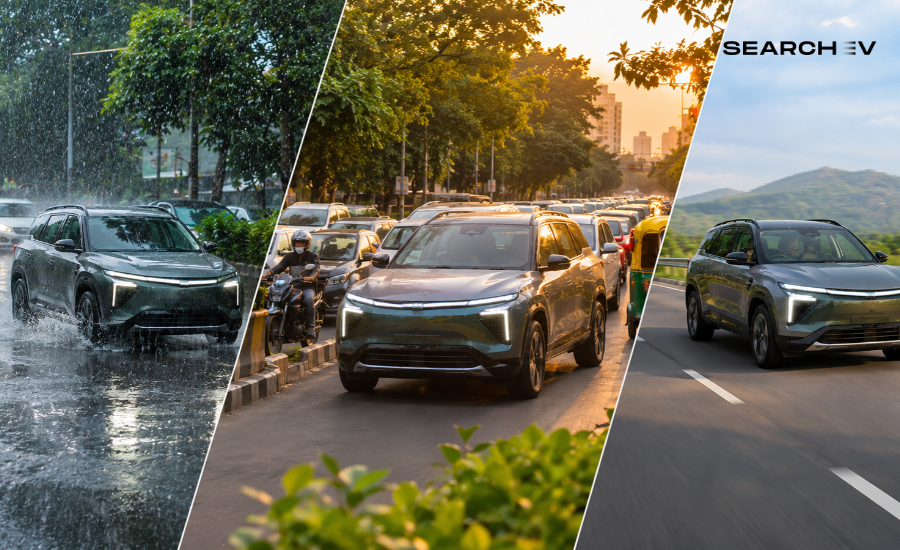
Real-world range refers to the actual distance an electric vehicle can cover under everyday driving conditions before its battery needs recharging.
Unlike certification testing, real-world driving involves several variables that change from one journey to another.
For example, an electric SUV may deliver different ranges when driven in Bengaluru’s traffic, on a highway towards Mysuru or on an uphill route through the Western Ghats.
The same vehicle may also deliver different results depending on the driving speed, AC usage, passenger load and weather.
Real-world range is generally determined through independent road tests, manufacturer estimates or owner-reported driving data.
It gives buyers a more practical understanding of what to expect after purchasing an electric vehicle.
However, even real-world range is not a fixed number. Two people driving the same EV can achieve different results because their driving habits and conditions may not be identical.
Claimed Range vs Real-World Range: What’s the Difference?
The main difference between claimed and real-world range is the environment in which the vehicle is tested.
Claimed range comes from a standardised certification procedure, while real-world range reflects the distance covered under actual driving conditions.
Here is a simple comparison:
| Parameter | Claimed Range | Real-World Range |
| Testing Environment | Standardised testing conditions | Actual road conditions |
| Driving Pattern | Prescribed test cycle | Everyday driving behaviour |
| Traffic Conditions | Controlled test conditions | Varies with location and time |
| AC Usage | Depends on the applicable test procedure | Depends on driver usage |
| Road Conditions | Standardised test conditions | City roads, highways, hills and uneven roads |
| Passenger Load | Prescribed test load | Actual passengers and luggage |
| Range Figure | Certification figure | Tested or estimated driving distance |
| Main Purpose | Vehicle certification and comparison | Practical range expectation |
For buyers, both figures are useful, but they serve different purposes.
Claimed range helps compare vehicles on a standardised basis, while real-world range helps you understand how the vehicle may perform during everyday use.
How Are Electric Vehicle Range Figures Tested in India?
Electric vehicle manufacturers cannot simply publish any driving range they want without following the applicable certification requirements.
In India, electric cars undergo homologation and testing through authorised agencies, including ARAI and other recognised testing agencies.
One commonly referenced testing procedure is the Modified Indian Driving Cycle (MIDC).
MIDC is a prescribed driving cycle designed to evaluate vehicle performance and energy consumption under standardised conditions.
The test measures how much energy a vehicle consumes while following a defined driving pattern. This information is used to determine its certified driving range.
Other markets use different testing procedures.
For example:
- MIDC (Modified Indian Driving Cycle)
MIDC is used for range certification in India. It provides a standardised reference for evaluating electric vehicle range and is commonly quoted in Indian vehicle brochures.
- WLTP (Worldwide Harmonised Light Vehicles Test Procedure)
WLTP is used in several international markets, including Europe. It uses a more dynamic testing procedure with different driving phases, speeds and acceleration patterns.
- EPA (Environmental Protection Agency)
The US EPA uses its own vehicle efficiency and range testing procedures. Its figures are generally considered useful for estimating everyday driving because the testing incorporates additional adjustments to reflect real-world usage.
It is important to remember that these testing cycles are not directly interchangeable. A vehicle’s WLTP, EPA and MIDC figures may differ even when the underlying battery and powertrain are the same.
When comparing electric vehicles, always check which testing cycle was used to arrive at the advertised range.
Real-World Range Test: How Much Distance Do Electric Cars Actually Cover?
One of the best ways to understand the difference between claimed and real-world EV range is to look at independent road-test results.
Autocar India published a real-world range test of several mass-market electric cars in April 2026. The results showed that the actual distance covered could vary significantly from the manufacturers’ certified figures.
Here are some examples from its testing:
| Electric Car | Claimed Range | Real-World Tested Range |
| Hyundai Creta Electric 51.4 kWh | 473 km | 432 km |
| Tata Nexon EV 45 kWh | 489 km | 350 km |
| Tata Curvv EV 55 kWh | 502 km | 365 km |
| Mahindra BE 6 79 kWh | 682 km | 449 km |
| MG Windsor EV 38 kWh | 332 km | 308 km |
| MG ZS EV 50.3 kWh | 461 km | 339 km |
Source: Autocar India’s real-world electric car range testing. Figures refer to the specific variants tested and their published certification figures at the time. They should not be treated as guaranteed range estimates for every model year or driving condition.
The Hyundai Creta Electric, for instance, covered 432 km against its 473 km ARAI-rated range in Autocar India’s test.
The Tata Curvv EV with its 55 kWh battery had a claimed range of 502 km, but the tested distance was 365 km.
The Mahindra BE 6 also showed a noticeable difference. Its 79 kWh battery version had a certified range of 682 km, while the independent test recorded 449 km.
Interestingly, the MG Windsor EV came relatively close to its claimed figure, covering 308 km against its 332 km certified range.
These results highlight an important point: the difference between claimed and real-world range is not the same for every electric vehicle.
Battery capacity, vehicle weight, aerodynamics, motor efficiency and driving conditions all play a role.
Why Is Real-World EV Range Lower Than Claimed Range?
There isn’t just one reason behind the difference. Several factors influence how efficiently an electric vehicle uses its battery during everyday driving.
Let’s look at the most important ones.
1. Driving Speed
Driving speed is one of the biggest factors affecting electric vehicle range, particularly during highway journeys.
At higher speeds, the vehicle needs more energy to overcome aerodynamic drag. As speed increases, the resistance from air becomes considerably more significant.
For example, an electric car travelling at 70–80 km/h may consume less energy than the same car travelling continuously at 110–120 km/h.
This is why highway range can sometimes be lower than city range, even though highway driving involves fewer stops.
Maintaining a steady and reasonable cruising speed can help improve efficiency.
2. Air-Conditioning Usage
Air-conditioning is another important factor, especially in Indian weather conditions.
Electric vehicles use battery power to operate their cooling and heating systems. When the AC runs continuously, it adds to the vehicle’s overall energy consumption.
The effect can be more noticeable during hot weather, when the cabin and battery thermal management systems may need additional energy.
This does not mean EV owners should avoid using air-conditioning. Instead, using a comfortable temperature setting and pre-cooling the cabin while connected to a charger, where supported, can help manage energy consumption.
3. Traffic and Road Conditions
Indian roads can be unpredictable. One journey may involve smooth highway driving, while another could include traffic congestion, road construction, frequent braking and uneven surfaces.
Stop-and-go traffic can affect range, but electric vehicles have an advantage over conventional vehicles through regenerative braking.
Regenerative braking allows an EV to recover some energy when slowing down or braking.
However, this recovered energy does not completely compensate for the energy used during acceleration.
Road gradients also matter. Uphill driving generally consumes more energy, while downhill driving can recover some energy through regeneration.
4. Passenger and Luggage Weight
The total weight carried by an electric vehicle can influence its efficiency.
A car travelling with four passengers and luggage may consume more energy than the same car driven by one person.
The difference can become more noticeable during frequent acceleration, uphill driving and stop-and-go traffic.
Removing unnecessary luggage and accessories can help reduce energy consumption.
5. Temperature and Weather Conditions
Battery performance is influenced by temperature.
Extremely high or low temperatures can affect battery efficiency and increase the energy required for thermal management.
In India, high summer temperatures can increase the demand for cabin cooling and battery temperature management.
Rain, wet roads and strong winds can also influence energy consumption by increasing rolling resistance or aerodynamic drag.
6. Tyre Pressure and Maintenance
Tyre pressure is something many EV owners overlook.
Underinflated tyres increase rolling resistance, forcing the electric motor to use more energy to move the vehicle.
This can reduce the distance covered on a single charge.
Regularly checking tyre pressure, maintaining the recommended levels and following the manufacturer’s service schedule can help preserve vehicle efficiency.
7. Driving Style
The way you drive also has a direct impact on range.
Frequent hard acceleration, sudden braking and aggressive driving can increase energy consumption.
Smooth acceleration, steady speeds and appropriate regenerative braking settings can help improve efficiency.
Many electric cars also offer Eco driving modes, which adjust power delivery and certain vehicle functions to prioritise energy efficiency.
How Much Real-World Range Can You Expect From an Electric Car?
There is no universal percentage that applies to every electric vehicle. However, real-world driving range is often lower than the certified figure.
A useful way to estimate your expected range is to calculate it using different percentages of the claimed figure.
For example:
| Claimed Range | At 70% | At 75% | At 80% |
| 200 km | 140 km | 150 km | 160 km |
| 300 km | 210 km | 225 km | 240 km |
| 400 km | 280 km | 300 km | 320 km |
| 500 km | 350 km | 375 km | 400 km |
| 600 km | 420 km | 450 km | 480 km |
| 700 km | 490 km | 525 km | 560 km |
These calculations are only planning estimates, not predictions for individual vehicles.
Some efficient EVs may achieve a higher percentage of their claimed range, while heavier vehicles and performance-oriented SUVs may deliver less under demanding conditions.
For a more accurate estimate, check independent road tests and owner-reported figures for the exact battery variant you are considering.
You can also use the SearchEV Real-World EV Range Calculator to compare claimed and estimated real-world range across different electric vehicles.
How Can You Improve the Real-World Range of Your EV?
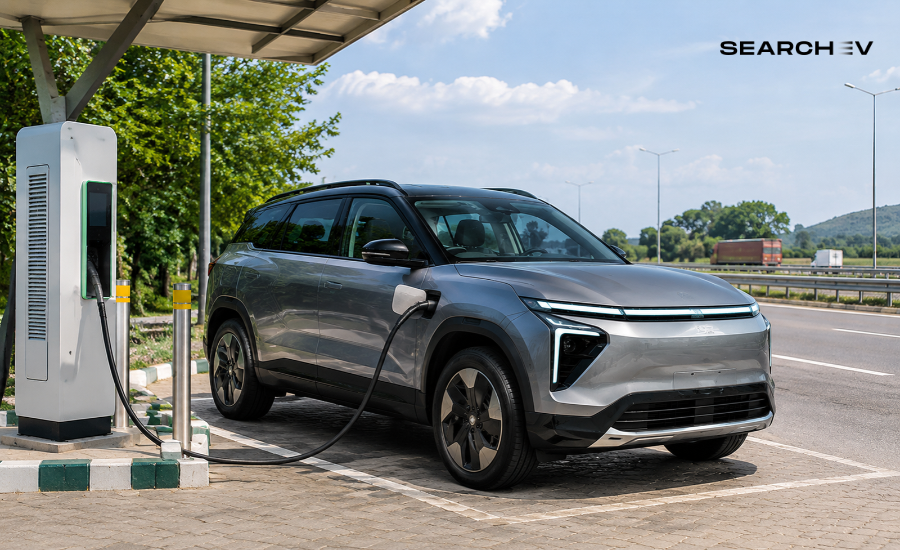
While you cannot change your electric vehicle’s battery capacity, you can make a few changes to get better efficiency from the available energy.
Here are some practical tips:
- Maintain a steady speed: Avoid unnecessary acceleration and maintain a comfortable cruising speed.
- Use Eco mode: Choose an efficiency-focused driving mode when you don’t need maximum acceleration.
- Check tyre pressure: Keep tyres inflated according to the manufacturer’s recommendations.
- Use AC efficiently: Set a comfortable temperature instead of continuously running the cooling system at maximum power.
- Avoid unnecessary weight: Remove luggage and accessories that you don’t need.
- Use regenerative braking: Understand your vehicle’s regeneration settings and use them appropriately.
- Plan your route: Avoid unnecessary detours and plan charging stops before long journeys.
- Maintain your vehicle: Follow the manufacturer’s battery, tyre and software maintenance recommendations.
These steps can help you use battery energy more efficiently and make everyday EV ownership more predictable.
Should You Trust the Claimed Range While Buying an Electric Car?
Claimed range is useful, but it should never be the only factor influencing your purchase decision.
For example, an electric car offering 450 km of claimed range may be a better option for your requirements than another model advertising 550 km if the first vehicle has better real-world efficiency, faster charging and stronger service support.
Before purchasing an EV, consider the following:
Check independent range tests: Look for road tests that measure actual driving distance rather than relying only on manufacturer figures.
Compare battery capacity: A larger battery can store more energy, but vehicle efficiency also matters.
Understand your daily commute: If you travel 40–50 km daily, you may not need an electric car with a 600 km claimed range.
Check charging infrastructure: Look for compatible charging stations around your home, workplace and regular travel routes.
Consider battery warranty: Understand the warranty period, kilometre limit and battery capacity-retention conditions.
Compare charging speeds: A vehicle with good DC fast-charging capability can be more convenient for long-distance journeys.
You can also explore our guides to 400 km range electric cars in India, 500 km range electric cars in India and 700 km range electric cars in India to compare models based on their claimed driving range.
Frequently Asked Questions
1. What is the difference between claimed range and real-world EV range?
Claimed range is the distance an electric vehicle is certified to cover under a prescribed testing procedure. Real-world range is the actual distance it can travel under everyday driving conditions, including traffic, air-conditioning, road conditions and different driving speeds.
2. Why do electric cars deliver less range than advertised?
Electric cars may deliver less range than advertised because certification tests use standardised conditions, whereas real-world driving involves changing speeds, weather, passenger loads, road gradients and air-conditioning usage. These factors can increase battery consumption.
3. What is ARAI range in an electric car?
ARAI range refers to the certified driving range determined through the applicable vehicle testing and homologation process. In India, manufacturers commonly quote range figures associated with the Modified Indian Driving Cycle (MIDC).
4. Is MIDC range the same as real-world range?
No. MIDC range is obtained through a standardised test procedure, while real-world range depends on actual driving conditions. Therefore, the distance covered in everyday use can differ from the certified figure.
5. What is a good real-world range for an electric car in India?
It depends on how you use the vehicle. For daily city commuting, a dependable real-world range of 150–250 km may be sufficient for many buyers. People who regularly travel between cities may prefer vehicles delivering 300–400 km or more in real-world conditions.
6. Does highway driving reduce electric car range?
Highway driving at higher speeds can reduce EV range because aerodynamic resistance increases with speed. However, the exact difference depends on the vehicle, cruising speed, weather and road conditions.
7. Does using AC reduce EV battery range?
Yes. Air-conditioning consumes electricity from the vehicle’s battery. Continuous cooling, particularly in hot weather, can reduce the distance available on a full charge.
8. Which electric car has the closest real-world range to its claimed range?
The difference varies depending on the model and test conditions. In Autocar India’s published testing, the MG Windsor EV 38 kWh covered 308 km against its 332 km claimed range, while the Hyundai Creta Electric covered 432 km against 473 km. These are specific test results, not guarantees for every owner.
9. How can I calculate the real-world range of my electric car?
You can calculate your vehicle’s actual efficiency by dividing the distance travelled by the battery energy consumed.
For example, if your EV covers 200 km while consuming 30 kWh, its efficiency is approximately 6.67 km/kWh.
You can then multiply this efficiency by the usable battery capacity to estimate the range under similar driving conditions.
10. Does battery degradation affect real-world EV range?
Yes. As an electric vehicle’s battery ages, its ability to store energy may gradually decrease. This can reduce the distance it covers on a full charge. The extent of degradation depends on battery chemistry, temperature, charging habits and vehicle usage.
Final Thoughts
The difference between claimed and real-world EV range is something every electric vehicle buyer should understand before making a purchase.
A manufacturer’s certified range provides a useful benchmark for comparing electric vehicles, but it doesn’t always represent the distance you will cover during everyday driving. Factors such as speed, air-conditioning, traffic, temperature and driving behaviour can all influence battery consumption.
Instead of choosing an electric car based only on the highest advertised range, look at independent road tests, owner experiences, battery capacity, charging speed and your actual daily driving requirements.
As electric vehicle technology continues to improve, battery efficiency and range are getting better. But knowing what to expect from a vehicle in real-world conditions will help you make a more informed buying decision.