Quick Reads
- Offered with two battery packs (38.5 kWh and 55 kWh), delivering a maximum claimed range of up to 440 kilometres.
- Debuts Skoda’s ‘Modern Solid’ design language on a compact 4.17-metre footprint.
- The Epiq could be Skoda’s volume-driver model for India in the electric space.
The Compact Skoda EV
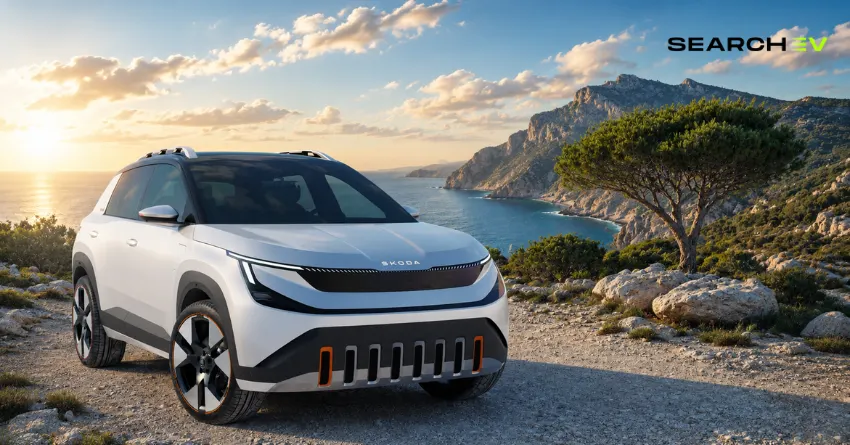
Built on the Volkswagen Group’s dedicated MEB+ electric skateboard platform, the Skoda Epiq measures just 4,171 mm in length. Despite the compact urban footprint, the dedicated EV architecture allows for an aggressively pushed-out wheelbase of 2,601 mm. This translates to a decently spacious cabin, including 475 litres of cargo space and an additional 25-litre front storage compartment (frunk).
The Epiq serves as the production pioneer for Skoda’s new ‘Modern Solid’ design philosophy. It abandons the traditional grille in favour of a glossy black ‘Tech-Deck Face’ that discreetly houses the vehicle’s ADAS radars and sensors. Minimalist T-shaped LED lighting signatures, active cooling shutters, and aerodynamic wheels help the SUV achieve a highly efficient drag coefficient of 0.275.
Under the floorboard, the Epiq caters to varying commuting needs with two battery options. The entry-level variants utilise a 38.5 kWh pack producing either 85 kW (114 bhp) in the Epiq 35 or 99 kW (133 bhp) in the Epiq 40, delivering a claimed range of 310 kilometres. The flagship Epiq 55 steps up to a 55 kWh battery and a 208 bhp front-mounted motor, pushing the maximum range to 440 km. When plugged into a capable DC fast charger, the larger battery can be replenished from 10 to 80% in roughly 24 minutes.
Inside, a massive 13-inch Android-based infotainment screen handles primary connectivity, but Skoda has wisely retained a row of physical buttons on the center console for crucial climate and driving functions.
The Global Lineup: Where Does the Epiq Fit?
To understand the Epiq’s significance, one must look at Skoda’s broader global electric portfolio. The brand currently relies on the Enyaq, a large, premium family SUV offering cavernous space and long-distance touring capabilities. Below that sits the recently introduced Elroq, a mid-size compact SUV designed as an electric alternative to the Karoq.
The Epiq completes the lower end of this tier. It is strictly positioned as the brand’s entry-level, most affordable crossover. The Epiq is engineered primarily for congested city environments where a tight turning circle and easy parking are paramount, without sacrificing the elevated driving position of an SUV.
Bottom Line: Indian Possibility? (The Kylaq Effect)
For the Indian automotive market, the global unveiling of the Epiq carries immense strategic weight. Historically, Skoda India operated in a premium niche. However, the recent introduction of the aggressively priced, sub-4-meter Kylaq SUV proved that the automaker is now focused on driving volume with heavily localised, accessible products.
The Epiq represents the exact formula required to replicate the Kylaq’s strategy in the electric vehicle space. As the Indian market rapidly shifts toward high-riding, compact EVs, a localised version of the Epiq would place Skoda directly in the crosshairs of compact EVs like the Hyundai Creta EV, the Maruti Suzuki eVitara, and the Tata Curvv EV.
If Skoda can leverage its Indian manufacturing facilities to heavily localise the MEB platform components and battery packs, we estimate the Epiq could launch in the subcontinent at a highly disruptive price point of around Rs 20 lakh.