Fresh off the nationwide dealership rollout of the e-Vitara, Maruti Suzuki is wasting absolutely no time expanding its zero-emission portfolio. In a clear signal of its aggressive “Vision 3.0” electrification strategy, a heavily camouflaged test mule of the automaker’s upcoming three-row electric vehicle, which is internally codenamed the YMC, has been spotted undergoing road tests in India.
For the nation’s largest carmaker, the MPV segment has historically been an impenetrable fortress dominated by the Ertiga in the budget segment. Now, Maruti Suzuki is preparing to translate that multi-row dominance into the electric era, engineering a dedicated 7-seater electric family hauler aimed directly at the competitive sub-Rs 25 lakh bracket.
Maruti YMC EV: Design and Road Presence
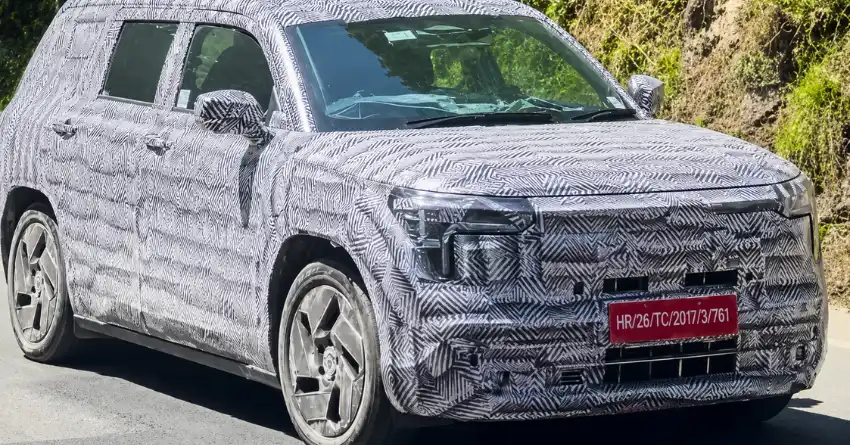
While the test mule is heavily wrapped, the spy images give away several crucial details. Measuring nearly 4.5 metres in length, the YMC carries a more boxy silhouette designed entirely to maximise third-row headroom.
The front fascia appears to feature a closed-off grille flanked by distinct L-shaped LED headlamps and a chunky lower bumper with functional air intakes, likely to channel cooling to the floor-mounted battery pack. In profile, the vehicle rides on large, aero-optimised alloy wheels strikingly similar to those seen on the e-Vitara.
A distinctly large rear-quarter glass area confirms the three-row seating configuration. At the rear, the MPV features a completely upright tailgate, slim L-shaped taillights that wrap around the rear windscreen, and, naturally, the absence of a tailpipe.
Interestingly, recent footage suggests the vehicle employs regular pull-type door handles and a manually operated tailgate rather than a powered unit, hinting at Maruti’s strategy to keep production costs strictly in check.
The Skateboard Architecture and Battery Tech
Powertrain-wise, the YMC is heavily related to the e-Vitara. So, the Maruti three-row EV will not only use the exact same dedicated EV architecture, but it will also likely borrow the e-Vitara’s battery configurations: a 49 kWh Lithium Iron-Phosphate (LFP) pack for the entry-level variants and a larger 61.1 kWh unit for the top-tier trims. However, given the larger footprint, three-row layout, and increased kerb weight of the YMC, the maximum ARAI-claimed range is expected to drop slightly below the e-Vitara’s 543 km figure.
Maruti Suzuki YMC Rivals
The most direct and formidable challenger to the Maruti electric MPV will be the Kia Carens Clavis EV. The Kia comes with a 51.4 kWh battery pack (a bigger battery on upper trims), claiming a 490 km range, and boasts a tech-heavy cabin featuring twin 12.25-inch displays, a panoramic sunroof, and ventilated seats.
Maruti’s trump card will be leveraging its massive service network and potentially undercutting the Kia on the entry-level pricing front.
Beyond the Kia, the Maruti three-row EV will also have to fend off aggressive new entrants like the disruptive VinFast VF MPV 7, the premium BYD eMax 7, and the Mahindra XEV 9S.
Maruti Suzuki Upcoming Electric Three Row MPV Launch Date
Expected to make its global debut towards the tail-end of 2026, the YMC MPV will be manufactured at Maruti Suzuki’s cutting-edge facility in Gujarat. Crucially, as part of the ongoing global alliance, this platform will also spawn a Toyota-badged derivative shortly after its launch, giving buyers an alternative front-fascia and service experience.