Most buyers either gloss over it or assume it’s just fancy marketing for a reversing camera. It isn’t. ADAS — Advanced Driver Assistance Systems — is one of the most important things to understand before you buy an electric vehicle. Not because it makes your car autonomous, but because it quietly makes every drive safer, and in an EV, it works better than in almost any other type of vehicle.
Here’s exactly what it is, how it works, and what to look for.
What ADAS Actually Is
ADAS is an umbrella term for a collection of technologies designed to help you drive more safely. Think of it as a co-pilot that never gets distracted, never blinks, and reacts in milliseconds.
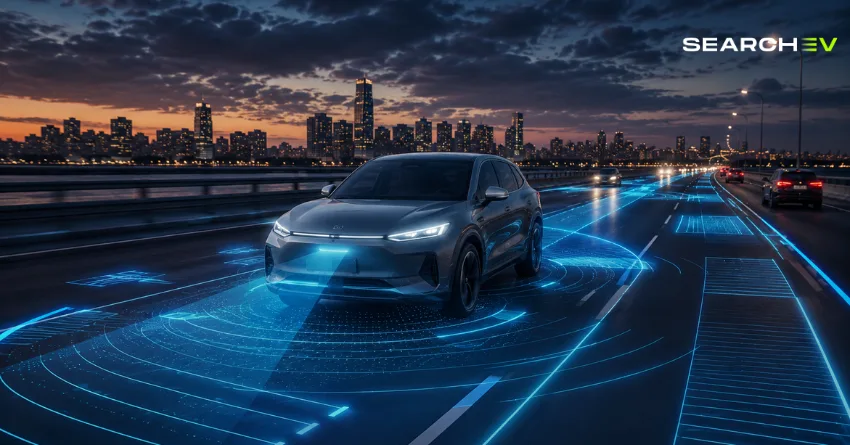
These systems use a combination of cameras, radar sensors, ultrasonic sensors, and sometimes LiDAR — all constantly feeding data to an onboard computer. That computer reads the road around your car and either warns you when something’s wrong, or steps in and acts before you can. The key word is “assistance.” ADAS is not self-driving. It does not replace you. It works with you.
The Features You’ll Actually Use
ADAS covers a wide range of functions. Some are already standard on most EVs. Others are premium add-ons. Here’s what each one does in plain terms:
Automatic Emergency Braking (AEB) — The car detects an imminent collision and brakes on its own if you don’t react in time. This is the most critical safety feature in modern vehicles, and it’s increasingly mandatory in most markets.
Adaptive Cruise Control (ACC) — Unlike regular cruise control, this one watches the car in front and adjusts your speed automatically to maintain a safe following distance. On a long highway drive, this alone significantly reduces fatigue.
Lane Keeping Assist (LKA) — If you start drifting out of your lane without signalling, the car gently steers you back or alerts you with a warning. Useful for those moments of micro-distraction on a straight road.
Blind Spot Monitoring (BSM) — Sensors on the sides of the car detect vehicles in your blind spots and alert you before you change lanes into one.
Rear Cross-Traffic Alert — When reversing out of a parking spot, this detects vehicles approaching from the sides — the ones your mirrors simply can’t show you.
Traffic Sign Recognition — Cameras read speed limit signs and display them on your dashboard, so you’re never guessing what the limit is after missing a sign.
Driver Drowsiness Detection — Monitors your steering patterns and alerts you to take a break if it detects fatigue. Simple idea, genuinely life-saving on long drives.
Why EVs Are Particularly Good at ADAS
This is the part most EV buying guides miss entirely.
Electric powertrains give ADAS systems a significant hardware advantage. Because an electric motor responds near-instantly to inputs — no combustion lag, no gear changes — the car can execute ADAS commands far more precisely and quickly than a petrol or diesel vehicle can.
When an AEB system decides to brake, that command travels to the motor in milliseconds and the car responds immediately. The same reaction in a combustion car involves more mechanical steps and slightly more latency. In an emergency, those milliseconds matter.
The synergy between ADAS and EVs is particularly compelling because electric powertrains allow for more precise control of vehicle dynamics, which directly enhances the effectiveness of driver-assistance features.
EVs also tend to be built on purpose-designed platforms — not converted from existing petrol cars — which means sensor placement, computing power, and software integration are often better thought out from the ground up.
The Levels of Autonomy: What They Mean for You
You’ll often see EVs advertised as “Level 2” or “Level 2+” autonomous. These levels are defined by the Society of Automotive Engineers (SAE), and understanding them stops you from having unrealistic expectations.
The SAE defines six levels of autonomy, with Level 0 being no automation at all, where the driver handles everything, through to full self-driving at Level 5.
Most vehicles on the market today sit at Level 1 or Level 2, while Levels 3 through 5 are still in development and testing phases.
What does that mean practically? Any ADAS feature available on public roads today still requires your full attention — no naps, no Netflix. The car assists; you remain responsible.
The difference between Level 2 and Level 2+ is that Level 2+ includes additional capabilities like automated lane changing, but the driver is still fully in control.
What to Check Before You Buy
Not all ADAS packages are equal. Here’s a quick checklist for your test drive and spec research:
- Does the base trim include AEB, or is it an optional extra?
- Is Adaptive Cruise Control standard, or does it only come on higher trims?
- Does the system use cameras only, or cameras combined with radar? (Radar-based systems perform more reliably in rain and low visibility.)
- Can the ADAS features be updated over the air as the software improves?
That last point is where EVs pull ahead again. Software-defined vehicles — which most modern EVs are — can receive ADAS improvements through OTA (over-the-air) updates, meaning the car you buy today can become meaningfully safer over time without a trip to the service centre.
The Bottom Line
ADAS is not a gimmick and it’s not a checkbox feature. It’s a genuine safety net — one that works quietly in the background and only makes itself known when something is about to go wrong.
For a first-time EV buyer, understanding which ADAS features come standard and which require an upgrade is as important as checking the range or the charging speed. Because the best EV isn’t just the one that goes the furthest — it’s the one that keeps you and everyone around you safer every single day.
Stay on top of every EV technology development as it happens — SearchEV covers the technology that’s actually moving the needle.