Every EV buyer asks the same thing: “Yes, but how far will it actually go?” The brochure says one number, your friend’s car shows another, and the dashboard changes every ten minutes. Good news: you don’t need a fancy tool. An EV range calculator is just two numbers multiplied together, and once you understand them you can check any claim yourself.
The basic formula
Range (km) = Usable battery (kWh) × Efficiency (km/kWh)
If you see efficiency as Wh/km instead (many Indian spec sheets do), flip it:
Range (km) = Usable battery (kWh) × 1000 ÷ Efficiency (Wh/km)
Two things trip people up. First, use the usable battery, not the gross number, if the maker publishes both. Second, efficiency is not fixed. It changes with how and where you drive, which is the whole reason real range differs from claimed range.
Worked examples
Example 1: Hyundai Creta Electric (51.4 kWh) At a mixed-driving efficiency of about 8.4 km/kWh: 51.4 × 8.4 ≈ 432 km. Drive it in the city at roughly 9.45 km/kWh and you get about 486 km. On the highway at roughly 7.36 km/kWh, it drops to about 378 km. Same car, same battery, a 100 km swing. That is the effect of driving style.
Example 2: Tata Nexon EV Max (38 kWh) At 135 Wh/km: 38 × 1000 ÷ 135 ≈ 281 km. That sits well below the claimed figure, which is exactly the gap this article is about.
Example 3: Bajaj Chetak C2501 (2.5 kWh) Its claimed range is 84 km, which works out to about 34 km per kWh. A real rider doing a bit more than that in traffic will land lower. Plug in your own number: 2.5 × 28 = 70 km.
Quick battery × efficiency table
| Battery | At 6 km/kWh | At 7 km/kWh | At 8 km/kWh | At 9 km/kWh |
| 30 kWh | 180 km | 210 km | 240 km | 270 km |
| 40 kWh | 240 km | 280 km | 320 km | 360 km |
| 50 kWh | 300 km | 350 km | 400 km | 450 km |
| 60 kWh | 360 km | 420 km | 480 km | 540 km |
| 75 kWh | 450 km | 525 km | 600 km | 675 km |
For scooters and bikes, efficiency is higher per kWh, usually 25 to 35 km/kWh for scooters, so a 3 kWh scooter lands somewhere between 75 and 105 km.
Claimed vs real range
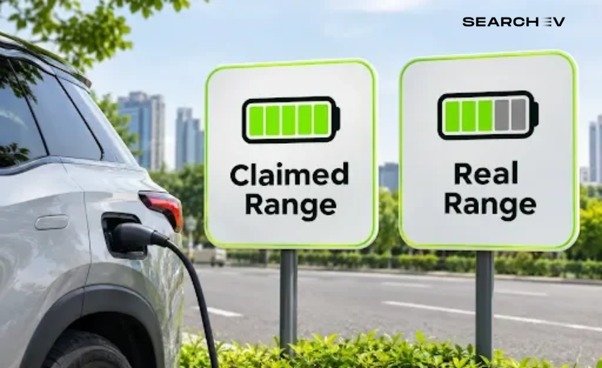
In India, claimed range comes from the ARAI/MIDC test (some brands quote IDC or their own certified figures). It is run under controlled conditions: steady, low speeds, no AC, no wind, no hills. Real roads are none of those.
In the road tests and estimates we looked at, real-world range came to about 74 to 80% of the claim. That is a handy rule of thumb:
Real range ≈ Claimed range × 0.75 to 0.85
Use 0.75 if you drive fast on highways or live somewhere hot. Use 0.85 if you mostly crawl around the city and drive gently.
What cuts your range
| Factor | What happens | What you can do |
| Speed | Air resistance rises sharply above about 80 km/h, so highway cruising eats range fast | Hold 80 to 90 km/h instead of 110 |
| AC | Adds a steady load, bigger on short city trips | Use it, but pre-cool while plugged in |
| Heat and cold | Extreme temperatures make the battery less efficient | Park in shade, avoid charging in peak heat |
| Load | Four adults plus luggage is a real extra weight | Take only what you need |
| Terrain | Climbs drain, descents give some back through regen | Use regen on downhill stretches |
| Rain and monsoon | Wet roads add rolling resistance and wipers and demisters add load | Expect a small dip |
| Tyre pressure | Low pressure raises rolling resistance | Check it every couple of weeks |
(The monsoon point comes from a single source, so treat it as a rough guide rather than a measured number.)
How much range do you actually need?
Don’t buy the biggest battery by default. Do this instead:
- Note your longest regular day, in km.
- Divide by 0.75 to allow for real conditions.
- Add a 20% buffer so you never arrive on 2%.
Example: a 60 km daily commute. 60 ÷ 0.75 = 80 km, plus 20% is about 96 km. A scooter with a claimed range of 110 to 120 km is plenty. For a car doing 150 km a day, you want a real range near 225 km, so a claimed range of 300 km or more.
Want it faster? Use this shortcut
If you already know the claimed range, skip the battery maths:
- Highway-heavy driver: claimed × 0.75
- Mixed driver: claimed × 0.80
- City, gentle driver: claimed × 0.85
This won’t be exact, but it will be much closer than trusting the brochure.
Conclusion
An EV range calculator is only two numbers. Take your battery size, take a realistic efficiency, multiply, and then trim a little for real roads. Do that for any car or scooter you are considering and you’ll never be surprised at the dashboard again. If you want ready-made numbers, see our guides on 400 km range electric cars and long range electric cars in India, or check how scooters compare in our Chetak and Ather range guides.
FAQ
- How do I calculate EV range?
Multiply usable battery capacity in kWh by efficiency in km per kWh. If you have Wh/km, divide battery Wh by that number.
- How accurate are claimed ranges?
They are lab figures. Expect roughly 70 to 90% of the claim in daily use, and lower at highway speeds.
- Does AC reduce range?
Yes, by a small amount in most cases, more on short, slow trips in heavy heat. Pre-cooling the car while it is plugged in helps.
- Is a bigger battery always better?
Not always. It costs more and weighs more. Size it to your real daily distance plus a buffer.
- How do I find my own car’s efficiency?
Reset the trip meter after a full charge, drive normally, then divide the km driven by the kWh the car reports (or the kWh added at the next full charge).