Picture this. You wake up, make your morning chai, walk to your car — and your EV has a new feature you didn’t have yesterday. Better range. Sharper regenerative braking response. Maybe even a tweak to how your cruise control behaves. Nobody came to your house. You didn’t visit a service centre. It just happened overnight.
That’s OTA. And if you’re buying an EV in 2026, understanding it is just as important as understanding the battery range or the charging speed.
OTA Stands For Over-the-Air — Here’s What That Means
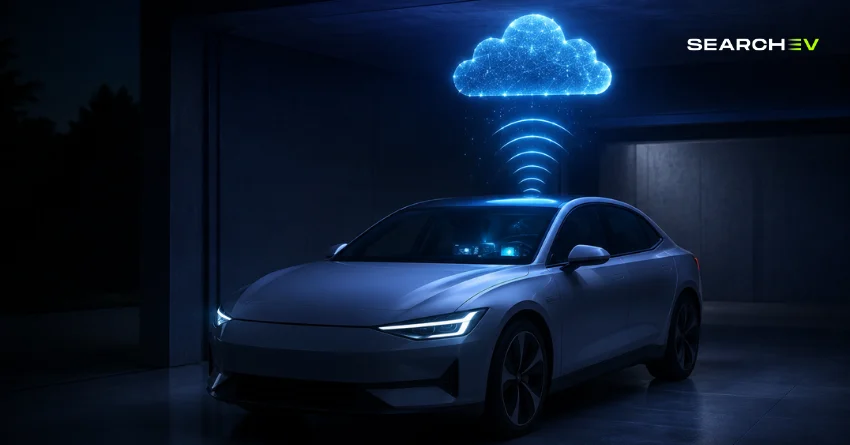
OTA is short for Over-the-Air. It refers to the process of sending software updates directly to your vehicle through a wireless internet connection — the same way your phone downloads a new version of its operating system while it sits on your nightstand.
Your EV has an onboard communication module — think of it as a SIM card embedded in the car — that keeps it connected to the manufacturer’s servers through 4G, 5G, or your home Wi-Fi. When an update is ready, the car downloads it in the background and installs it when you’re not using the vehicle.
You get a notification. You approve it. It runs overnight. You wake up to a slightly better car.
No appointment. No waiting room. No service centre.
What Can an OTA Update Actually Change?
This is where most people are surprised. OTA updates aren’t just for fixing a glitchy touchscreen. Depending on how advanced the car’s software architecture is, an update can touch nearly every system in the vehicle.
There are two types that matter:
SOTA — Software Over-the-Air. This covers the infotainment system, navigation maps, in-car apps, the user interface, and connected services. Most EVs with OTA capability can do this at minimum.
FOTA — Firmware Over-the-Air. This goes deeper. It can update the systems controlling the battery management, ADAS features, regenerative braking, charging curves, and in some cases, the drivetrain itself. This is the more powerful category — and not every manufacturer offers it.
Real examples of what OTA has already delivered to EV owners:
- Tesla pushed a software update that unlocked additional horsepower on the Model 3 Performance — for free, to existing owners.
- Volkswagen’s ID.4 received OTA updates that improved infotainment responsiveness and battery performance post-purchase.
- Jaguar used OTA to improve battery efficiency on the I-PACE without owners ever visiting a dealer.
New AI and machine learning algorithms can also be introduced via OTA to improve features like adaptive cruise control, collision detection, or battery management in electric vehicles. The car you buy today can genuinely become more capable two years from now — without new hardware.
How It Works Under the Hood
You don’t need to understand the technical layers to benefit from OTA, but a rough picture helps you trust the process.
When a manufacturer develops an update, it goes through extensive lab testing and a staged rollout — first to a small percentage of cars in the fleet, then gradually to everyone. This controlled approach catches problems before they reach millions of vehicles.
Once approved, the update package is encrypted and signed digitally. Your car verifies that the package is genuinely from the manufacturer before it installs anything. There are also rollback mechanisms built in — if something goes wrong during installation, the car automatically reverts to the previous stable version. Critical systems like steering and braking remain isolated throughout, so they’re never at risk during an update.
The update itself typically takes 20 to 45 minutes and is designed to run while the car is parked. Most manufacturers let you schedule it so it never catches you off guard.
Not All OTA Is Created Equal
This part matters when you’re comparing EVs before a purchase.
A window sticker or spec sheet that says “OTA capable” doesn’t tell you the whole story. The question worth asking is: what exactly can be updated?
Some EVs — particularly older models or those converted from existing petrol platforms — offer OTA only for the infotainment and navigation systems. Important updates to the battery management or safety systems still require a dealer visit on these cars.
Others, built on purpose-designed EV platforms from the ground up, offer full FOTA capability. Tesla, Rivian, Lucid, Polestar, and newer models from Hyundai, Kia, BMW, and Mercedes have all embraced deeper OTA integration. The EV’s software platform — not just its hardware — is part of what you’re buying.
When test-driving or researching a used EV, it’s worth checking: when was the last update installed? A car that hasn’t received an update in several months may have been sitting offline, which is worth flagging.
Why It Matters for Resale Value Too
One angle that doesn’t get discussed enough — OTA updates directly affect what your EV is worth when you sell it.
A vehicle that has received consistent software upgrades and security patches retains value better than one that hasn’t. A buyer looking at your three-year-old EV knows it’s running current software, not the version that shipped from the factory. That’s a meaningful advantage in the used market that petrol cars simply don’t have.
Your car keeps improving. And a car that keeps improving holds its value better.
The Bottom Line
OTA updates are one of the most underappreciated advantages of owning an electric vehicle. They turn your car from a static product into an evolving platform — one that gets patched, improved, and occasionally upgraded just by being parked in your garage overnight.
When you’re comparing EVs, don’t just ask how far it goes on a charge. Ask how deep the OTA support goes. Because the best EV isn’t only the one that performs well on day one. It’s the one that’s still getting better on day one thousand.
Stay on top of every EV technology development as it happens — SearchEV covers the technology that’s actually moving the needle.