On 13th May, the Bihar government officially approved the heavily revised Bihar Electric Vehicle (Amendment) Policy 2026. In the cabinet meeting conducted by the Bihar Chief Minister, Samrat Choudhary, the government decided to adopt suggestions that would lead to increased use of electric vehicles despite significant automotive hubs such as Delhi and Karnataka withdrawing tax benefits for electric vehicles.
Working under the ambit of “Mukhyamantri Bihar Paryavaran Anukul Parivahan Rozgar Yojana (Chief Minister Bihar Environment-Friendly Transport Employment Scheme)”, the government has allocated a special fund worth Rs 110 crore to drive mass adoption of electric vehicles during the fiscal year 2026-27. The long-term target that the state is setting is an aggressive 30% EV penetration rate in all new vehicle registrations across the state by 2030.
The Game Changer: A Rs 1 Lakh Discount for Women
The headlining element of the 2026 amendment is its razor-sharp focus on female vehicle ownership. While other states typically offer flat subsidies based on battery capacity or vehicle category, Bihar is using direct financial incentives to put women behind the wheel.
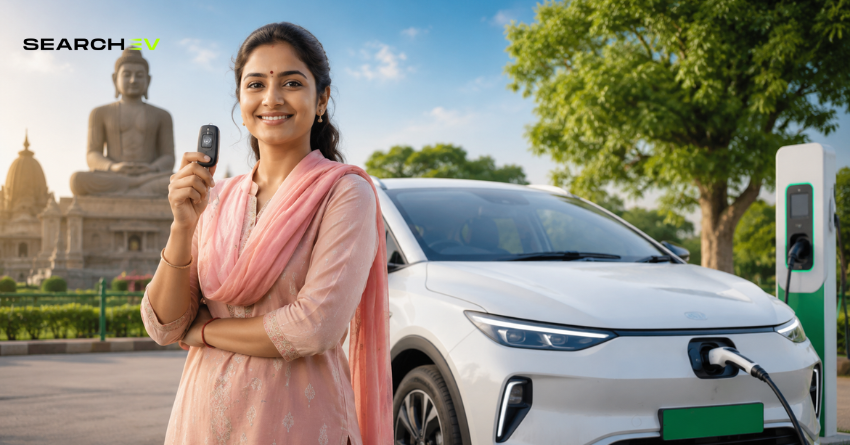
Under the new framework, any woman purchasing and registering a non-commercial electric four-wheeler in her name will receive a massive direct subsidy of Rs 1 lakh through Direct Benefit Transfer (DBT). For a price-sensitive market like India, this effectively slashes the upfront price of many entry-level urban EVs like the MG Comet or Tata Tiago EV, making them much more affordable to own, presenting the value proposition against traditional petrol hatchbacks as more attractive.
The two-wheeler and commercial utility segments have also been heavily subsidised to boost both personal mobility and rural logistics:
- Electric Two-Wheelers: Women buyers and SC/ST beneficiaries will receive a Rs 12,000 subsidy, while general category buyers get a flat Rs 10,000.
- Electric Cargo Three-Wheelers: Designed to boost last-mile delivery logistics and self-employment, general category buyers will receive up to Rs 50,000, while SC/ST buyers get an enhanced Rs 60,000 subsidy.
Bihar EV Policy 2026: Tax Waivers and The Charging Infrastructure Push
The updated Bihar EV Policy is attempting to address the EV adoption problem holistically.
Helping the reduction of the overall on-road cost of the vehicle is a 50% exemption on motor vehicle tax for all electric vehicles registered in Bihar. Furthermore, buyers can stack these benefits with additional incentives linked to the central government’s vehicle scrappage policy.
To ensure these vehicles actually have places to plug in, financial assistance for establishing public EV charging stations has been heavily prioritised in the state budget. State transport officials confirmed they will actively seek grants under the Ministry of Heavy Industries’ newly implemented PM E-DRIVE scheme to rapidly expand charging infrastructure across both urban centres and crucial rural corridors.
Automotive analysts point out that Bihar’s approach is currently one of the most uniquely structured state EV policies in the country. By explicitly linking aggressive financial incentives to women’s mobility and commercial cargo transport, the government isn’t just trying to sell cars to early adopters; it is trying to generate grassroots self-employment while modernising rural transport.
State transport officials estimate that if the 30% EV adoption target is met by 2030, Bihar will save approximately 10 crore litres of petrol and diesel annually. For a state actively grappling with rising fuel transport costs and urban air quality issues, this 2026 policy revision is a calculated, aggressive step toward a cleaner transport ecosystem.