Electric two-wheelers are becoming an interesting option for businesses that depend on regular local deliveries. From food orders and grocery runs to pharmacy supplies, courier parcels and small retail distribution, delivery riders spend a significant part of their working day on the road.
For these riders, choosing an electric vehicle is not just about saving money on fuel. The vehicle needs to carry goods comfortably, handle repeated stops, cover the required daily distance and remain dependable throughout working hours.
That is why a regular electric scooter and a purpose-built delivery scooter are not necessarily the same thing. A commuter scooter may be suitable for carrying a small delivery bag, but a commercial electric scooter or utility moped is designed with load-carrying requirements in mind.
In this guide, we look at electric delivery scooters and bikes in India, the models worth considering, their practical specifications and what businesses should check before purchasing one.
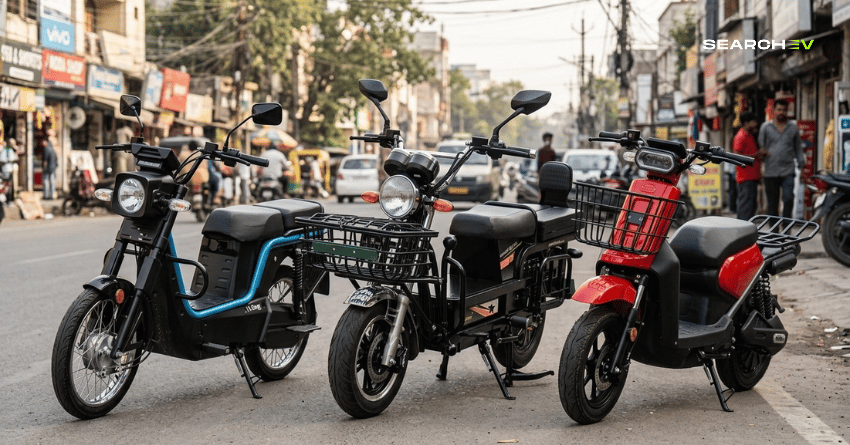
Best Electric Delivery Scooters in India: Quick Comparison
| Model | Approximate price | Claimed range | Load capacity |
| Kinetic Green E-Luna | ₹69,990–₹89,990 | 110–140 km, depending on variant | Up to 150 kg |
| Komaki CAT 2.0 | Variant-dependent; manufacturer listings start around ₹82,499 | Varies by battery variant | Manufacturer claims up to 350 kg |
| HCD India NPS Quick | ₹80,850 + GST in Delhi NCR; Karnataka listing from ₹89,999 + GST | 65–70 km single battery; 130–140 km dual battery | Up to 200 kg |
Prices and specifications are indicative and may vary by variant, location and dealer. Some manufacturers publish different figures across battery configurations. Confirm the exact vehicle’s approved load capacity, price and availability before purchase.
1. Kinetic Green E-Luna
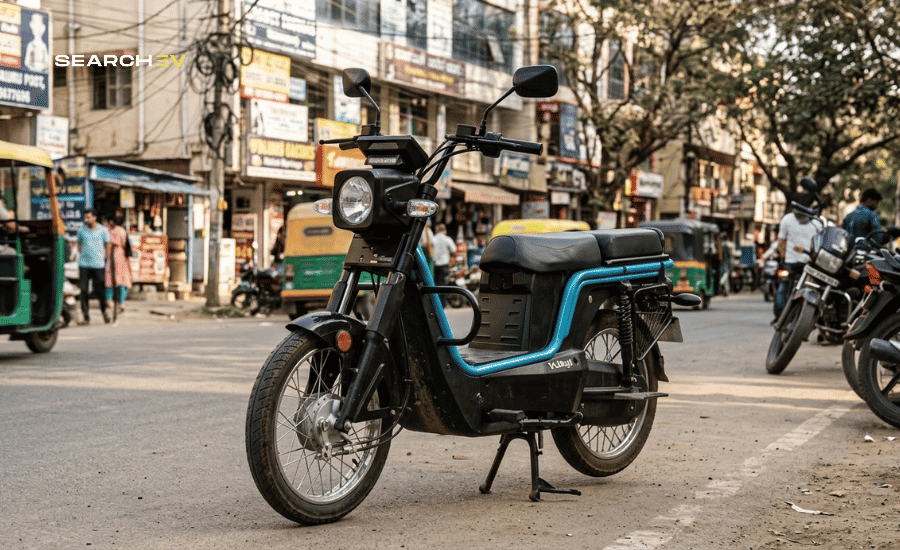
The Kinetic Green E-Luna is one of the more practical electric two-wheelers to consider for small businesses and delivery riders.
Unlike a conventional family scooter, the E-Luna follows a utility-moped design. Its straightforward construction, practical seating arrangement and detachable-seat functionality make it easier to adapt for carrying everyday goods.
The E-Luna is available in multiple variants, with prices starting at ₹69,990 and going up to ₹89,990. Depending on the version, the claimed range is between 110 km and 140 km per charge. The model has a top speed of 50 km/h and a stated payload capacity of up to 150 kg.
The E-Luna Go, for example, uses a 2.3 kWh lithium-ion battery and has a claimed range of 110 km. Kinetic Green lists a charging time of approximately five hours for this version.
For a local grocery store, small business owner or delivery rider covering several neighbourhoods, the E-Luna could offer a useful balance between everyday usability and carrying ability.
However, it is important to distinguish between the vehicle’s total payload rating and the amount of goods you can carry. The rider’s weight and any additional accessories also contribute to the load.
Best suited for: Local deliveries, small business operations, grocery distribution and riders who need a practical electric moped.
2. Komaki CAT 2.0
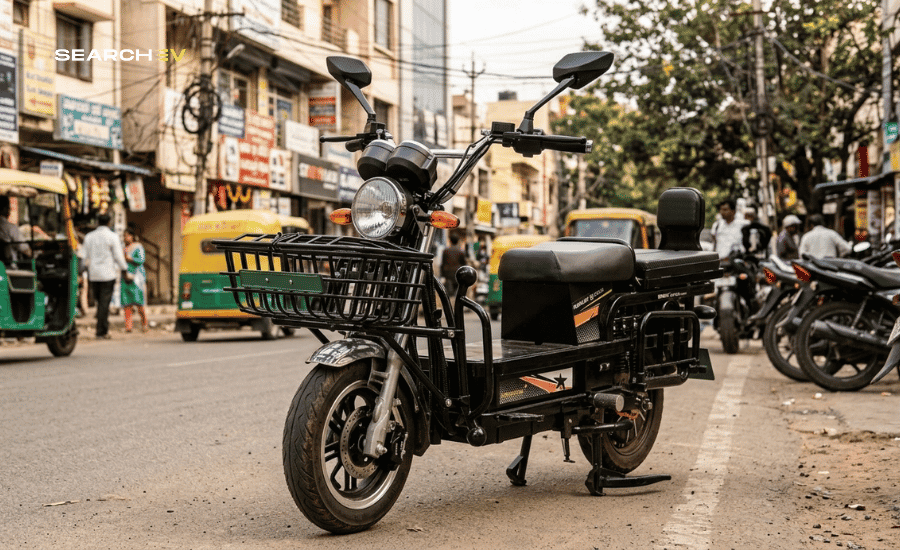
The Komaki CAT 2.0 is more directly positioned towards commercial and utility applications.
Its design focuses on carrying goods rather than providing the conventional styling and features associated with personal electric scooters. Komaki highlights its strong frame, convertible seating arrangement and loading capacity as key features.
One important detail is that the CAT 2.0 is offered in different battery configurations. The manufacturer’s listings show different range and price figures depending on the battery option. Some versions are advertised with a range of around 95–100 km, while others claim approximately 110–140 km or more.
Komaki also advertises a loading capacity of up to 350 kg. This is a manufacturer-stated figure, so commercial buyers should verify the certified payload and the permitted load for the exact variant they intend to purchase. Do not assume every battery configuration or registration category carries the same approved rating.
The CAT 2.0 could be worth evaluating for businesses that need a dedicated cargo-style electric two-wheeler rather than a regular commuter scooter with a delivery box attached.
Before booking, ask the dealer for the exact battery chemistry, range, charging time, warranty, vehicle registration status and approved loading capacity.
Best suited for: Businesses that need a purpose-oriented electric cargo scooter for repeated local deliveries.
3. HCD India NPS Quick
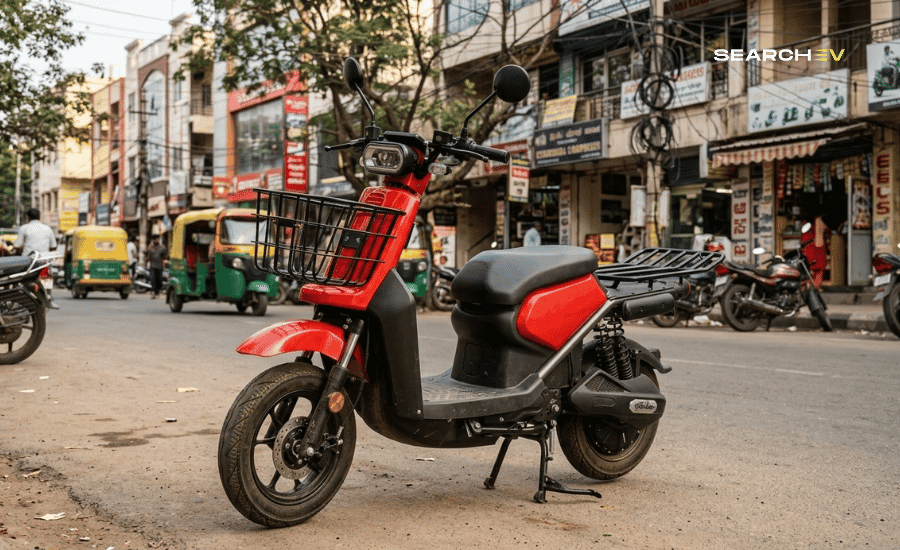
The HCD India NPS Quick is another utility-focused electric two-wheeler designed around carrying goods and supporting delivery operations.
According to HCD India’s product information, the scooter has a stated load capacity of up to 200 kg. It offers a claimed range of 65–70 km with a single battery and 130–140 km with the double-battery configuration.
The model has a listed top speed of 25 km/h and comes with practical features such as a removable battery, external charging capability, a foldable rear seat, a front basket option and additional rear suspension support.
The manufacturer lists the Delhi NCR price at ₹80,850 plus GST and a Karnataka starting price of ₹89,999 plus GST. However, its product page currently displays a sold-out status. Interested buyers should contact HCD India to confirm whether the model is available for a new order.
The double-battery configuration may be useful for businesses that need more distance between charging sessions. However, the actual benefit depends on the route, load and charging arrangement.
Best suited for: Small delivery businesses and operators looking for a utility-focused scooter with a removable-battery option, subject to stock confirmation.
Electric Delivery Scooters vs Regular Electric Scooters
Not every delivery rider needs a dedicated cargo scooter. The right choice depends on the type of goods being transported and the distance covered each day.
A food delivery rider may only need a regular electric scooter with a secure delivery box. A grocery store distributing heavier orders may benefit from a utility moped with a higher payload rating.
Here is how the two categories differ:
| Requirement | Regular electric scooter | Cargo or utility electric scooter |
| Primary use | Personal commuting | Goods and local deliveries |
| Storage | Under-seat boot and accessories | Larger or adaptable cargo area |
| Load carrying | Depends on the vehicle’s approved payload | Often designed around commercial loads |
| Comfort | Usually designed for rider and pillion | Depends on cargo configuration |
| Best use | Food, parcel and light deliveries | Grocery, retail and heavier local deliveries |
If you are considering a conventional electric scooter for delivery work, explore the SearchEV electric scooter listings. You can compare different models by price, range and specifications before deciding whether a regular scooter will meet your requirements.
Can Electric Bikes Be Used for Delivery Work?
Yes. Electric motorcycles can also be used for delivery work, particularly when riders cover longer routes or need a higher-speed vehicle for regular city travel.
However, most electric motorcycles currently sold in India are designed primarily for personal commuting or performance riding rather than carrying commercial loads.
A rider may be able to use a suitable electric motorcycle with an approved delivery box or carrier, but the accessories must not compromise the vehicle’s balance, handling, braking or approved load limits.
For businesses considering this route, it is worth comparing commuter-focused electric motorcycles before making a purchase.
You can explore the SearchEV electric bike listings to see the available models. Our electric bike price guide also provides a broader view of the price and specification differences across the market.
A regular electric motorcycle should not automatically be treated as a cargo vehicle. Always check the manufacturer’s guidance on luggage carriers, accessories and permitted loads.
How Much Can an Electric Delivery Scooter Save?
One of the biggest reasons businesses consider electric delivery vehicles is the potential reduction in daily running costs.
A petrol two-wheeler requires regular fuel purchases, while an electric scooter can be charged using electricity. The difference can become meaningful for a rider covering several kilometres every day.
For example, consider a delivery rider travelling 80 km per day.
Assume the following illustrative figures:
- Petrol scooter mileage: 45 km/l
- Petrol price: ₹100 per litre
- Electric scooter energy consumption: 3 kWh per 100 km
- Electricity price: ₹8 per unit
Estimated petrol cost per day
80 km ÷ 45 km/l × ₹100 = approximately ₹178.
Estimated electric charging cost per day
80 km × 3 kWh ÷ 100 × ₹8 = approximately ₹19.
That gives an estimated difference of around ₹159 per day.
Over 26 working days, the illustrative difference is approximately ₹4,134 per month.
These are example calculations, not guaranteed savings for every vehicle. Actual electricity consumption, charging losses, petrol prices, battery efficiency, maintenance, financing and vehicle downtime can change the result.
For a business operating several delivery vehicles, the savings should be calculated using the actual route distance and vehicle specifications rather than a generic running-cost claim.
What Should Delivery Businesses Check Before Buying?
1. Payload capacity
This should be one of the first specifications you check. A vehicle with a long claimed range is not necessarily suitable for carrying heavy goods.
Ask for the approved payload rating for the exact model and variant. Include the rider, delivery equipment and goods when calculating the total load.
2. Real-world range with cargo
A manufacturer’s range figure is generally not the same as the distance a vehicle will cover while carrying goods through stop-and-go traffic.
Ask for an estimate under a realistic load and route. Ideally, test the vehicle with the kind of cargo your riders will carry.
3. Battery charging and swapping
Consider how the vehicle will be charged during working hours. A removable battery can make charging easier when the vehicle cannot be parked near a charging point.
For businesses operating multiple shifts, check whether spare batteries or a battery-swapping arrangement are practical and supported.
4. Charging time
A vehicle that takes several hours to recharge may be perfectly suitable for a single-shift operation. It may not work as well for a business that needs the same vehicle on the road throughout the day.
Plan charging around delivery schedules and available downtime.
5. Service network and spare parts
A delivery vehicle earns money only when it is operational. A breakdown can affect both delivery commitments and business revenue.
Before purchasing, identify the nearest authorised service centre, ask about spare-part availability and understand the warranty process.
6. Brakes, suspension and tyres
Carrying goods changes how a two-wheeler behaves. Braking distance, stability and suspension performance become especially important.
Do not overload a regular scooter by adding an oversized delivery box or carrier. Use approved accessories and remain within the vehicle’s permitted load rating.
7. Total ownership cost
Compare the purchase price, financing, battery warranty, charging cost, insurance, maintenance and expected downtime.
A slightly more expensive vehicle may be a better business purchase if it offers better support and suits the delivery route more effectively.
Which Electric Delivery Scooter Should You Choose?
The right model depends on the type of delivery business.
- For small local deliveries: The Kinetic Green E-Luna is worth considering for its utility-moped format and stated 150 kg payload.
- For dedicated cargo use: The Komaki CAT 2.0 is worth evaluating, particularly if its approved load rating and battery configuration match your requirements.
- For removable-battery convenience: The HCD India NPS Quick has a removable-battery option, but confirm current availability before shortlisting it.
- For regular parcel or food delivery: A conventional electric scooter may be sufficient if its approved payload, range and storage meet the requirement.
- For longer routes: Consider a suitable registered electric motorcycle, but check its carrying capacity and approved accessories first.
You can shortlist models through SearchEV’s electric scooter listings and electric bike listings. If you are comparing two personal-use models, the SearchEV EV comparison tool can also help.
Final Verdict
Electric delivery scooters and bikes can help businesses reduce their dependence on petrol and manage everyday delivery expenses. But the best vehicle is not necessarily the one with the lowest price or the highest advertised range.
For delivery work, payload capacity, real-world range with cargo, battery charging, braking performance and service support matter more than a long list of features.
The Kinetic Green E-Luna, Komaki CAT 2.0 and HCD India NPS Quick are three utility-focused options worth researching. Their specifications and availability differ, so compare the exact variants and get written confirmation of the approved load capacity before purchasing.
For a business, the real question is simple: will the vehicle complete the daily route, carry the required goods safely and remain reliable enough to earn consistently?
That is the standard an electric delivery vehicle should meet.
Frequently Asked Questions
Which is the best electric scooter for delivery in India?
The right choice depends on the goods being carried and daily distance. The Kinetic Green E-Luna, Komaki CAT 2.0 and HCD India NPS Quick are utility-focused options worth comparing.
Which electric scooter has the highest load capacity for delivery?
Komaki advertises a loading capacity of up to 350 kg for the CAT 2.0. Buyers should verify the certified payload for the exact variant before using that figure for business planning.
Is the Kinetic Green E-Luna suitable for delivery work?
The E-Luna’s utility-moped design, detachable-seat functionality and stated 150 kg payload make it worth considering for local deliveries and small businesses.
How far can an electric delivery scooter travel on one charge?
It depends on the battery configuration, rider weight, cargo, speed and route. Some models advertise ranges above 100 km, but businesses should plan using real-world range under their usual delivery load.
Can I use a regular electric scooter for food delivery?
Yes, provided the vehicle can safely accommodate the rider and delivery equipment within its permitted load capacity. Check the manufacturer’s guidance before installing a delivery box.
Are electric delivery scooters cheaper to run than petrol scooters?
They can have lower energy costs per kilometre, particularly for riders covering substantial daily distances. However, the full calculation should include charging losses, battery replacement, maintenance and financing.
What is more important for a delivery scooter: range or payload?
Both matter, but payload should never be compromised. Choose a vehicle that can legally and safely carry your typical load while completing the required route on a practical real-world range.