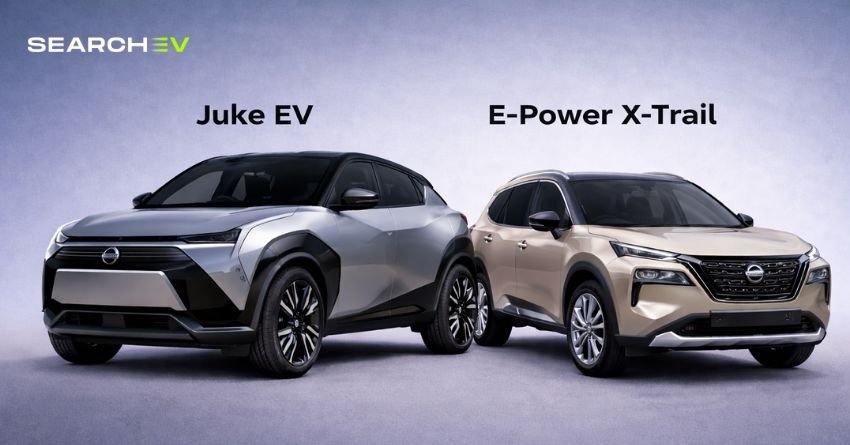
During its recent global Vision Event at its Japanese headquarters, Nissan Motor Corporation mapped out its immediate electrification and hybrid product roadmap, unveiling two SUVs: the all-new Juke EV and a significantly updated X-Trail.
While the launch showcases Nissan’s next-gen styling dynamics, the reveal also hints at the brand’s global powertrain strategy to maintain a balance between pure battery-electric vehicles and e-Power series-hybrid vehicles.
The Juke Enters the Electric Era
The Nissan Juke EV has historically polarised opinions with its unconventional aesthetics. Its third-generation iteration leans even further into that reputation. Drawing heavy inspiration from the recent Hyper Punk concept, the new Juke EV adopts a sharp, polygonal design language characterised by intersecting geometric lines, a blacked-out bonnet, and flush C-pillar door handles.
The Juke EV features the same CMF-EV platform that currently underpins the Leaf. Production will be anchored at the automaker’s Sunderland plant in the United Kingdom, with a scheduled market launch in the spring of 2027.
While exact technical specifications are yet to be revealed to the public, the shared CMF-EV architecture suggests the Juke will likely utilise the 52 kWh and 75 kWh battery configurations. This gives us an estimate on the projected range of these packs, which is expected to be around the 600-kilometer mark (WLTP-rated range). Furthermore, the crossover is confirmed to feature Vehicle-to-Grid (V2G) technology, allowing owners to discharge battery power back into local energy ecosystems.
The Updated X-Trail
The new X-Trail champions Nissan’s unique e-Power hybrid technology.
Rather than functioning as a conventional parallel hybrid, the e-Power system uses an internal combustion engine exclusively as an onboard generator to charge the battery. The wheels are driven entirely by dual electric motors, creating an all-wheel-drive layout that mimics the instant torque delivery of a pure EV without the requirement of plug-in charging.
Visually, the updated X-Trail adopts a more muscular stance. The front fascia integrates a wider, blacked-out V-Motion grille flanked by hexagonal daytime running lights. The cabin is notably updated too, including the integration of a native Google operating system within the NissanConnect infotainment suite. This allows for hands-free Google Assistant commands and native Google Maps navigation, supported by a high-definition 3D Around View Monitor for urban maneuverability.
Nissan’s Broader Electrification Strategy
These two vehicles are a crucial part of Nissan’s overall vehicle portfolio strategy globally. The Juke EV is Nissan’s third electric car, being a part of its electric lineup expansion in key markets, especially the compact EV class in Europe. X-Trail, on the other hand, is an investment in the more proven hybrid tech space, albeit with the innovation of E-power ensuring an EV-like drive experience. This way Nissan is trying to cater different market requirements and buyer preferences.
For Indian consumers, while there is no direct hint from Nissan on bringing any of these cars to our market, Nissan might possibly consider future plans to bring the X-Trail e-Power via a CBU route. However, there is no denying the fact that the CBU strategy had fallen flat with the X-Trail the last time they did.