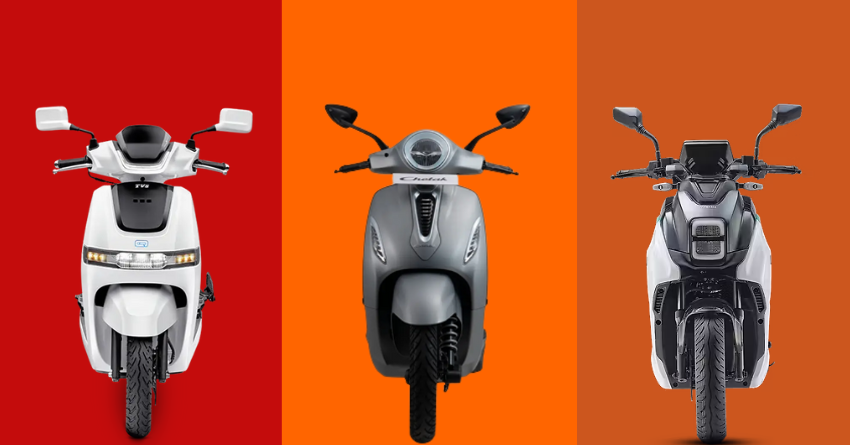
India’s electric scooter space is no longer experimental. It’s competitive, crowded, and getting smarter by the month. At the centre of it all are two familiar rivals: TVS iQube and Bajaj Chetak. Now, with Yamaha EC-06 entering the conversation, it’s worth stepping back and looking at how these three actually compare in everyday terms, not just spec sheets. Let’s break it down.
The Price
Starting with price, because that’s where most buying decisions begin. In Delhi, the TVS iQube starts at ₹96,422 (ex-showroom), so it’s the cheaper option if you’re trying electric for the first time. The Bajaj Chetak begins at ₹1.02 lakh (ex-showroom Delhi), which means you pay a bit more upfront. It doesn’t look like a huge difference, but for many people it matters. TVS keeps the iQube affordable and easy to enter, while Bajaj prices the Chetak higher because it focuses more on how the scooter feels, looks, and rides.
Going by how Yamaha EC-06 is positioned globally,is priced at ₹1.67 lakh if it comes to India, which puts it squarely in premium territory rather than among everyday mass-market scooters. In short, iQube is the budget-friendly gateway, Chetak asks for a little extra, and Yamaha targets riders willing to pay for performance and brand appeal.
The Features
The iQube leans hard into technology. In Delhi, the TVS iQube starts at ₹96,422 (ex-showroom), which makes it the cheaper way to get into an electric scooter. The Bajaj Chetak begins at ₹1,02,498 (ex-showroom Delhi), so you’re paying a little extra right from the start. It may not look like a big difference, but for many buyers it matters. TVS keeps the iQube affordable for first-time EV users, while Bajaj prices the Chetak higher because it puts more focus on finish, feel, and overall ride comfort.
Yamaha EC-06 goes in a different direction altogether. It prioritises riding dynamics with multiple ride modes, reverse, and a stronger motor. It doesn’t try to out-tech TVS or out-polish Bajaj. Its selling point is how it rides. So if you like connected features, iQube fits. If you care about build and finish, Chetak stands out. If performance matters most, Yamaha takes the lead.
The Range
Range is one of iQube’s biggest strengths. With battery options going up to 5.3kWh, its top variants claim as much as 212 km, giving riders more freedom for mixed city and longer suburban runs. Chetak runs on a smaller battery (around 3.5kWh on higher trims) and offers up to about 153 km. That’s perfectly fine for daily commuting, but it’s clearly designed with urban use in mind.
Yamaha EC-06 sits between the two with a claimed 169 km range from its 4kWh pack. Respectable, but still not matching iQube’s long-range versions. Practically speaking, iQube offers the most flexibility, Chetak suits predictable city routines, and Yamaha balances range with higher performance.
The Performance
On the road, these scooters feel very different. The TVS iQube feels the quickest out of the three in everyday riding, touching around 82 kmph and delivering enough power to make overtakes and short highway stretches comfortable. The Bajaj Chetak takes a calmer approach. With a top speed closer to 73 kmph, it’s clearly tuned for smooth, steady progress rather than outright pace.
Then there’s the Yamaha EC-06. It feels quick as soon as you press the throttle and moves ahead faster than the other two. This one is for people who enjoy a fun ride, even if that means giving up a little comfort and practicality.
The Charging
Both the TVS iQube and Bajaj Chetak usually take about 3 to 5 hours to reach 80% on a normal home charger, depending on the variant. For most people, that simply means plugging in at night or during office hours and riding again later.
The Yamaha EC-06 takes longer to charge. That’s fine for riders who don’t mind waiting, but for everyday users without fast charging at home, it could feel a bit inconvenient.
Warranty and ownership
Both TVS iQube and Bajaj Chetak come with similar battery warranty coverage and are backed by well-established dealer networks. TVS has workshops in more towns and cities, so getting service is usually easier. Bajaj has fewer centres, but they try to make the experience feel a bit more premium when you visit.
As for the Yamaha EC-06, it’s now officially available, but ownership is still very much early-stage. Service centres are limited compared to TVS and Bajaj, and real-world running costs are only just starting to emerge. So while the scooter looks promising, buyers may need to be comfortable with a smaller support network for now, especially outside big cities.
Sales momentum
In January 2026, TVS iQube helped TVS sell nearly 33,000 electric two-wheelers, while Bajaj Chetak took Bajaj close to 23,000 units. TVS is still ahead because its scooters are available in more cities and in more versions, but Bajaj is slowly closing the gap with new variants and more dealerships opening up. Yamaha, for now, remains outside the volume race.
Final word
Here’s the real takeaway. TVS iQube wins on price, range, and tech flexibility. The Bajaj Chetak feels well put together, looks good, and is easy to live with in daily city traffic. The Yamaha EC-06 is more about speed and style, but you pay more for it, and charging takes longer, too. If you want maximum value and distance for your money, iQube makes sense.
If you care more about refinement and everyday riding feel, the Chetak is hard to ignore. Yamaha will appeal to a smaller group looking for something sportier and willing to pay for it. India’s EV scooter market has matured. Now it’s not about going electric. It’s about choosing the electric scooter that fits how you actually live and ride.