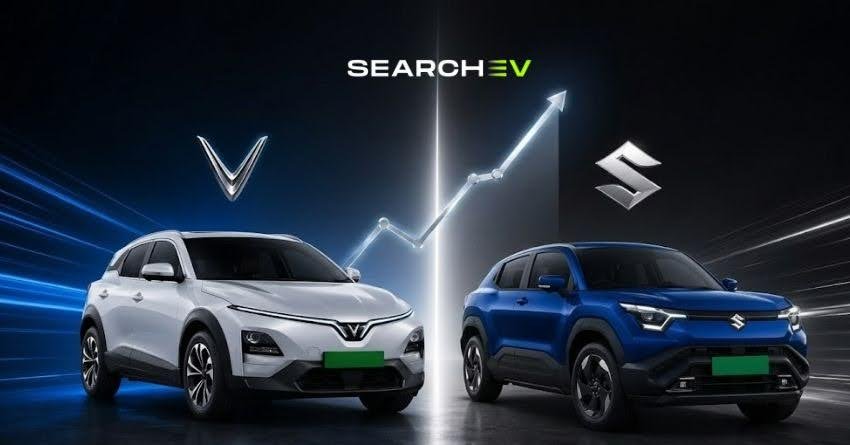
After months of aggressively expanding its footprint and highly publicised product debuts, Vietnamese automaker VinFast has achieved what many industry expert considered highly improbable in the Indian market. After trailing behind Maruti Suzuki for the entirety of March, the newcomer has successfully closed the gap and edged past the nation’s undisputed passenger vehicle giant, Maruti Suzuki, in the mid-April electric vehicle sales tally.
The Mid-April 2026 EV Sales
Built by aggressive pricing and strong market reception of its value-packed VF 6 and VF 7 electric SUVs, Vinfast secured the 4th position in overall EV sales within three months of its launch in India. Maruti, on the other hand, driven by the strong reception of the e-Vitara launch in January, had successfully toppled VinFast, taking the 4th spot on the charts by March.
However, VinFast recorded a watershed moment in the middle of April 2026, beating a household name in a small yet growing and competitive electric car market. VinFast reclaimed the 4th spot with 715 units, edging past Maruti Suzuki’s 655, per Vahan data.
Missing the higher spot by a margin of just 60 units, Maruti Suzuki finds itself in the unfamiliar position of playing catch-up. While Maruti technically retains an unmatched overall passenger vehicle market share in India, this neck-and-neck electric finish is a massive change from the usual fundamental philosophy where legacy automakers are predicted to instantly dominate the EV transition.
The Catalyst: The VF MPV 7 and a Disruptive Strategy
One of the driving reasons for VinFast’s rising share in the Indian electric car market is its slew of launches. Unlike Maruti Suzuki, whose EV presence is solely dependent on a single, focused product rollout, VinFast has been seen rapidly expanding its product portfolio.
The recent introduction of the VinFast VF MPV 7, for instance, has been an attempt to capture the white space in the sub-₹25 lakh electric seven-seater family utility vehicle segment that has existed for quite some time now. With the introduction of a premium, three-row electric MPV that undercuts rivals like the BYD eMax 7, VinFast has found a spot.
Moreover, the VF6 and the VF7, with their incredible performance to price value and fancy clothes, are winning a lot of potential SUV buyers shifting to electric. Furthermore, the brand is coupling its vehicles with an assured 75% buyback program and a 10-year battery warranty, successfully attracting buyers who were earlier hesitant to switch to a relatively new brand.
Maruti’s Cautious Climb: The e Vitara
On the other side of the arena, Maruti Suzuki’s 655 units represent a steady, calculated start for its heavily anticipated electric volume driver, the e Vitara.
Maruti is currently doing the complex task of transitioning its massive ICE-loyalist base to battery-electric technology. While the e-Vitara is a fundamentally strong, highly localised product backed by the most extensive service network in the country, Maruti’s approach is rather safe currently.
The brand has announced plans to launch three more electric cars in India by 2031. This includes an electric MPV based on the same platform as the Grand Vitara, the YMC (7 Seater). The launch is expected within this year, potentially going against the Vinfast VF MPV 7. The other two launches, including the Fronx EV (or Brezza EV), and a born EV compact hatchback (eWX-based) are expected to debut later.
This explains how Mauri Suzuki is playing with the ideology that the EV infrastructure, including dealership-level capabilities should be compatible enough before aggressively pushing volume, whereas VinFast is utilising shock-and-awe marketing to capture early market share.