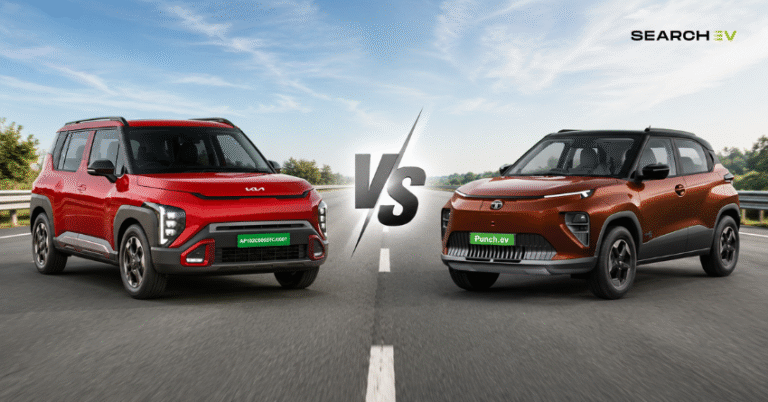
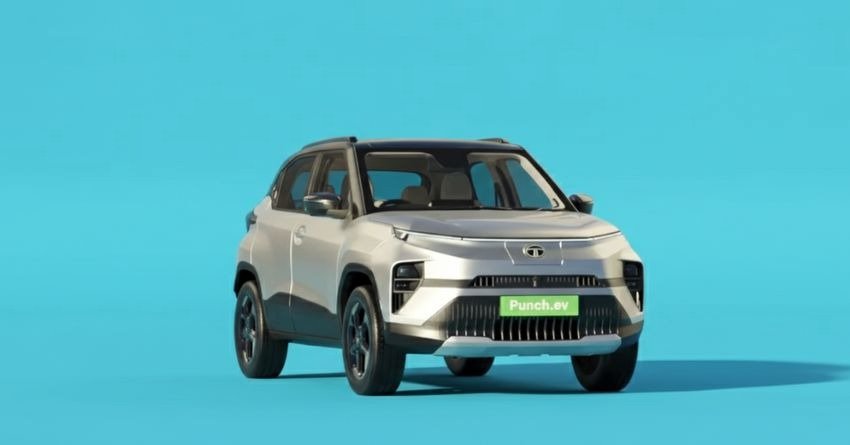
The Tata Punch EV has been updated for the first time since launch, bringing light exterior tweaks, added tech, and small cabin improvements, while keeping the same battery and motor options. The refreshed electric SUV is set to arrive on February 20, 2026, with prices expected to start at around ₹10.2 lakh (ex-showroom).
Rather than reinventing the Punch EV, Tata has focused on polishing the package as competition intensifies in India’s compact EV space.
Exterior: Updated Design
Most of the visual changes are concentrated at the front. The facelift drops the earlier black strip between the headlamps in favour of a neater sealed grille. A full-width LED light bar now links the daytime running lamps, giving the car a wider and more contemporary stance. The front bumper has also been reworked with sharper creases and angular detailing.
Tata has also added newly designed aero-focused alloy wheels, likely sized at 195/60 R16, and introduced a new body shade inspired by the Harrier’s Sunlit Yellow, paired with a contrasting black roof. While the rear design hasn’t been officially revealed, connected LED tail lamps similar to the ICE Punch are expected, along with elements like skid plates, an integrated spoiler, a shark-fin antenna, and a front-mounted charging port.
Cabin: Smarter Touches
Inside, the overall dashboard layout carries over, but Tata has made small usability upgrades. These include redesigned AC vents, updated upholstery, and improved seat cushioning for better thigh support.
The big talking point is the expected 12.3-inch touchscreen infotainment system with a new interface, complementing the existing 10.25-inch digital instrument cluster. Other features continue from the current model, including ventilated front seats, wireless charging, multi-colour ambient lighting, voice-enabled controls, automatic climate control, panoramic single-pane sunroof, and a 360-degree camera.
Additional highlights include a two-spoke steering wheel with illuminated logo, rotary drive selector, touch-sensitive climate panel, piano black centre console, and contoured door panels.
Safety and Driver Assistance
Safety remains a strong focus. The Punch EV facelift is expected to offer six airbags, electronic stability control, hill-hold assist, all-wheel disc brakes, electronic parking brake with auto-hold, front and rear parking sensors, and a 360-degree camera.
Speculation also points to Level 2 ADAS joining the feature list, though Tata has yet to officially confirm this.
Battery, Performance and Charging
Mechanically, the facelift sticks with the same dual battery strategy.
The Standard variant uses a 25 kWh pack with a claimed MIDC range of 315 km, while the Long Range version gets a 35 kWh battery rated at 421 km.
Power output stands at 82 bhp for the Standard model and 122 bhp for the Long Range, producing 114 Nm and 190 Nm of torque respectively. Tata claims 0–100 kmph times of under 9.5 seconds for the Long Range and 13.5 seconds for the Standard version.
Charging options remain unchanged, with a 3.3 kW wall box charger, 7.2 kW fast charger, and DC fast charging support. Using a 50 kW DC charger, the battery can be topped up from 10 to 80 per cent in around 56 minutes. Tata also hints at minor software updates that could slightly improve real-world efficiency.
Positioning and Competition
The Punch EV continues to occupy the middle ground of India’s electric car market, offering more space and features than basic city EVs, while staying more affordable than premium compact electrics. It will continue to rival models such as the Citroën eC3.
Launch and Expected Pricing
The facelifted Punch EV goes on sale on February 20, 2026. Pricing is expected to rise marginally over the outgoing model, starting at approximately ₹10.2 lakh (ex-showroom).
The Bigger Picture
This facelift isn’t about radical change. It’s about keeping a strong seller relevant. Tata has sharpened the design, upgraded cabin tech, and strengthened the feature list, while retaining a proven electric drivetrain. For customers, that means a familiar range and charging behaviour, now paired with fresher styling and a more premium interior. For Tata, it’s a calculated move to defend its position in a segment that’s about to see serious competition. Sometimes evolution beats disruption, and that’s exactly the approach Tata has taken with the Punch EV facelift.