Renault has introduced a new electric vehicle platform as part of its long-term futuREady strategy, which outlines how the brand plans to expand its electrified lineup over the coming years. The platform, called RGEV medium 2.0, is built to support future electric models with a WLTP range of up to 750 km.
When combined with a range-extender system, the total driving range could go up to around 1,400 km. This announcement is also linked to Renault’s wider global plan to roll out 26 new models by 2030, while steadily increasing the share of electrified vehicles across its portfolio.
Renault’s Electrification Targets
As part of its future-ready strategy, Renault has laid out its electrification plans for the years ahead. The company aims for all of its sales in Europe to be electrified by 2030, while in international markets it expects around half of its sales to come from electrified vehicles. By the end of the decade, Renault is also targeting global sales of more than two million vehicles, with about half of those expected to come from markets outside Europe. According to Renault brand CEO Fabrice Cambolive, the plan is about strengthening Renault’s position in Europe while also growing the brand’s presence in other global markets.
RGEV Medium 2.0 Platform
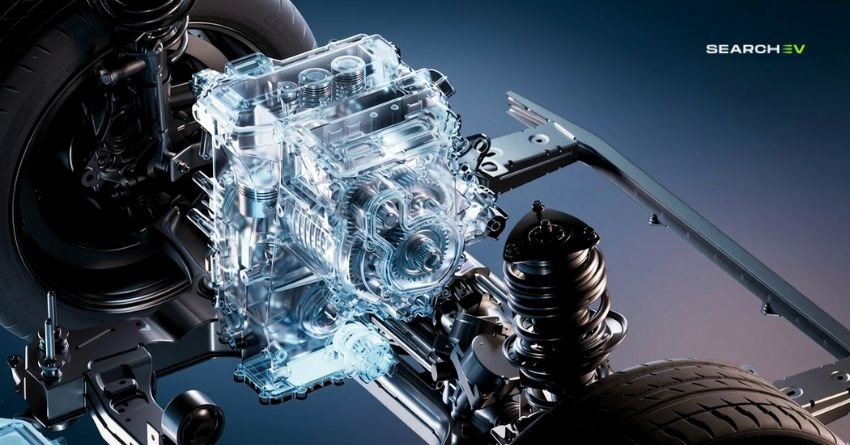
At the centre of Renault’s EV strategy is the RGEV medium 2.0 platform, a new architecture designed for vehicles ranging from B+ to D segments. The platform features an 800-volt electrical system, which allows ultra-fast charging and improved efficiency for future electric vehicles. Renault plans to offer the platform in three different configurations:
- The platform has been designed to support several types of electric setups. One version will be a fully electric model capable of delivering up to 750 km of WLTP range.
- There will also be a 4×4 electric variant, aimed at vehicles that need more capability, including towing capacity of up to two tonnes.
- Another option could feature a range-extender system, which may allow the vehicle to achieve a combined range of up to 1,400 km.
Because of this flexibility, Renault will be able to use the same platform across different types of vehicles in the future.
While the company is accelerating its EV development, Renault has also confirmed that its E-Tech full-hybrid powertrain will remain part of its lineup beyond 2030.
The brand sees hybrid technology as an important transition step for customers who are gradually moving toward fully electric vehicles.
Commercial Vehicles And New Technology
Renault also shared details about its future commercial vehicle plans. The upcoming Trafic van E-Tech electric will become the brand’s first software-defined vehicle (SDV). It will also use 800-volt technology and is expected to offer a driving range of up to 450 km. Alongside production models, Renault presented the R-Space Lab concept, which explores future interior and design ideas. The concept measures 4.5 metres in length and features a one-box layout with a modular cabin.
Inside, the concept includes a curved openR panorama display, steer-by-wire technology, seat-integrated airbags, and rear doors that open to 90 degrees. Renault also demonstrated features like driver-monitoring systems and AI-based driving assistance as part of the concept. The company made it clear that the R-Space Lab isn’t meant to preview a specific production car. Rather, it is primarily a concept that was employed to discuss new design concepts and technologies that may be present in Renault vehicles in the future.
Renault’s Global Expansion Plans
Renault also intends to increase its non-European presence. The 2025 brand has sold approximately 620,000 vehicles in the foreign markets, which is an 11 per cent growth in relation to the previous year. Renault also has more expansion to do in the coming few years, and the company is already gearing up to introduce 14 new models in global markets before the year 2030.
These vehicles will be produced through manufacturing hubs in Morocco, Türkiye, Latin America, South Korea, and India. The company will also use the Geely Electric Architecture (GEA) platform to expand its zero- and low-emission vehicle range in certain regions.
India To Play A Key Role
India will be an important part of Renault’s global plan. The company has confirmed that four new models will be designed and built in India by 2030, including electric and full-hybrid versions. One preview of this strategy is the Bridger Concept, a sub-four-metre B-segment SUV with 200 mm ground clearance and 400 litres of boot space.
The SUV that eventually goes into production is expected to use Renault’s RGMP small platform. It will likely be offered with petrol, hybrid, and fully electric powertrain options, giving buyers a few different choices depending on the market.
Renault plans to launch the model in India before the end of 2027, after which it may be introduced in other markets.
Looking Ahead
With the introduction of the RGEV medium 2.0 platform and a large number of new models planned for the decade ahead, Renault is preparing for a significant shift toward electrification. The company’s strategy combines fully electric vehicles, hybrid technology, and global manufacturing expansion, as it works toward strengthening its presence in both established and emerging markets.