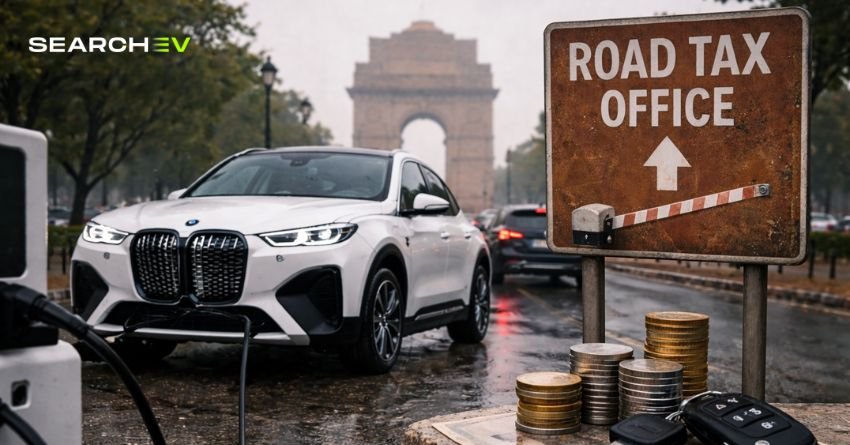
The national capital has long been the poster child when it came to incentivising early adopters of the EV technology, to combat the crippling air quality crisis. However, with the newly released Draft Delhi Electric Vehicle Policy (2026–2030), the government is making a notable change in their strategy to spur EV adoption.
EVs currently hold nearly 4-5% pie in the total passenger car market in India, and policymakers have realised that subsidising premium models does little to solve mass-transit pollution. Therefore, with the new Draft Delhi EV policy, the government is officially proposing an end to road tax and registration fee waivers for electric vehicles priced above the ₹30 lakh (ex-showroom) threshold. By pulling the plug on tax benefits for luxury models, the policymakers are focusing on concentrating incentives on middle-class buyers, intending to democratise mass-market EV penetration, with vehicles like the Tata Nexon EV, MG Windsor, and upcoming localised models becoming the true volume drivers.
The End of Luxury Subsidies
Since the inception of the original 2020 Delhi EV policy, purchasing a ₹60 lakh electric SUv in Delhi meant saving upwards of ₹6 lakh in road taxes
It was a massive, state-funded windfall that disproportionately benefited high-net-worth early adopters.
The Draft EV Policy 2026–2030, currently open for public feedback until May 10, 2026, is now ending this loophole, by drawing a hard line:
- EVs up to ₹30 Lakh: Eligible for a 100% exemption on road tax and registration fees until March 31, 2030. They also qualify for a ₹1 lakh scrappage incentive if the buyer scraps an older BS-IV vehicle.
- EVs above ₹30 Lakh: Zero exemptions. Buyers will have to pay the full road tax and registration fees applicable to internal combustion engine (ICE) vehicles in that price bracket.
- Strong Hybrids: Recognising the impact of hybrid vehicles in a country with developing EV infrastructure, as a practical bridge technology, strong hybrids priced up to ₹30 lakh will now receive a 50% exemption on road tax as well. For example, the top end Grand Vitara model priced a hint over ₹19 lakhs, will see nearly a lakh worth of price reduction in Delhi.
Projected Impact on Premium EVs
For buyers eyeing electric vehicles north of the ₹30 lakh boundary, the cost of ownership in Delhi is about to increase. Assuming the Delhi govt. applies the standard 10% road tax bracket (the typical baseline for passenger vehicles over ₹10 lakh) once the EV exemption is lifted, the on-road prices for popular premium EVs will see a severe, immediate hike.
We have put together a projection of how the withdrawal of the road tax waiver will impact the final pricing of popular premium EVs in the capital:
| EV Model | Approximate Ex-Showroom Price | Estimated Road Tax Impact (10%) | What Will it Mean for the Market? |
| BYD Seal | ₹41.00 Lakh – ₹53.15 Lakh | ₹4.10 Lakh – ₹5.31 Lakh | Price gap against German ICE luxury sedans reduces. |
| Hyundai Ioniq 5 | ₹46.30 Lakh | ₹4.63 Lakh | Crosses the psychological ₹50 lakh on-road barrier. |
| BYD Sealion 7 | ₹49.40 Lakh – ₹54.90 Lakh | ₹4.94 Lakh – ₹5.49 Lakh | Loses its aggressive price advantage over entry-level German SUVs. |
| Volvo EX40 | ₹50.10 Lakh | ₹5 Lakh | Premium buyers will have to absorb full ICE-equivalent taxation. |
| Kia EV6 | ₹65.97 Lakh | ₹6.59 Lakh | High CBU pricing compounded by the loss of local tax relief. |
| BMW iX1 | ₹66.90 Lakh | ₹6.69 Lakh | Tax alone equates to the price of an entry-level hatchback. |
(Note: The exact financial impact will depend on the finalised tax slabs notified by the Delhi Transport Department upon the policy’s formal implementation.)
A Fragmented Nation: The State-by-State Tax Landscape
Delhi is not the only state realising that EV subsidies are fiscally unsustainable long-term. India is rapidly developing a highly fragmented EV taxation landscape, where a vehicle’s on-road price fluctuates wildly depending on the state of registration.
To provide a clearer picture of the current market, here is how Delhi’s proposed structure compares to other key automotive hub states:
| State | EV Road Tax Exemption Policy (2026 Context) | Strategic Intent |
| Delhi (Proposed) | 100% waiver up to ₹30 lakh. 0% above ₹30 lakh. 50% waiver for strong hybrids under ₹30 lakh. | Focus on mass-market adoption and curbing immediate urban emissions via hybrids. |
| Uttar Pradesh | 100% complete waiver across all EV price brackets. | Aggressive push to lure both buyers and heavy manufacturing investments. |
| Karnataka | Tiered taxation: 5% (under ₹10L), 8% (₹10-25L), 10% (above ₹25L). No blanket waivers. | Revenue recovery. As a mature EV market (over 6% penetration), subsidies are no longer deemed necessary. |
| Tamil Nadu | 100% complete waiver across all EV price brackets. | Sustaining its status as the “Detroit of India” and supporting massive local EV mega-factories. |
As Karnataka recently withdrew its blanket waivers to introduce a tiered tax system, Delhi’s draft policy joins that bandwagon as regional EV adoption matures.
Market Implications: What Automakers Must Do Next
The immediate consumer reaction in Delhi will likely be a frantic rush to dealerships. Premium EV buyers have a rapidly closing window to register their vehicles and secure the tax waiver before the draft policy is officially notified.
Long-term, this ₹30 lakh ceiling creates a psychological and financial boundary in the Indian EV market. Automakers will be under immense pressure to localise their manufacturing, rather than relying on Completely Knocked Down (CKD) or Completely Built Unit (CBU) imports, in an attempt to at least price their mid-tier EVs safely below the ₹30 lakh mark.
For the luxury segment, manufacturers like Hyundai, Kia, Volvo, BMW, and BYD will have to change their approach to marketing these vehicles. Electric vehicles must be marketed on their state-of-the-art tech and futuristic drive and ownership experience. Luxury EVs would need to set the benchmarks in innovation, as the running cost and green adoption angle alone would find it difficult to justify their purchase.