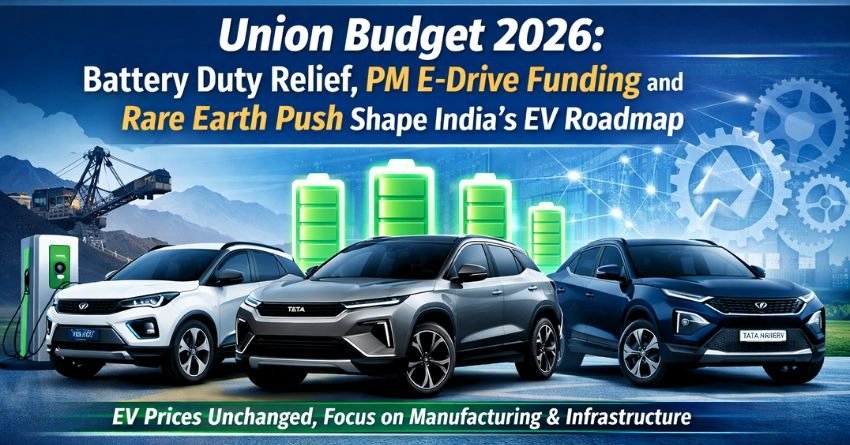
The Indian Union Budget 2026-27 prioritises battery manufacturing, rare earth minerals, charging infrastructure, and the PM E-Drive initiative for the EV sector. However, there are no immediate price cuts for EV consumers. The government’s strategy reflects a move away from short-term incentives and toward long-term ecosystem development.
Key Takeaways
- Customs duty exemptions for lithium-ion battery production and related inputs were extended until 2028.
- Rare Earth Corridors are being built in Odisha, Kerala, Andhra Pradesh, and Tamil Nadu to strengthen local supply chains.
- The PM E-Drive initiative receives ₹1,500 crore for EV infrastructure, service integration, and vehicle incentives.
- Capital expenditure will increase to ₹12.2 lakh crore, including support for EV adoption and charging networks.
- There are no new buyer incentives or GST cuts for EVs; prices remain largely unchanged.
Battery and Critical Mineral Support
The budget still retains the duty exemptions on capital items for lithium-ion batteries, which are the most important factor for lowering production costs and increasing local manufacturing. According to experts, this might help reduce dependence on imports and eventually make EVs cheaper.
At the same time, PLI (Production Linked Incentive) schemes for battery manufacturing and recycling plants have been expanded with the goal of reducing long-term operational costs.
Rare Earth Corridors and Strategic Minerals
To improve supply chains, the government built dedicated Rare Earth Corridors in four states, focusing on key minerals needed for EV motors and electronics. The primary goal of this project is to reduce dependency on imports, particularly from China, while also attracting private and venture capital investment in advanced EV components.
PM E‑Drive Scheme and Infrastructure Boost
The PM E-Drive project, India’s largest EV incentive program, has a budget of ₹1,500 crore.
- The package includes a digital platform for charging station access, payments, and EV services.
- Support for charging infrastructure, including public and fleet vehicles.
- Indirect incentives for EV purchasers, with a concentration on two-wheelers, three-wheelers, and buses.
- Also includes 4,000 electric buses for the Purvodaya districts, accelerating the electrification of public transportation.
EV Car Prices Stay the Same for Now
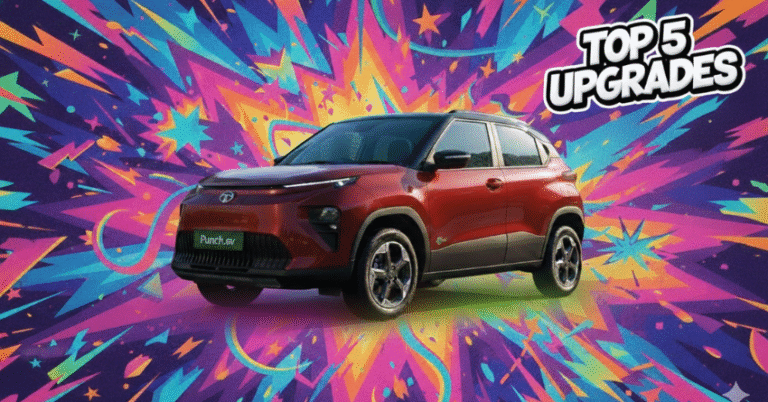
There are no direct price cuts for electric cars in this budget. GST rates remain unchanged, and no new buyer subsidies were announced. As a result, the prices of the electric vehicles stayed exactly where they were on February 1, 2026. Take the Tata Nexon EV as an example. Depending on the variant, it continues to be priced between ₹14.5 lakh and ₹18.5 lakh (ex-showroom).
Manufacturers are still paying import duties of around 5 to 10 per cent on key battery raw materials. That limits their ability to reduce costs for buyers. At the same time, the budget didn’t raise taxes on petrol or diesel vehicles either, so the overall price gap between EVs and conventional cars remains unchanged.
So, Will EVs Become Cheaper?
Not right away. EV prices won’t drop overnight because of this budget. The changes announced now are more about the long game. As charging networks expand, batteries are made locally, and running costs come down, electric cars should slowly become easier on the wallet.
How This Budget Compares to Last Year
In the 2025–26 budget, EVs got indirect support through FAME-II and broader tech initiatives like IndiaAI, but those measures are no longer in play. The 2026–27 budget takes a different route. There are no direct subsidies this time. The emphasis is on local production, stronger infrastructure, and smoother EV services. The payoff isn’t immediate, but the idea is to reduce costs steadily by cutting import dependence.
Bottom Line
The Union Budget 2026 focuses mainly on developing a strong EV infrastructure rather than providing immediate subsidies. Prices for electric vehicles will not fall immediately, but the budget provides the framework for future cost savings, stronger local supply chains, and enhanced charging infrastructure. As the electric vehicle market in India expands and matures, buying an electric vehicle will become more affordable in the future.