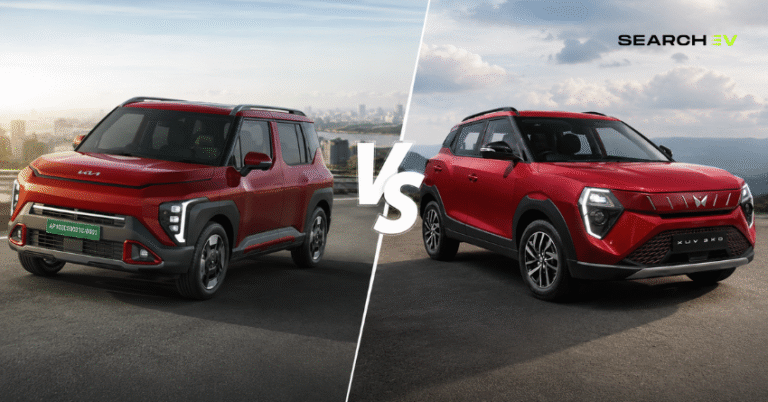
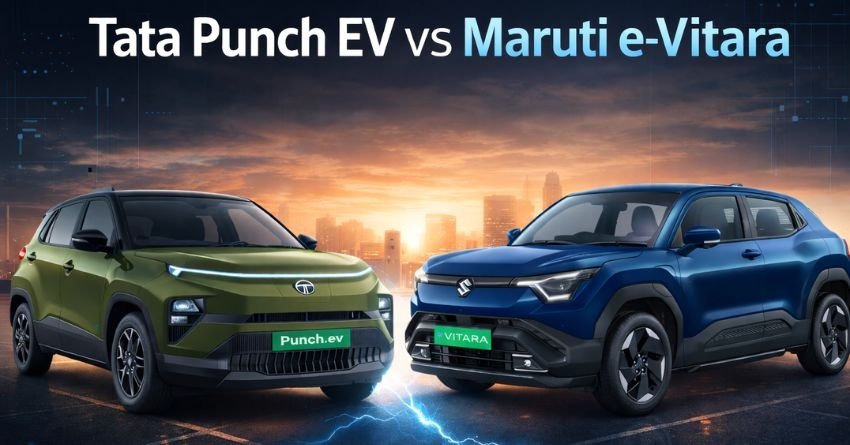
Electric SUVs are becoming a mainstream choice in India, and two of the top names holding attention are the Punch EV and the e-Vitara. Both represent their makers’ serious push into electrification, Tata with an accessible city-friendly electric SUV, and Maruti Suzuki with its first proper long-range EV SUV. This comparison looks at how they differ across key ownership categories to help you decide which one fits your priorities.
Price And Positioning
The Punch EV starts at an affordable price point, with the base ex-showroom tag around ₹9.99 lakh and higher trims going up to about ₹14.44 lakh in India. That puts it squarely within reach of everyday customers looking for an electric SUV without a high upfront cost.
The e-Vitara, according to early official pricing estimates, comes in higher, expected to start closer to around ₹18 lakh and go up toward ₹22.5 lakh or more once its full range is revealed. This difference isn’t just numbers on a price tag; it reflects the ways each brand has chosen to position its electric SUV, with Punch EV targeting cost-conscious city commuters and e-Vitara aiming at customers willing to pay more for longer range and premium features.
Features And Tech
The Punch EV focuses on practical tech that actually matters day to day, with a sizable touchscreen, digital driver display, connected car features, ventilated seats, and comfort gear that suit city driving. The Punch EV’s setup centres on useful tech for everyday driving, a large 10.25-inch infotainment screen, digital cluster, connected car services, and comfort gear that make city travel more convenient.
In contrast, the e-Vitara’s official feature list leans toward a broader technology package, including Level 2 ADAS, advanced connectivity, and a larger battery platform, along with premium comfort features expected in a bigger SUV. The result is a more comprehensive, flagship-style feature set compared to the Punch EV’s simpler, everyday-focused tech approach. The upshot for customers is that you’re trading off simple, useful technology in the Punch EV for a more comprehensive, flagship-style feature package in the e-Vitara.
Range And Battery
Range is one of the standout differences between these two electric SUVs. Tata’s Punch EV offers dual battery options: a 25 kWh battery delivering around 315 km of MIDC-claimed range and larger packs of 35 kWh, going up to about 421 km. That is very usable for typical city use and moderate highway distances on a charge. Maruti e-Vitara is expected to be offered with 49 kWh and 61.1 kWh battery pack options. The larger 61.1 kWh battery is officially rated to deliver up to 543 km on a single charge as per ARAI certification, pushing its range significantly beyond the Punch EV.
For customers who often drive longer distances or want fewer stops between charges, the e-Vitara’s larger battery and its ARAI-certified range of up to about 543 km make a noticeable difference compared with the Punch EV’s claimed range of around 421 km on its bigger battery pack.
Performance And Driving Experience
Performance in electric SUVs really comes down to how the powertrain and battery work together, and the Punch EV and e-Vitara tell different stories. The Punch EV’s drivetrain is tuned so that it feels smooth and composed in everyday traffic; it doesn’t jump at you, but it gets moving confidently when you need it to, with higher-range versions making about 122 bhp and 190 Nm of torque from the larger 35 kWh battery pack. That setup suits city roads and moderate highway speeds without feeling abrupt.
The e-Vitara, by comparison, comes with a larger 61.1 kWh battery and a significantly higher output of around 172 bhp and 192.5 Nm of torque, which gives it a more assertive shove when you’re accelerating or cruising on fast roads. Put simply, Punch EV feels relaxed and controlled for daily use, while e-Vitara delivers stronger performance on longer runs and when you want a bit more urgency in the passing lane.
This translates into a driving experience that feels more capable over long distances and during overtaking manoeuvres, which matters if you spend a lot of time on inter-city routes.
The Charging
Both SUVs support modern charging interfaces, but their charging characteristics respond to their battery sizes. The Tata Punch EV uses a CCS2 port and supports both AC and DC charging: with a 3.3 kW or 7.2 kW AC home charger, it can charge fully in roughly 3.6–5 hours, while a 50 kW DC fast charger can take it from about 10 % to 80 % in around 56 minutes.
The Maruti e-Vitara is also expected to offer both AC and DC charging: for the 49 kWh battery, AC charging with a 7 kW home charger takes around 6.5 hours and with an 11 kW AC charger about 4.5 hours, while the 61 kWh battery takes around 9 hours (7 kW) or 5.5 hours (11 kW) to go from 10 % to 100 %. DC fast charging on the e-Vitara is reported to replenish the battery from about 10 % to 80 % in roughly 45 minutes on suitable chargers.
Both brands are developing ecosystem support at dealerships and public charging points, but e-Vitara’s focus on range and performance means owners may find it more flexible for longer journeys, with less frequent stops.
The Safety
Safety is a key consideration for family customers, and both the Punch EV and the e-Vitara have strong credentials. The Punch EV comes with a well-engineered structure and safety systems typical of modern EVs, delivering peace of mind for daily use.
The e-Vitara has also been recognised with a five-star Bharat NCAP safety rating, underlining its strong crash-protection design and reinforced battery structure that meet high safety standards and give customers confidence in its build quality. In simple terms, customers shouldn’t feel compromised on safety either way, but e-Vitara’s broader ADAS suite adds extra reassurance for tech-forward customers.
What’s Next?
The Punch EV has been on sale since 2025 and is now heading into 2026 with upgrades, which means it is a proven product with an established ownership base. In contrast, the e-Vitara has been making headlines since its showcase at Bharat Mobility, but several feature details and real-world aspects still remain under wraps. That makes the Punch EV the safer, more predictable choice today, especially for city-focused customers looking for affordability and practicality.
However, the e-Vitara can be a better alternative for those prepared to wait, particularly those looking for longer range, higher performance, and a more premium feature set. Finally, if your priority is low-cost public transit, the Punch EV makes more sense. However, if range, power, and a more spacious SUV feel are more important, the e-Vitara can emerge as the stronger all-rounder once fully disclosed.