A new policy proposal could significantly change how vehicles are sold and used across the Delhi region. The Commission for Air Quality Management has put forward a draft plan that pushes for a full shift to electric vehicles across the National Capital Region.
The plan suggests slowly phasing out new petrol, diesel, and CNG vehicles over the next few years, with the aim that by April 1, 2030, all new vehicles sold in the region would be electric. The plan was prepared by a group of experts led by Ashok Jhunjhunwala from IIT Madras to cut pollution from vehicles across the region.
Phased EV Transition Timeline
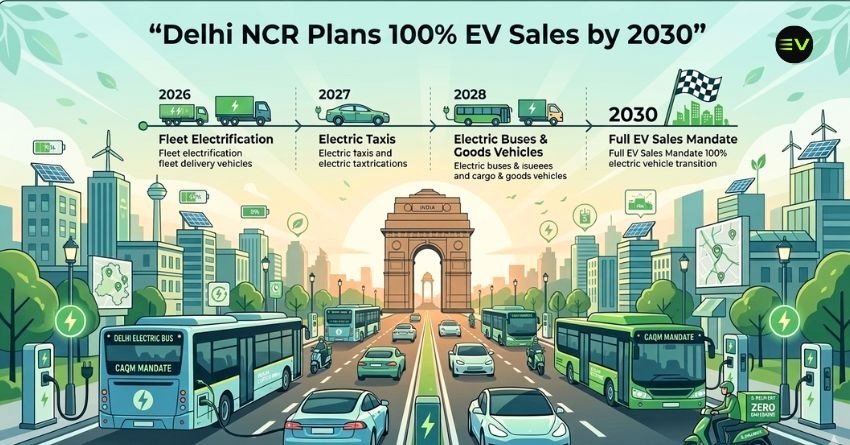
The draft also sets out when different categories of vehicles would begin moving to electric over the next few years. From January 1, 2026, delivery platforms and e-commerce fleets would need to ensure that all newly added vehicles run on electric power or CNG. Some categories of commercial fleets have already begun moving in this direction.
The next major step comes on April 1, 2027, when all newly registered taxis in Delhi NCR will have to be fully electric. By April 1, 2028, the proposal requires all new buses and light goods vehicles entering service in the region to be electric.
The last step in the plan comes on April 1, 2030, when new registrations of petrol, diesel, or CNG vehicles, including private cars and two-wheelers, would stop in the region. After that point, only electric vehicles would be allowed to be registered.
“Right to Charge” Proposal
One challenge that still slows down EV adoption is the limited charging infrastructure. To deal with this, the panel has suggested introducing a legal “Right to Charge” rule that would make it easier for people to install charging points.
Under this proposal, residential societies, office complexes, and commercial buildings would be required to allow residents or tenants to install EV charging points if they request them. Delhi has already been expanding its charging network. Authorities plan to add 7,000 new charging points in 2026, which would bring the city’s total to more than 16,000 chargers. However, experts say the region will likely need more than 36,000 charging points to properly support a fully electric vehicle ecosystem by 2030.
Automakers Raise Concerns
The proposal has already started conversations within the auto industry. Companies like Maruti Suzuki, Tata Motors, and Hyundai Motor Company have raised concerns about the plan. At a recent stakeholder meeting, industry representatives questioned why passenger cars were being targeted so strongly. They noted that private cars contribute only about 3.4% of transport-related pollution, and said other sources of emissions should also be looked at before taking such a step.
The expert panel has encouraged companies to launch electric cars priced below ₹5 lakh, a target manufacturers say remains difficult given current battery costs. Several companies also argued for a more technology-neutral approach. Instead of focusing only on battery electric vehicles, they said options like hybrids, CNG models, and flex-fuel vehicles should also remain part of the transition.
Pollution Driving Policy Urgency
The panel says strong action is needed because air pollution in Delhi and nearby areas continues to remain at dangerous levels. Health experts involved in the discussion highlighted that during peak winter pollution periods, when the Air Quality Index crosses 250, the air inhaled by newborns in the region can be comparable to the impact of smoking 10 to 15 cigarettes a day.
According to committee members, improving air quality is not only an environmental issue but also a public health priority, particularly for children growing up in the region. If the roadmap moves forward, the Delhi NCR region could become one of the first major metropolitan areas in the world to target 100% electric vehicle sales within this decade.