
New rules say all new electric cars and cargo vehicles must have sound alerts by 2026 under PM E-DRIVE and existing EVs must add them by 2027.
To improve road safety and promote electric mobility, the central government has implemented two major policy changes: the requirement for sound-emitting devices in electric vehicles (EVs) and detailed guidelines for expanding public EV charging infrastructure under the PM E-DRIVE plan.
Central Motor Vehicles Rules
Electric vehicles, known for their silent operation, have raised safety concerns among vulnerable road users. To address this, the Ministry of Road Transport and Highways has suggested a draft change to the Central Motor Vehicles Rules that would require new electric passenger and cargo vehicles (category M and N) to be fitted with an Acoustic Vehicle Alerting System (AVAS) by October 1, 2026. Existing EV models will be obliged to adopt the system by October 1, 2027.
AVAS is intended to produce artificial sounds, particularly at low speeds or while reversing, to make EVs more audible to pedestrians, cyclists, and other drivers. The draft is based on the AIS-173 standard for audibility standards, which may change over time.
Notably, the proposal currently excludes two- and three-wheelers (e-scooters and e-rickshaws), even though they run quietly at moderate speeds. The policy brings India in line with global standards, as the European Union, the United States, and Japan already require noise-generating systems in electric vehicles for pedestrian safety.
PM E-DRIVE offers 72,000 public EV charging stations
Parallel to the safety push, the government has announced operating rules for the PM E-DRIVE scheme, which aims to expand EV charging infrastructure nationally.
Under the scheme:
- A budget of ₹2,000 crore is set out for public charging infrastructure, as part of a bigger ₹10,900 crore spend.
- The goal is to install around 72,000 public charging stations throughout the cities, highways, state capitals, smart cities, and transit lines.
- Prioritised locations include major cities, high-traffic routes, airports, train stations, gas stations, and 50 national highway corridors.
- The rules provide for subsidies on upstream infrastructure costs and, in certain cases, EV supply equipment (EVSE) costs, subject to specified benchmark limits.
- Certain “public good” installations, such as charging stations in government buildings, schools, hospitals, or residential complexes, can receive a full subsidy if they are open to the public.
The scheme also specifies minimum charger capacities: 12 kW for two and three-wheelers, 60 kW for four-wheelers, and 240 kW for heavier vehicles such as buses and trucks. In addition, Bharat Heavy Electricals Ltd (BHEL) is being considered as the nodal agency to aggregate demand, manage tenders, and possibly manage a uniform “super-app” for EV users (charging availability, booking, payments, etc.).
Scheme extension, challenges ahead
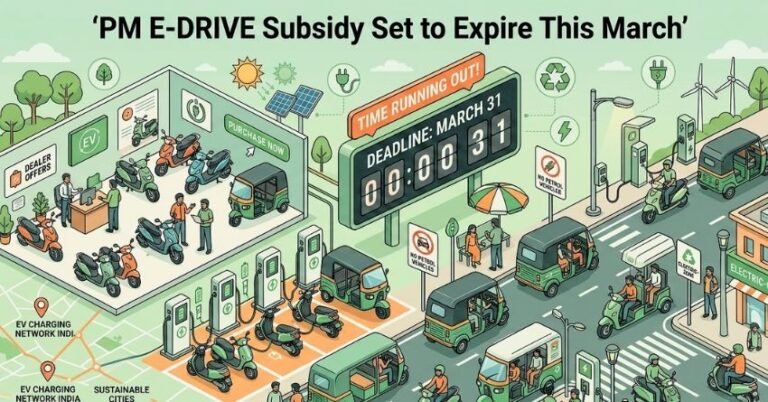
While the original deadline for PM E-DRIVE was March 2026, the government has extended the program for electric buses, trucks, and ambulances to March 2028. However, incentives for two and three-wheelers would expire in 2026. According to some industry analysts, adoption will be dependent on addressing challenges such as site acquisition, utility clearances, state coordination, and managing rising component costs.
Final Verdict
With the execution of these two major policies under PM E-DRIVE, India is definitely taking a step further towards safer and convenient transportation through EVs. On the other hand, these policies meet worldwide standards, but their success completely depends on the flawless execution, state support, and infrastructure upgrades. If executed well, these initiatives will boost the EV adoption rate and strengthen India’s position in the global transition to green mobility.