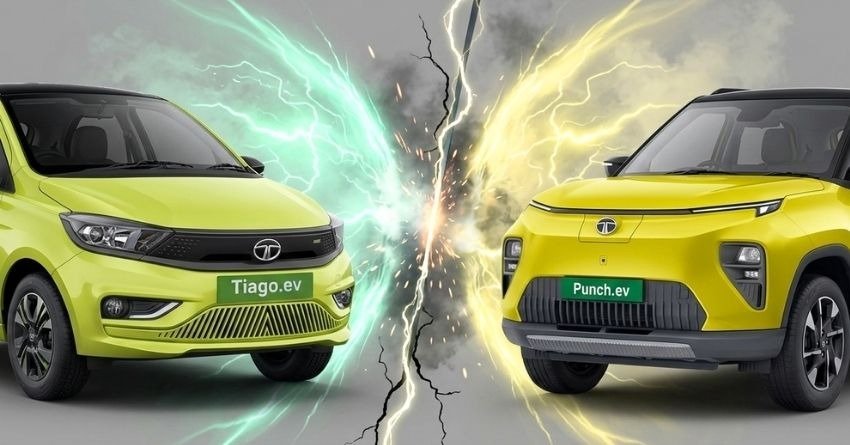
The upgraded Tata Punch EV and the upcoming facelift of the Tata Tiago EV give buyers two different approaches to affordable electric mobility in 2026. One leans toward a small SUV with a bigger battery and more tech, while the other focuses on being a compact, easy-to-live-with city hatchback.
The Punch EV has already received its latest updates, while the Tiago EV is preparing for a facelift expected later this year. That makes this comparison slightly unusual: one car is already updated, while the other is evolving. Still, both sit in the same price band and target the same urban EV buyer. Here’s how they stack up.
Price Comparison
The Tata Tiago EV currently starts at ₹7.99 lakh (ex-showroom) for the 19.2kWh version and goes up to ₹11.14 lakh for the 24kWh XZ+ Tech Lux trim. In Delhi, that roughly translates to ₹8.5–12 lakh on-road, keeping it firmly in the budget EV space.
The Tata Punch EV, on the other hand, starts at ₹9.69 lakh for the Smart 30kWh variant and reaches ₹12.59 lakh for the Empowered+ S 40kWh version. In simple terms, it sits about ₹1.5–2 lakh above the Tiago EV, depending on the trim. The difference mostly comes from the larger battery options and the SUV-style positioning.
The upcoming Tiago EV facelift is expected to bring a small price bump, possibly around ₹10,000–₹20,000. Meanwhile, the Punch EV also offers Tata’s Battery-as-a-Service option, where the entry price drops to around ₹6.49 lakh plus a ₹2.6/km battery rental. For buyers who drive less every month, that option could make the Punch surprisingly competitive on price.
Features Face-Off
Inside the cabin, the Punch EV clearly aims a bit higher. It comes with a 10.25-inch Harman touchscreen paired with a 10.25-inch digital driver display that supports navigation projection. Add to that ventilated leatherette seats, a sunroof, wireless charging, and Tata’s Arcade. ev app suite, and the Punch starts to feel more like a premium compact SUV than an entry EV.
The Tiago EV keeps things simpler right now with a smaller infotainment screen, digital instrument cluster, and basic convenience features like a rear wiper. The facelift version is expected to change that. Spy images suggest refreshed LED DRLs, a larger touchscreen, upgraded connected tech, and possibly even a sunroof and 360-degree camera.
Even with those upgrades, the Punch EV will likely remain the more feature-rich option. Still, the Tiago EV has one advantage: its smaller hatchback footprint makes it easier to manoeuvre through tight city lanes and crowded parking spots.
Range Battle
Range is where the Punch EV pulls ahead quite clearly. The larger 40kWh battery claims an ARAI range of 468 km, with real-world figures around 350 km in mixed driving conditions. That makes longer intercity drives far more practical.
The current Tiago EV with its 24kWh battery is rated at 293 km ARAI, with a tested real-world range closer to 210–220 km. The base 19.2kWh version sits even lower at a claimed 250 km. The facelift could bring a slightly larger battery pushing range past the 300 km mark, but even then, the Punch EV’s bigger pack and newer drivetrain setup are expected to keep it comfortably ahead. For daily commutes of 50–100 km, both work fine. But if range anxiety is a concern, the Punch EV offers a bigger buffer.
Performance Edge
The Punch EV’s larger battery version produces 129 hp and 154 Nm of torque, while the 30kWh version delivers 88 hp. Acceleration from 0–100 kmph/h takes under 9 seconds, and the car offers multiple drive modes, including City, Eco, and Sport.
The Tiago EV is tuned more for city driving. The 24kWh version produces 74 hp and 114 Nm, while the smaller battery variant makes 60 hp. In city traffic, the Tiago EV feels light and responsive, which suits short daily drives. But when the car is fully loaded or when you try to overtake on the highway, the power difference becomes noticeable. The Punch EV simply has more muscle. It feels more relaxed at higher speeds and handles highway runs with greater confidence.
Charging Showdown
Both EVs support fast charging, though the Punch EV again holds an advantage. It can use a 65kW DC fast charger and go from 20% to 80% in around 26 minutes. Tata also claims that a quick 15-minute charge can add roughly 135 km of range.
The Tiago EV’s current fast charging setup takes about 58 minutes for a 10–80% charge on its smaller battery pack. Home charging times for both cars remain similar, with 3.3kW and 7.2kW AC chargers taking roughly 5–9 hours depending on the battery size.
If the Tiago EV facelift adopts newer charging hardware alongside a larger battery, the gap could narrow slightly. For now, though, the Punch EV has the quicker top-up capability.
Warranty Assurance
Tata has also given the Punch EV an interesting long-term advantage: a lifetime high-voltage battery warranty for the first owner, with fair-use conditions that extend coverage up to 15 years. The vehicle itself carries a 3-year or 1.25 lakh km warranty.
The Tiago EV currently offers an 8-year or 1.6 lakh km battery warranty, which is standard for many EVs in this price range. The facelift model may adopt the same lifetime warranty structure as the Punch EV, but that hasn’t been confirmed yet. For buyers planning to keep their EV for a long time, the Punch EV’s warranty policy adds a layer of reassurance.
Sales Momentum
The Punch is also one of the biggest hits of Tata, but silently. The lineup alone sold more than 19,000 units in January 2026, and the total sales have already passed the 7-lakh mark. It has obviously been assisted by the SUV styling and good reputation in safety, which have helped it to reach a large number of buyers.
The Tiago EV, however, has a lesser number of sales, yet it remains in its niche as one of the cheaper EV choices in the Tata inventory. Tata registered 8,385 EV wholesales in February 2026, which indicates that the electric cars of this company are gradually gaining demand.
The Tiago EV should also receive a facelift in the future, likely in 2026, and this should draw a little more attention to it in the market. Until it comes, the Punch EV remains the more favoured electric model of Tata.
Bottom Line
The Tata Punch EV is the better pick if you want more range, stronger performance, and a more premium feature set. The Tata Tiago EV still makes sense for buyers looking for the most affordable electric hatchback that’s easy to drive in tight city spaces. The decision really comes down to priorities: maximum value and simplicity, or a slightly more expensive EV that offers more tech, range, and versatility.