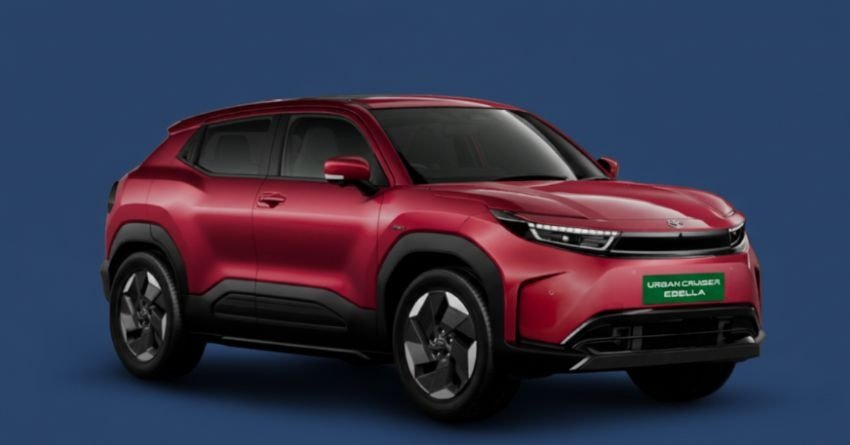
Toyota Urban Cruiser Ebella EV is stepping into a segment where customers are already comparing multiple electric SUVs side by side. The main rivals include the Maruti e-Vitara, Hyundai Creta Electric, Tata Curvv EV, and Mahindra BE 6.
Electric SUVs are no longer niche products. For many customers, this is now the default shortlist. Most of these models overlap in price, size, or use case, which makes comparisons unavoidable.
Here’s how the Urban Cruiser Ebella EV lines up against its real competitors.
Toyota Urban Cruiser Ebella Pricing Comparison
The Toyota Urban Cruiser EV price in India is expected to fall between ₹18 lakh and ₹25 lakh (ex-showroom), depending on the variant. That puts it right in the middle of the current EV SUV landscape.
The Maruti e-Vitara price in India starts at roughly ₹15 lakhs. Maruti’s strategy is clear: keep aggressive pricing while relying on range and brand awareness. The Hyundai Creta Electric is priced close to the Urban Cruiser EV, indicating that Hyundai is not pitching it as a budget-friendly electric SUV. The Creta starts at ₹10.79 lakh.
The Tata Curvv EV starts at ₹17.49 lakh, which is similar to Toyota’s price tag, especially for higher models. The Mahindra BE 6 has been released in India with a starting price of roughly ₹18.90 lakh (ex-showroom). Higher-spec versions go up to nearly ₹26.90 lakh depending on the battery and options, overlapping with the Urban Cruiser EV’s range.
| Electric SUV | Starting Price (Ex-showroom) |
| Toyota Urban Cruiser EV | ₹18 lakh – ₹25 lakh (expected) |
| Maruti e-Vitara | Around ₹15 lakh (expected) |
| Hyundai Creta Electric | From ₹10.79 lakh |
| Tata Curvv EV | From ₹17.49 lakh |
| Mahindra BE 6 | From ₹18.90 lakh |
Toyota Urban Cruiser Ebella Range and Battery Comparison
The Toyota Urban Cruiser EV is offered with two battery choices, a 49 kWh pack and a larger 61 kWh unit. With the bigger battery, it delivers a claimed range of over 543 km, which puts it among the strongest long-range options in this segment.
The Maruti e-Vitara sticks closely to that formula. It uses similar battery sizes and, with the larger pack, delivers a range figure that’s almost identical to the Toyota. On paper, there’s very little to separate the two in terms of range.
Hyundai takes a more balanced approach with the Creta Electric. The smaller 42 kWh battery is rated at around 420 km, while the larger 51.4 kWh pack stretches that to about 510 km. It may not lead the segment, but it comfortably covers daily driving and regular highway runs.
The Tata Curvv EV pushes things forward with bigger batteries in the 50–60 kWh range. That extra capacity brings its range close to 500 km, which makes it far more flexible than the Nexon. It’s meant for customers who want more room and range without jumping straight to a premium EV.
Mahindra takes a more aggressive route with the BE 6. Larger 60–80 kWh batteries push range well past 500 km, and the focus is clearly on performance and presence. This one feels built to stand out rather than blend in.
| Electric SUV | Battery Options | Claimed Range (Approx.) |
| Toyota Urban Cruiser EV | 49 kWh, 61 kWh | Up to 543 km |
| Maruti e-Vitara | Similar to Toyota (around 49–61 kWh) | Around 540+ km |
| Hyundai Creta Electric | 42 kWh, 51.4 kWh | 420 km – 510 km |
| Tata Curvv EV | Around 50–60 kWh | Close to 500 km |
| Mahindra BE 6 | Around 60–80 kWh | Well over 500 km |
Toyota Urban Cruiser Ebella Features and Positioning
The Toyota Urban Cruiser EV sets the reference point here by focusing on core fundamentals. It offers Level 2 ADAS, a clean dual-screen layout, connected car features, and a 360-degree camera, all wrapped in a cabin designed for everyday usability rather than flash.
The Maruti e-Vitara feels closest to the Toyota Urban Cruiser EV in day-to-day use. The tech stack and safety kit are largely similar, and the drive is tuned to be smooth and predictable. The real difference comes down to pricing and Maruti’s wider mass-market reach.
The Hyundai Creta Electric clearly leans toward comfort and features. Along with ADAS, it brings ventilated seats, a panoramic sunroof, dual screens, and a more premium cabin feel. It’s the option for customers who want their EV to feel well-equipped and plush inside. The Tata Curvv EV takes that same foundation and adds a sharper design, larger displays, and a more modern interior. Together, they offer both practical and style-led choices.
Availability and Timing
The Toyota Urban Cruiser Ebella EV has been formally unveiled in India, and bookings have begun, while deliveries and complete pricing information are still being rolled out at dealerships.
The Hyundai Creta Electric, Tata Curvv EV, and Mahindra BE 6 have already been released in India and are available for purchase, with bookings open and deliveries either underway or beginning in stages, depending on the city and model. These models have become well-established in the current EV market, and consumers are actively comparing prices.
The Tata Curvv EV is already on the market, strengthening Tata’s position in the mid-size electric SUV segment. At the same time, the Creta Electric offers Hyundai’s renowned comfort-focused approach to EV customers. Meanwhile, Mahindra’s BE 6 is designed for customers seeking a more futuristic and performance-oriented electric SUV. The only exception is the Maruti e-Vitara, which has been officially announced and production has begun, but has yet to be marketed for customers, with bookings and delivery planned later in 2026.
How Customers May Choose
Customers looking for familiarity and a safe all-rounder will likely gravitate toward the Toyota Urban Cruiser EV or the e-Vitara. Those who prioritise comfort, cabin quality, and features will naturally look at the Hyundai Creta Electric.
The Tata Curvv EV remains the value choice and adds design appeal, and the BE 6 targets customers who want something bolder and more futuristic. With this many options landing together, this part of India’s EV market is only going to get more competitive.
A Quick Sneak Peek
| Electric SUV | Price | Battery Options | Claimed Range (Approx.) | Key Features & Positioning | Availability / Booking |
| Toyota Urban Cruiser Ebella EV | 18 – 25 Lakh (expected) | 49 kWh, 61 kWh | Up to 543 km | Level 2 ADAS, dual-screen layout, 360° camera, practical cabin, reliability-focused | Unveiled, bookings open, deliveries rolling out |
| Maruti e-Vitara | Around 15 Lakh (expected) | ~49–61 kWh | Around 540+ km | Similar tech and safety as Toyota, smooth & predictable drive, mass-market appeal | Announced, production begun, bookings & delivery planned later in 2026 |
| Hyundai Creta Electric | From 10.79 Lakh | 42 kWh, 51.4 kWh | 420 – 510 km | Comfort-focused, ventilated seats, panoramic sunroof, dual screens, premium cabin | Already launched, bookings & deliveries underway |
| Tata Curvv EV | From 17.49 Lakh | ~50–60 kWh | Close to 500 km | Sharp design, large displays, modern interior, practical & stylish | Already launched, bookings & deliveries underway |
| Mahindra BE 6 | 18.90 – 26.90 Lakh | ~60–80 kWh | Well over 500 km | Futuristic styling, performance-oriented, larger battery, premium feel | Already launched, bookings & deliveries underway |