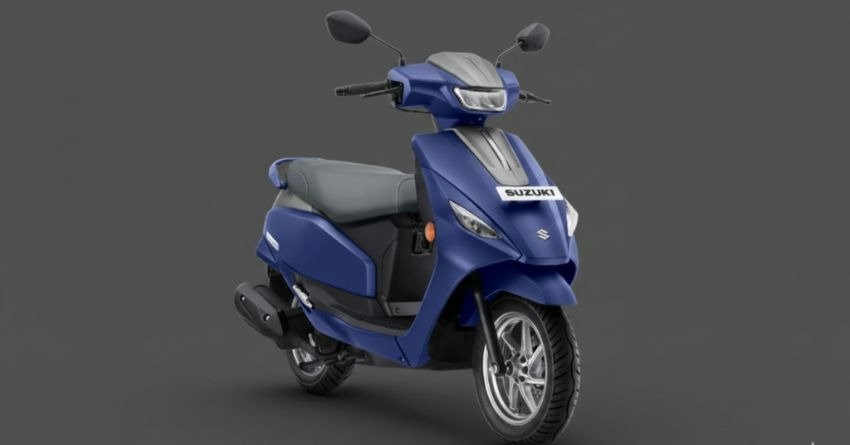
As more electric scooters arrive in the mass market, customers are paying less attention to styling or features and looking more closely at the numbers that affect everyday use. Suzuki’s entry into the segment with the e-Access puts it up against established names like Ather, TVS, and Bajaj. A direct comparison of range, top speed, and pricing shows where each scooter stands and who it is really meant for.
Range comparison
On range, the Suzuki e-Access trails the rest. With a claimed range of around 95 km on a single charge, it is better suited to short, city-focused commuting rather than longer daily travel. The Ather Rizta sits at the other end of the spectrum. Depending on the variant, its claimed range goes up to 159 km, while even the lower versions stay above 120 km. This gives Rizta a clear advantage for riders with longer daily usage.
The TVS iQube falls in between. Its claimed range varies by variant, typically ranging from 94 km to about 123 km. It doesn’t lead the segment on range, but it isn’t at the bottom either, placing it squarely in the middle of the pack. The Bajaj Chetak offers a claimed range of around 127 km on most variants, placing it ahead of Suzuki and competitive with mid-spec iQube models.
Top speed figures
The top speed figures show a similar trend. The Suzuki e-Access, with a top speed of about 71 km/h, is adequate for city driving but still behind most other competitors. Among them, Ather Rizta is at the top, with a maximum speed of approximately 80 km/h, which provides added assurance when riding on highways.
The TVS iQube stands very close behind at nearly 78 km/h, thus it is still in the fight under all riding conditions, while the Bajaj Chetak rates the lowest with about 63 km/h as a top speed; this shows that the manufacturer is stressing the gears for leisurely and smooth urban riding, as opposed to speed.
Price positioning
The Suzuki e-Access is expected to launch at a price of around ₹1.88 lakh (ex-showroom), and although it claims a lower mileage range, it will still be on the more expensive side of the segment. Ather Rizta, on the other hand, has a wide price range, beginning at ₹ 1.04 lakh and stretching to INR 1.6 lakh, based on the battery pack and variant selected.
The TVS iQube also has a similar scheme, with the prices starting at approximately INR 1.08 lakh and increasing with the availability of bigger batteries. On the one hand, the Bajaj Chetak’s pricing varies between ₹ 1.02 lakh and ₹ 1.34 lakh, making it an economical option. Thus, the pricing would further strengthen the value proposition of the Chetak.
What the comparison suggests
Taken together, the numbers point to clear roles for each scooter. Ather Rizta presents the best overall EV offering by uniting the best-in-class range with the top speed of its variants. The TVS iQube remains a well-rounded and reliable choice for the urban daily routine, offering steady performance for this purpose. Bajaj Chetak zeroes in on being economical and easy-to-use, matching a useful range with prices that are even lower than those of the competitors, although it does not go as fast as others. Suzuki e-Access, despite the strength of the brand, appears less compelling when assessed purely on core EV metrics such as range and value.