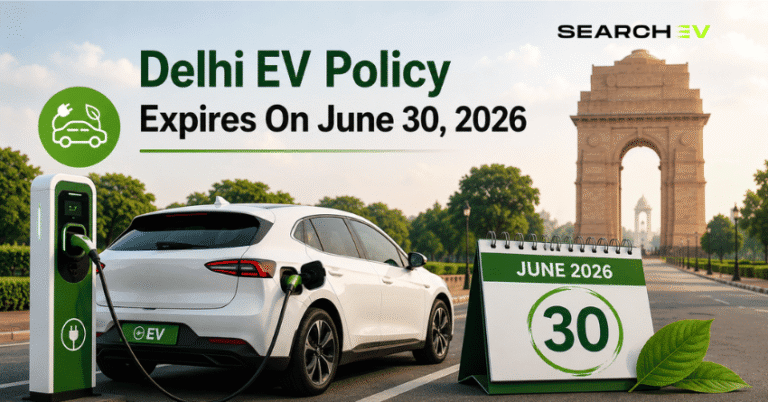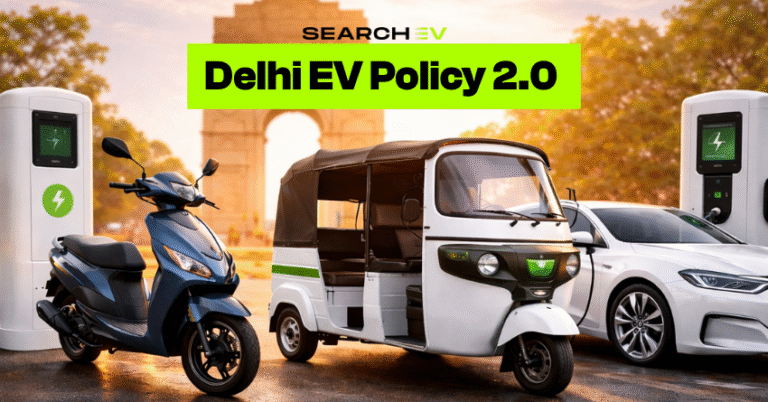
Delhi’s Transport Department has put out a draft of EV Policy 2.0, laying out a fresh push to speed up the shift to electric vehicles across the city. Expected to roll out in 2026, the policy brings together buyer incentives, easier financing, support for local manufacturing, and upgrades to power infrastructure.
Officials say the new policy builds on the first EV policy and focuses on mass adoption, affordability, and long-term energy planning, rather than limited pilot schemes.
Two-Wheeler Push
Electric two-wheelers remain at the centre of EV Policy 2.0. The draft proposes a subsidy of ₹21,000 per e-two-wheeler, while women customers could receive a higher incentive of ₹30,000 per vehicle. Officials say this move is meant to encourage wider participation and support women commuters.
The government also plans to sharply raise its adoption target. The number of electric two-wheelers on Delhi roads is proposed to increase from 5 lakh to 12 lakh vehicles over the next three years, underlining the city’s plan to make e-scooters a primary mode of urban transport.
EV Cars Incentive
For electric cars, the policy proposes bringing back consumer incentives that had ended after the first 1,000 registrations under the previous framework. Under EV Policy 2.0, private electric cars priced below ₹25 lakh would qualify for subsidies.
The first 27,000 eligible electric car customers could receive an incentive of ₹10,000 per kWh, capped at ₹1 lakh per vehicle. Officials have stated that this structure is aimed at supporting mass-market EVs rather than high-end luxury cars.
Retrofit Incentives
For the first time, the draft policy introduces incentives for converting existing petrol and diesel cars to electric. The proposal offers ₹50,000 per vehicle for the first 1,000 retrofit conversions. Officials believe this could reduce emissions faster by allowing vehicle owners to switch to electric vehicles without waiting to buy new cars.
Scrapping Support
EV Policy 2.0 also links EV adoption with the phase-out of older vehicles. The draft includes plans for scrapping incentives for old two-wheelers, three-wheelers, and light commercial vehicles. The goal is to encourage residents to replace ageing, high-emission vehicles with electric alternatives.
Loan Interest Aid
To address affordability, the policy proposes an Interest Subvention Scheme. Under the proposal, the government would cover 5 per cent of the loan interest for eligible EV customers. Officials say the move is meant to make financing easier for middle-income families and small fleet operators.
Manufacturing Support
The draft also places emphasis on local manufacturing, with incentives planned for companies making EV parts such as batteries, chargers, and battery management systems in India. According to officials, this aligns with national manufacturing goals and could support job creation in and around Delhi’s industrial ecosystem.
R&D Funding Plan
EV Policy 2.0 proposes a major jump in research funding. The R&D fund may increase from ₹5 crore to ₹100 crore, aimed at supporting work on battery technology, charging systems, and next-generation EV components.
Power And Storage
To handle rising power demand, the policy plans to add 2.5 GWh of battery energy storage capacity by 2030. Officials say this will help handle peak demand and keep the power supply stable as more electric vehicles are added to the roads.
Adoption Targets
With bigger subsidies, easier loan support, retrofit incentives, and power upgrades, the government expects EV adoption to pick up quickly. The electric two-wheeler target alone is proposed to rise to 12 lakh vehicles, underlining how large the EV push under Policy 2.0 is expected to be.