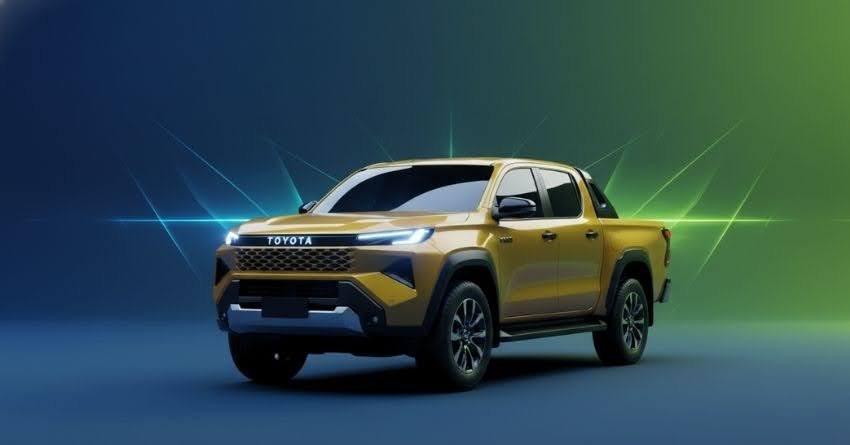
Toyota has launched the ninth generation of its much-loved pickup truck, the Hilux, which, for the first time in its long legacy, comes with a fully electric (EV) powertrain option. With this launch, the car manufacturer steps deep into the electric body-on-frame segment.
The all-new electric Hilux is about to begin delivery in globally selected markets by December 2025. Making its worldwide public appearance as an IMV-underpinning body-on-frame vehicle that has traditionally defined the tough pickup. With the unveiling of an EV model, the demand for electric utility vehicles will be met while continuing to carry the legendary Hilux off-road and durability credentials.
Rugged EV Platform
The new Hilux EV is the first-ever fully electric vehicle made by Toyota on a body-on-frame platform architecture (IMV). Contrary to what is termed a free-standing skateboard chassis, the electric Hilux uses the traditional, rugged construction that its relatives have known for durability and off-road capability, but has a heavy battery pack placed right under the rear seats, protecting it within the robust frame design of the vehicle and causing the least compromise in the interior space.
Dual-Motor All-Wheel Drive
The vehicle features a dual-motor setup, with one electric motor powering the front axle and another driving the rear axle, providing full-time all-wheel drive. The configuration delivers torque of 205 Nm on the front axle and 268.6 Nm on the rear.
Battery and Range Figures
The new electric powertrain includes specifications that define its utility parameters. The truck is fitted with a 59.2 kWh battery pack capable of a claimed WLTP range of just over 240 km with a full charge. While Toyota touts “best-in-class charging capabilities,” more detailed information on actual charging speeds and times has yet to be elaborated upon.
Utility and Capability Metrics
Despite the addition of an electric component, the Hilux EV still has good utility figures that must be addressed in a proper pickup. For this variant, the payload is at 715 kg, while towing weighs 1,600 kg. More importantly, the Hilux EV shares the same 700mm wading depth as its current ICE (Internal Combustion Engine) counterpart, proving its off-roading strength.
Future Hydrogen Option
Beyond the battery-electric model, Toyota has confirmed plans for the zero-emission Hilux family to grow further in the years to come. A hydrogen fuel cell (FCEV) powertrain version of the Hilux is officially slated to arrive in the market in 2028, thus widening the low-emission utilisation options for the vehicle.
Key Details
| Feature | Detail |
| Platform | IMV Body-on-Frame |
| Powertrain | Dual-Motor (Full-Time AWD) |
| Battery Size | 59.2 kWh |
| Range (WLTP) | Over 240 km |
| Payload Capacity | 715 kg |
| Towing Capacity | 1,600 kg |