Ola Electric has officially filed a design patent for a compact four-wheel EV in India, trademarking or boldly opening slightly larger and more profitable horizons for its expansion beyond electric scooters. The design reveals a tiny, practical, affordable electric car meant mainly for the mass-market EV segment. By this very step, Ola aims to outperform established competition in the likes of Tata Tiago EV and MG Comet EV, presumably to come up with a high-value, low-cost product to service the needs of daily urban commuters based on its modular EV platform and in-house battery technology.
Tallboy, Five-Door Practicality
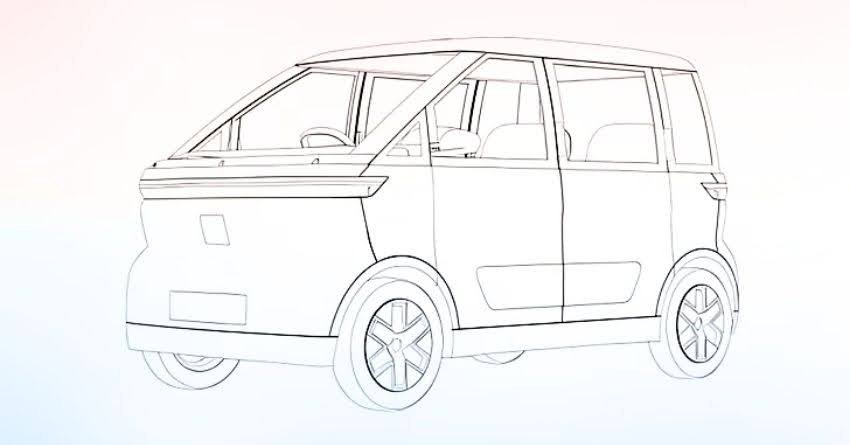
The patented design images reveal that it gets a tall, boxy profile, often referred to as a tallboy design. This method is great for minimising both the size of the EV and the height of its interior, which is comfortable and suitable for urban commuting.
The most important feature of the design is that it consists of a four-door layout plus the tailgate, which makes it a five-door vehicle. This decision gives it a huge practical benefit over direct competitors like the two-door MG Comet EV by making access for rear passengers much more convenient.
Design Language Simplified
The EV has a chic and basic design that is in line with the futuristic appearance of the whole lineup of Ola’s electric scooters. The front is somewhat flat and neat with a large windshield and what looks like a horizontal full-width LED light bar taking over the area. To be more specific, the latter is sleek. The wheels have been moved nearer to the vehicle’s corners to achieve the maximum wheelbase and interior space. The complete design is one of uncluttered contours and basic, geometrical shapes.
Modular Platform Foundation
The compact electric vehicle is to be made on Ola’s new-generation modular platform, named the Gen 4 base. This structure is planned for huge flexibility, which not only allows production of cars but also bikes, trikes, and perhaps even other transportation tools. Using this to its full potential will be crucial for Ola to get large-scale production costs and a lower price for the end consumer. The platform is made for vehicles that are lighter and more energy-efficient than usual.
In-House Battery Power
The electric powertrain is to be the one that uses technology created by Ola. The EV will utilise the company’s home-grown and made 4680 battery cells, which have been approved by the Automotive Research Association of India ARAI. The battery manufacturing vertical integration is a considerable strategic benefit because it greatly reduces the dependency on external suppliers and gives more control over the two dominating factors in the mass-market entry-level EV sector performance and cost, which are also the two most critical factors in the mass-market EV sector.
Market Strategy Shift
The filing of the patent application for small cars indicates a strategic shift that is concentrating on volume and lower prices, probably discarding the earlier, more classy electric sedan concept. This compact electric vehicle has already been positioned to challenge the current electric hatchbacks in a rapidly expanding segment. Such a vehicle launch would result in substantial expansion in Ola’s product range and put Coco, the monopolist in the low-cost EV segment, under more competition.