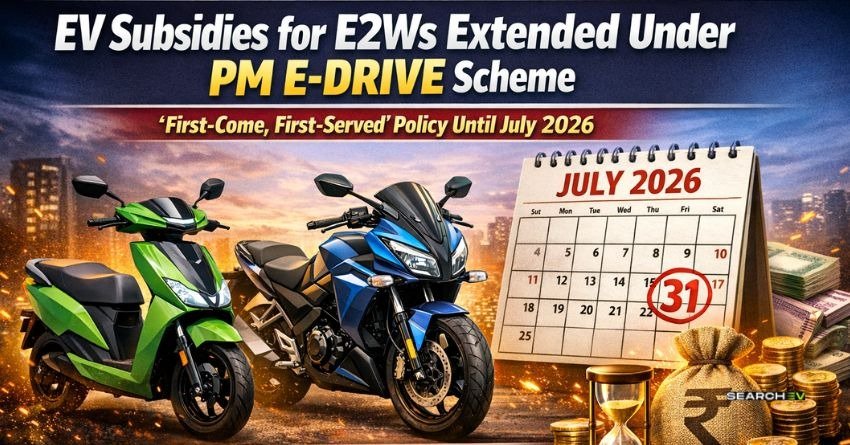
In a much-needed relief for EV buyers, the Ministry of Heavy Industries has extended the subsidy deadlines under the PM E-DRIVE scheme. The earlier March 31 deadline for the PM E-DRIVE incentive scheme applicable to electric two-wheelers has now been extended to July 2026. Meanwhile, other segments, such as electric three-wheelers, buses, trucks, ambulances, and charging infrastructure, will continue to receive support until March 2028, in line with the scheme’s overall extension announced last year.
This move gives more time to people planning to buy electric scooters, especially those who were rushing to purchase before the earlier March 31 deadline. This benefit does not, however, allow you to delay making the purchase decision. The government has made it quite clear that reimbursements will cease as soon as the allotted funds are depleted, even if that occurs before the revised deadline.
Understanding the PM E-DRIVE Scheme Extension
The PM E-DRIVE Scheme, which was introduced in October 2024, offers incentives for the purchase of electric vehicles. It was initially slated to expire on March 31, 2026, but the government extended the scheme’s overall tenure to March 31, 2028, last year. However, while it had also indicated that demand incentives specifically for electric two-wheelers would end by March 31, 2026, the latest amendment extends the subsidy window for e-2Ws until July 31, 2026.
Under the ₹10,900-crore PM E-DRIVE scheme, the allocated budget for two-wheelers, three-wheelers, trucks, and ambulances accounted for ₹3,679 crore, while the remaining ₹7,171 crore is reserved for electric buses, charging infrastructure, and testing facility upgrades.
The extension came about partly because funds allocated for the e-2W and e-3W segments haven’t been completely utilised. As of January 27, 2026, around ₹1,703 crore has been reimbursed to two- and three-wheeler OEMs. A total of 19.19 lakh e-2Ws and 2.93 lakh e-3Ws have been sold under the scheme so far, against a target of supporting 24.79 lakh electric two-wheelers and 3.16 lakh three-wheelers.
Application of the PM E-Drive Incentive
While the deadline extension is a win for widespread adoption, the application of the financial parameters needs to be understood well:
- The Ministry has made it explicitly clear in its notification that the PM E-DRIVE is a strict “fund-limited” initiative. This means if the allocated ₹10,900 crore budget dries up before the terminal date, the scheme shuts down immediately, and no further claims will be entertained.
- To qualify for the subsidy, electric two-wheelers must cost under ₹1.5 lakh, while e-rickshaws and e-carts are capped at ₹2.5 lakh.
- Subsidies for heavier L5 electric three-wheelers (cargo and large passenger autos) officially ended in December 2025 after rapidly hitting deployment targets.
- As a reminder, effective April 1, 2025, the e-2W subsidy was trimmed to ₹2,500 per kWh of battery capacity, with a hard maximum cap of just ₹5,000 per vehicle (down from the previous ₹5,000 per kWh and ₹10,000 per vehicle cap).
What This Means for OEMs
The government’s move prevents a sudden drop in EV sales that automakers feared after the March deadline, while also giving them a short but meaningful boost in demand by extending the policy till July. Additionally, it allows OEMs to experiment a little more with their localisation and pricing strategies while maintaining customer enthusiasm prior to the full phase-out of the subsidies.